- Your cart is empty
- Continue Shopping


2-MAP Guide: Chemistry, Pharmacology, Effects, Risks, and Research
- Guides
- Posted on
-
by admin
- 0 comments
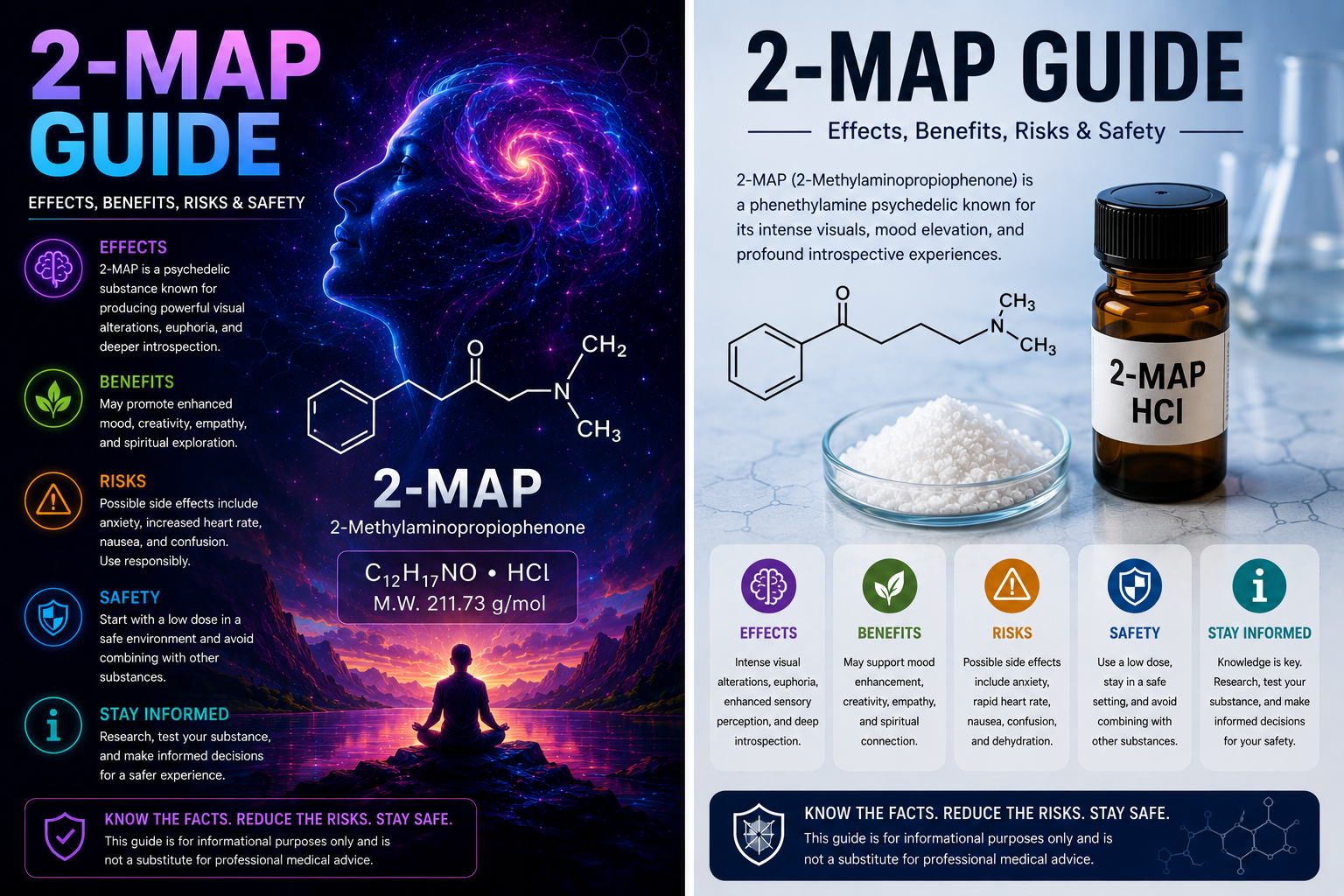
2-MAP Guide:
2-MAP, commonly referring to 2-methyl-AP-237, is a synthetic opioid belonging to the acyl piperazine class of novel psychoactive substances. It is also encountered under names such as 2-Methyl-AP-237, 2MAP, 2MAP237, 2-M-AP-237, and methyl-AP-237. The hydrochloride form is commonly referred to as 2-methyl-AP-237 HCl.
2-MAP emerged on illicit drug markets in the late 2010s and subsequently attracted attention from forensic laboratories, public-health agencies, and international drug-control organizations. Unlike approved opioid medicines, 2-MAP has not undergone the clinical development necessary to establish a recognized therapeutic use or a comprehensive human safety profile.
The compound is particularly important from a public-health perspective because it belongs to a class of synthetic opioids capable of producing µ-opioid receptor activity. As with other potent opioids, excessive exposure can result in profound central nervous system depression, respiratory depression, loss of consciousness, and death. UK government advisers have described serious acute risks associated with 2-methyl-AP-237 and related acyl piperazine opioids.
This 2-MAP guide examines the compound’s chemistry, relationship to AP-237, pharmacology, reported effects, risks, analytical identification, legal status, and current scientific understanding.
Important: This article is intended for educational and informational purposes only. It does not provide instructions for obtaining, synthesizing, preparing, dosing, or using 2-MAP. Because this is a potent synthetic opioid with limited human research and potentially life-threatening effects, it should not be treated as a safe alternative to prescription opioid medicines.
What Is 2-MAP?
2-MAP is a shortened name for 2-methyl-AP-237, a synthetic opioid in the acyl piperazine family.
The compound is structurally related to AP-237, also known as bucinnazine or buccinnazine. AP-237 is an opioid compound with a history of medicinal use in China, whereas 2-methyl-AP-237 is a distinct analogue that has not been authorized as a medicine. The UK’s Advisory Council on the Misuse of Drugs notes that AP-237 was initially synthesized in Japan and has been licensed in China for cancer pain, while 2-methyl-AP-237 itself is not licensed as a medicine.
2-MAP belongs to the broader category of new synthetic opioids (NSOs). These substances can be chemically modified to produce compounds with opioid receptor activity while avoiding the structures of more traditional pharmaceutical opioids.
The emergence of compounds such as 2-MAP has created significant challenges for toxicologists and regulators because new analogues can appear before sufficient pharmacological and toxicological information becomes available.
What Does the Name 2-Methyl-AP-237 Mean?
The name provides information about the compound’s chemical relationship to AP-237.
AP-237 is the parent compound, while 2-methyl-AP-237 contains an additional methyl substitution on the piperazine ring.
The compound’s systematic chemical name is:
1-{2-Methyl-4-[(2E)-3-phenylprop-2-en-1-yl]piperazin-1-yl}butan-1-one
Other names documented by international and government sources include:
- 2-Methyl-BCP
- 2-Methyl bucinnazine
- Methyl-AP-237
- N-Butyryl-N′-cinnamyl-2-methyl-piperazine
- 1-(4-Cinnamyl-2-methylpiperazin-1-yl)butan-1-one
The World Health Organization’s critical review lists 98608-61-8 for the base and 98608-59-4 for the hydrochloride form.
These identifiers are useful in scientific literature and analytical chemistry because street names can vary considerably.
Chemical Structure of 2-MAP
2-MAP is an acyl piperazine opioid.
The molecule contains a piperazine ring, a six-membered heterocyclic structure containing two nitrogen atoms. It also contains an acyl group and a cinnamyl-related aromatic structure.
According to the WHO critical review, the free-base molecular formula is C18H26N2O, with a molecular weight of approximately 286.41 g/mol.
The structure is important because the piperazine framework is shared by several compounds in the acyl piperazine opioid family.
However, closely related structures should not be assumed to have identical pharmacological effects. Small substitutions can influence:
- Receptor affinity
- Receptor efficacy
- Metabolism
- Lipophilicity
- Pharmacokinetics
- Toxicity
- Analytical behavior
This is why laboratory identification must distinguish 2-MAP from AP-237, AP-238, para-methyl-AP-237, and other related compounds.
2-MAP HCl: Understanding the Hydrochloride Form
2-MAP HCl refers to the hydrochloride salt of 2-methyl-AP-237.
Many amine-containing compounds can be converted into hydrochloride salts. The salt form has a different chemical composition from the free base because the protonated molecule is associated with chloride.
The hydrochloride form can have different physical characteristics, including changes in:
- Molecular weight
- Solubility
- Crystalline properties
- Stability
- Handling characteristics
The existence of a hydrochloride form does not mean that 2-MAP HCl is a pharmaceutical product.
The WHO review specifically identifies a separate CAS number for the hydrochloride form, illustrating why analytical records should distinguish between the parent compound and its salt.
History of 2-MAP
The chemistry behind 2-MAP predates its appearance as a novel psychoactive substance.
Government and scientific reviews indicate that acyl piperazine compounds have been known for decades. 2-methyl-AP-237 was described in Italian drug patents filed in 1984 and 1985, while related acyl piperazines date back even further.
Its emergence on illicit drug markets occurred much later.
The U.S. Drug Enforcement Administration describes 2-methyl-AP-237 as a novel synthetic drug that emerged on the illicit market in 2019. The agency also identifies opioid-like activity and potentially severe adverse health effects associated with synthetic opioids in this class.
This history illustrates an important distinction between a compound’s chemical discovery and its modern recreational or illicit appearance.
A substance may have existed in patent or research literature for decades without undergoing the clinical testing required for medical approval.
2-MAP and AP-237
The relationship between 2-MAP and AP-237 is central to understanding the compound.
AP-237 is an acyl piperazine opioid also known as bucinnazine. According to the UK ACMD, AP-237 was initially synthesized in Japan and has been licensed in China for the treatment of cancer pain since 1986.
2-MAP is a methyl-substituted analogue of AP-237.
Despite this relationship, the two compounds have different regulatory and medical histories.
AP-237: has a documented medicinal history in China.
2-MAP: has no recognized therapeutic use and has emerged primarily as a novel synthetic opioid.
The distinction is critical because it would be misleading to use AP-237’s medical history as evidence that 2-MAP is an approved or clinically established medicine.
Pharmacology of 2-MAP
2-MAP is classified as an opioid because it can activate µ-opioid receptors (MORs).
The µ-opioid receptor is one of the principal biological targets responsible for the effects of opioid drugs.
Activation of these receptors can influence:
- Pain perception
- Reward pathways
- Breathing
- Gastrointestinal activity
- Consciousness
- Muscle tone
- Stress responses
The same receptor activity that can produce analgesic effects can also produce serious adverse effects.
In particular, strong opioid receptor activation can suppress the brain’s respiratory drive.
This means that opioid toxicity is fundamentally different from many other categories of psychoactive substances. A person can become dangerously unconscious while breathing progressively more slowly or irregularly.
The UK ACMD specifically identifies respiratory depression as a serious acute risk of 2-methyl-AP-237 and related synthetic opioids.
Why Respiratory Depression Is the Major Concern
Respiratory depression is one of the most dangerous consequences of opioid exposure.
Normally, the brain continuously regulates breathing in response to carbon dioxide and oxygen levels. Strong µ-opioid receptor activation can interfere with this process.
As respiratory depression worsens:
- Breathing may become unusually slow or shallow.
- Oxygen levels can fall.
- The person may become increasingly difficult to wake.
- Loss of consciousness can occur.
- Severe oxygen deprivation can damage the brain and other organs.
- Breathing can stop completely.
This is why synthetic opioids are associated with potentially fatal overdoses.
The risk is especially concerning with novel compounds because their potency, pharmacokinetics, and dose-response relationships may not be well established in humans.
Reported Effects of 2-MAP
Information about 2-MAP’s subjective effects comes from a mixture of scientific, toxicological, and observational sources.
Because controlled human studies are limited, subjective reports should not be treated as standardized clinical data.
Opioid-type effects associated with this class can include:
- Analgesia
- Sedation
- Relaxation
- Euphoria
- Reduced alertness
- Altered perception of discomfort
- Respiratory depression
- Nausea
- Vomiting
- Constipation
- Itching
The presence of desirable opioid effects does not imply that a substance is safe.
In fact, some of the same pharmacological properties that produce analgesia or euphoria can also contribute to dependence, respiratory depression, and fatal poisoning.
Physical Risks of 2-MAP
2-MAP presents several serious health concerns.
Respiratory depression
This is the most important acute toxicity concern.
Excessive opioid receptor activation can suppress breathing, potentially resulting in fatal respiratory failure.
Loss of consciousness
Severe intoxication can progress from drowsiness to profound unconsciousness.
An unconscious person may also be unable to protect their airway if vomiting occurs.
Nausea and vomiting
Opioid receptor activation can affect gastrointestinal function and may cause nausea or vomiting.
Constipation
Opioids commonly reduce gastrointestinal motility, which can result in constipation and other gastrointestinal complications.
Dizziness and impaired coordination
Sedation and altered consciousness can increase the risk of falls, accidents, and injuries.
Cardiovascular effects
Severe opioid poisoning can produce secondary cardiovascular instability, particularly when breathing is significantly impaired.
Psychological and Behavioral Risks
Although opioid toxicity is primarily associated with physiological effects, psychological and behavioral risks are also important.
Repeated exposure can produce:
- Tolerance
- Craving
- Compulsive use
- Physical dependence
- Withdrawal symptoms
- Increasing preoccupation with obtaining the substance
The risk of dependence is an important reason why synthetic opioids are treated as a major public-health concern.
Novel compounds can be particularly problematic because people may underestimate their risks based on unfamiliarity or descriptions such as “research chemical.”
The absence of extensive clinical data does not mean that a new opioid is mild.
Dependence and Withdrawal
µ-opioid receptor activation can lead to physiological adaptation.
With repeated opioid exposure, the nervous system can become accustomed to the presence of the drug. When exposure stops, withdrawal symptoms can occur.
Opioid withdrawal may involve:
- Anxiety
- Restlessness
- Muscle aches
- Sweating
- Gastrointestinal symptoms
- Insomnia
- Runny nose
- Irritability
- Strong cravings
The precise withdrawal profile of 2-MAP has not been characterized as extensively as that of established opioids.
Nevertheless, its opioid receptor activity provides a strong pharmacological reason to take dependence potential seriously.
2-MAP and Overdose Risk
Overdose is the most serious acute concern associated with 2-MAP.
The danger arises primarily from excessive opioid-mediated depression of the central nervous system and respiratory system.
Warning signs of a potentially life-threatening opioid overdose can include:
- Extremely slow or absent breathing
- Unresponsiveness
- Inability to wake the person
- Blue, gray, or pale lips or skin
- Gurgling or abnormal breathing sounds
- Severe limpness
- Pinpoint pupils
If opioid overdose is suspected, emergency medical services should be contacted immediately. Where legally available, naloxone is an opioid antagonist used in emergency overdose response and can temporarily reverse opioid effects while emergency care is obtained.
Because the exact pharmacology and potency of novel synthetic opioids may vary, emergency medical evaluation remains essential even if a person appears to improve after an initial response.
Risks of Combining 2-MAP With Other Substances
Combining opioids with other central nervous system depressants can greatly increase the danger of respiratory depression.
Particular concern exists with combinations involving:
- Benzodiazepines
- Alcohol
- Other opioids
- Sedative-hypnotics
- Certain anesthetic or sedating drugs
- Other substances capable of suppressing consciousness or breathing
The combination of multiple depressants can produce effects that are stronger and less predictable than either substance alone.
This is especially dangerous with novel synthetic opioids because reliable human interaction studies may not exist.
The UK ACMD’s assessment emphasizes respiratory depression as a major acute harm associated with 2-methyl-AP-237 and related acyl piperazine opioids.
2-MAP and Tolerance
Tolerance occurs when repeated exposure reduces the response produced by a particular amount of a drug.
Opioid tolerance can develop through adaptations in receptor signaling and broader neural systems.
Tolerance is clinically important because it can contribute to escalating exposure and can change overdose risk.
For example, a person who has developed opioid tolerance may perceive a particular exposure as less intense, while a period of abstinence can reduce tolerance. Returning to a previously tolerated amount after reduced tolerance can therefore increase overdose risk.
Because 2-MAP lacks a comprehensive clinical safety database, its specific tolerance characteristics remain insufficiently documented.
2-MAP and Metabolism
Metabolism determines how a substance is transformed within the body.
Understanding metabolic pathways is important for:
- Toxicology
- Drug testing
- Pharmacology
- Forensic investigations
- Identifying active metabolites
- Understanding duration of biological activity
The metabolic profile of a novel synthetic opioid may differ significantly from that of a structurally related compound.
This is another reason why assumptions based solely on AP-237 or other opioids are unreliable.
Analytical laboratories may need authenticated reference materials and validated methods to identify the parent compound and its metabolites.
Analytical Identification of 2-MAP
Forensic laboratories play an important role in identifying 2-MAP.
Because novel psychoactive substances may be structurally similar, advanced analytical techniques are often necessary.
Methods can include:
- Gas chromatography-mass spectrometry (GC-MS)
- Liquid chromatography-mass spectrometry (LC-MS)
- High-resolution mass spectrometry (HRMS)
- Nuclear magnetic resonance (NMR)
- Chromatographic reference comparisons
The UK ACMD notes that 2-methyl-AP-237 and certain related compounds can be differentiated analytically despite structural similarities.
This is important because AP-237, AP-238, para-methyl-AP-237, and other related compounds can have similar chemical frameworks while remaining distinct substances.
Why Appearance Cannot Confirm 2-MAP
The WHO review notes that 2-methyl-AP-237 hydrochloride has been described as a white crystalline material or crystalline solid.
However, appearance is not a reliable identification method.
Many chemicals can appear as white powders or crystals.
An unknown material labeled “2-MAP” could potentially contain:
- Another synthetic opioid
- A related analogue
- An adulterant
- A mixture
- Manufacturing impurities
- Incorrectly labeled material
Only appropriate analytical testing can provide meaningful evidence about chemical identity.
2-MAP and Drug Testing
Whether a particular drug test detects 2-MAP depends on the test design.
Routine opioid immunoassays are generally developed around specific target structures and may not detect every novel synthetic opioid reliably.
Specialized toxicology laboratories can use mass spectrometry and other analytical methods to identify emerging substances.
This distinction is important because a negative result on a routine screening test does not necessarily prove that a person has not been exposed to a novel opioid.
Detection windows can also vary depending on:
- The substance
- Metabolism
- Frequency of exposure
- Biological sample
- Laboratory method
- Detection threshold
Is 2-MAP HCl a Prescription Medicine?
No.
2-methyl-AP-237 has no recognized therapeutic use and is not an approved prescription medicine.
The UK ACMD reported that none of the reviewed acyl piperazine compounds, including 2-methyl-AP-237, were authorized medicinal products in the UK.
This is an important distinction from AP-237 itself, which has had a medicinal history in China.
The fact that 2-MAP is chemically related to a compound with medical use does not make 2-MAP a medicine.
Is 2-MAP FDA Approved?
No established FDA-approved medical indication exists for 2-methyl-AP-237.
The U.S. regulatory information summarized by the UK ACMD states that 2-methyl-AP-237 and related acyl piperazine opioids were not approved for medical use in the United States.
A substance can be described in scientific databases or appear in forensic literature without having undergone pharmaceutical approval.
Therefore, 2-MAP should not be promoted as an approved treatment for pain or any other medical condition.
International Legal Status
The legal status of 2-MAP has changed as governments have responded to its appearance as a synthetic opioid.
The World Health Organization’s Expert Committee on Drug Dependence reviewed 2-methyl-AP-237 among several novel synthetic opioids.
In March 2023, the United Nations Commission on Narcotic Drugs added 2-methyl-AP-237 to Schedule I of the 1961 Single Convention on Narcotic Drugs. The UK government records this international control decision.
The precise domestic legal consequences depend on each country’s implementation of international drug-control obligations.
2-MAP Legal Status in the United Kingdom
The UK’s legal position subsequently became more restrictive.
In 2024, the UK government accepted recommendations concerning acyl piperazine opioids, including 2-methyl-AP-237. The government announced plans to control 2-methyl-AP-237 and several related compounds as Class A drugs under the Misuse of Drugs Act framework.
UK government documentation further records that legislation was introduced to control multiple acyl piperazine opioids, including 2-methyl-AP-237.
Because laws can change, anyone researching the current legal position should consult the relevant government legislation rather than relying on older research-chemical websites.
2-MAP in China and Other Jurisdictions
Drug regulation varies considerably between countries.
Chinese authorities have separately addressed 2-methyl-bucinnazine, describing it as a derivative of bucinnazine with opioid-like activity and noting its appearance on illicit drug markets from around 2019.
This illustrates why international legal research must be jurisdiction-specific.
A compound’s legal status in one country does not establish its status elsewhere.
Current Scientific Research
The scientific literature surrounding 2-MAP remains much smaller than that surrounding established opioids such as morphine, oxycodone, or methadone.
Nevertheless, its emergence has prompted research and regulatory review focused on:
- Chemical structure
- Opioid receptor activity
- Toxicology
- Forensic detection
- Public-health risks
- Legal control
- Abuse potential
The WHO’s Expert Committee reviewed 2-methyl-AP-237 alongside several other novel synthetic opioids as part of its assessment of emerging psychoactive substances.
Government reviews have subsequently emphasized the potential for severe health consequences, particularly respiratory depression and overdose.
Research Limitations
Several important questions remain incompletely answered.
Researchers need more information about:
Human pharmacokinetics
How quickly is 2-MAP absorbed, distributed, metabolized, and eliminated?
Metabolic pathways
Which metabolites are produced, and do any remain biologically active?
Receptor pharmacology
How does 2-MAP compare quantitatively with other opioids at the µ-opioid receptor?
Toxicity
What are the acute and chronic toxicological effects?
Dependence
What are the characteristics of tolerance, dependence, and withdrawal?
Drug interactions
How does 2-MAP interact with alcohol, benzodiazepines, other opioids, and other central nervous system depressants?
Long-term health effects
What consequences might repeated exposure have on neurological, respiratory, cardiovascular, hepatic, renal, or other systems?
The absence of answers to these questions is itself an important scientific finding: 2-MAP is not adequately characterized to support assumptions of safety.
How to Evaluate 2-MAP Information Online
Online information about 2-MAP can come from very different sources.
Readers should distinguish between:
- Government toxicology reports
- WHO reviews
- Peer-reviewed research
- Forensic laboratory publications
- Chemical databases
- Historical patents
- Community reports
- Vendor descriptions
These sources have different evidentiary value.
A government or WHO review can provide a strong foundation for chemical and regulatory information.
An anecdotal report can describe an individual’s experience but cannot establish a safe exposure level or medical effectiveness.
A vendor’s description should not be treated as independent evidence of purity, potency, or safety.
Frequently Asked Questions About 2-MAP
What is 2-MAP?
2-MAP is a common abbreviation for 2-methyl-AP-237, a synthetic opioid in the acyl piperazine family.
What does 2-MAP stand for?
2-MAP generally refers to 2-methyl-AP-237. Other documented names include 2-Methyl-BCP, 2-Methyl bucinnazine, and methyl-AP-237.
What is 2-MAP HCl?
2-MAP HCl is the hydrochloride salt form of 2-methyl-AP-237. The WHO review identifies a separate CAS number for the hydrochloride form.
Is 2-MAP an opioid?
Yes. It is classified as a synthetic opioid and is associated with µ-opioid receptor activity.
Is 2-MAP the same as AP-237?
No. 2-MAP is a methyl-substituted analogue of AP-237 and is a distinct chemical compound.
Is 2-MAP a prescription medication?
No. 2-methyl-AP-237 has no recognized therapeutic use and is not an authorized medicine.
Can 2-MAP cause respiratory depression?
Yes. Respiratory depression is one of the principal serious risks identified for 2-methyl-AP-237 and related synthetic opioids.
Can 2-MAP cause dependence?
Because it is an opioid acting on µ-opioid receptors, dependence and compulsive use are important concerns. However, the precise dependence profile of 2-MAP has not been characterized as extensively as established opioids.
Is 2-MAP legal?
Its legal status varies by jurisdiction, and international controls have changed. It was added to Schedule I of the 1961 Single Convention in 2023.
Can 2-MAP be identified by appearance?
No. A white crystalline appearance is not sufficient to establish chemical identity. Laboratory analysis is required for reliable identification.
Is 2-MAP safe?
Its safety cannot be established from the available evidence. Serious opioid-related risks, particularly respiratory depression and potentially fatal overdose, make 2-MAP a high-risk substance.
Conclusion
2-MAP, or 2-methyl-AP-237, is a synthetic opioid belonging to the acyl piperazine family. It is structurally related to AP-237 and has appeared as a novel psychoactive substance since the late 2010s.
The compound’s chemistry is relatively well documented. The WHO identifies its systematic chemical name, molecular formula C18H26N2O, molecular weight of approximately 286.41 g/mol, and separate identifiers for the free base and hydrochloride forms.
Its pharmacology is considerably more concerning from a public-health perspective. As a synthetic opioid with µ-opioid receptor activity, 2-MAP can produce opioid-type effects while carrying the serious risks associated with opioid toxicity. Government and scientific reviews identify respiratory depression, overdose, dependence, and potentially fatal outcomes as major concerns.
2-MAP should also be clearly distinguished from AP-237. Although AP-237 has a medicinal history in China, 2-methyl-AP-237 has no recognized therapeutic use and has not undergone equivalent clinical development.
Its regulatory status has also evolved rapidly. Following international review, 2-methyl-AP-237 was placed in Schedule I of the 1961 Single Convention in 2023, with individual countries subsequently implementing or considering additional controls.
For researchers, toxicologists, and readers studying novel synthetic opioids, 2-MAP illustrates an important modern drug-policy challenge: a chemically novel substance can reach illicit markets before comprehensive human safety data exist.
The most reliable way to understand 2-MAP is therefore through government toxicology assessments, WHO documentation, peer-reviewed research, forensic analytical evidence, and current legislation, rather than relying on anecdotal reports or marketing claims.
Above all, 2-MAP should not be confused with a conventional prescription opioid or regarded as a benign “research chemical.” Its opioid pharmacology and documented respiratory-depression risk make it a substance with potentially severe and life-threatening consequences.
