- Dein Warenkorb ist leer
- Weiter einkaufen


DMXE-HCl-Leitfaden: Chemie, Pharmakologie, Wirkungen, Risiken und Forschung
- Anleitungen
- Veröffentlicht am
-
by Admin
- 0 Bemerkungen
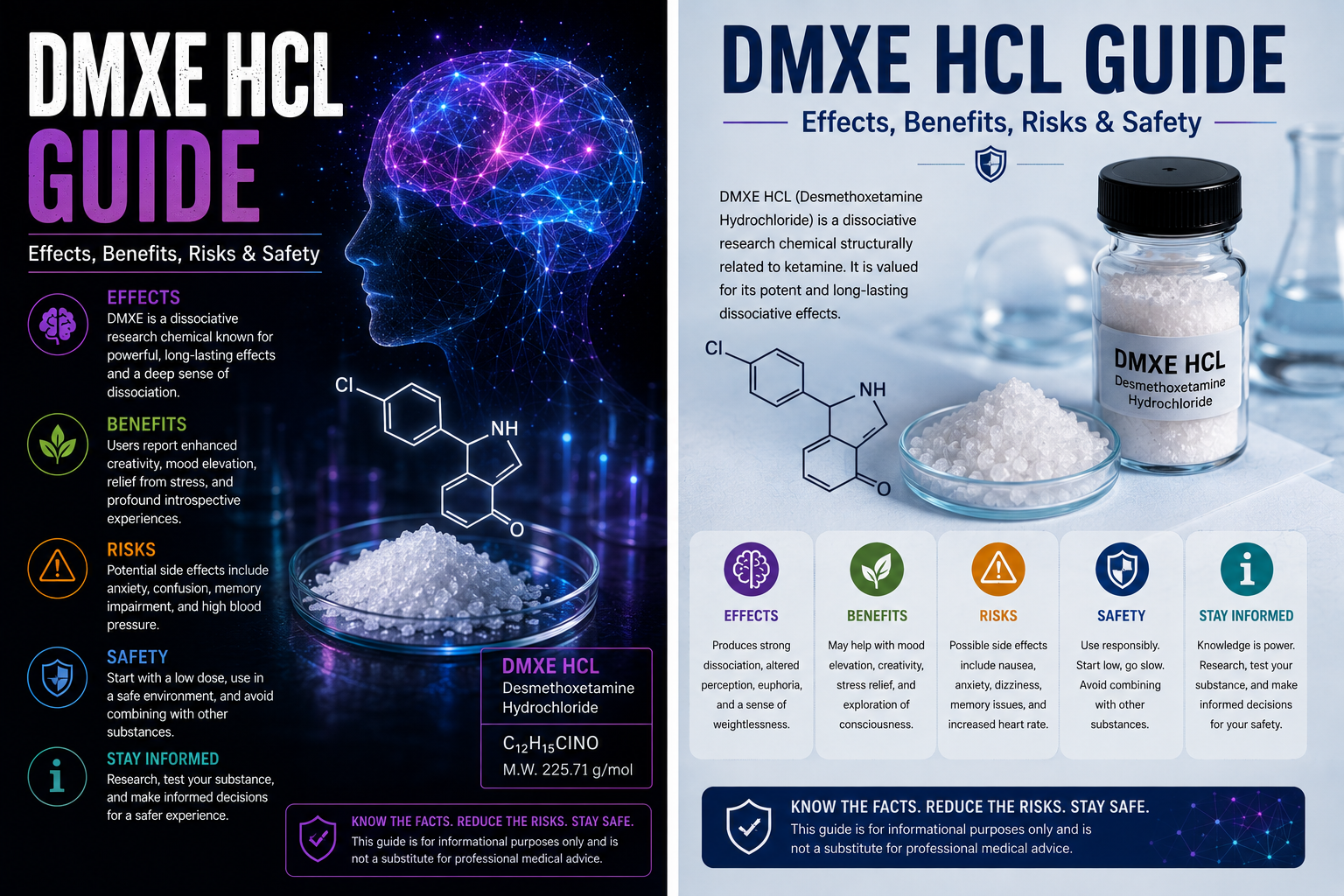
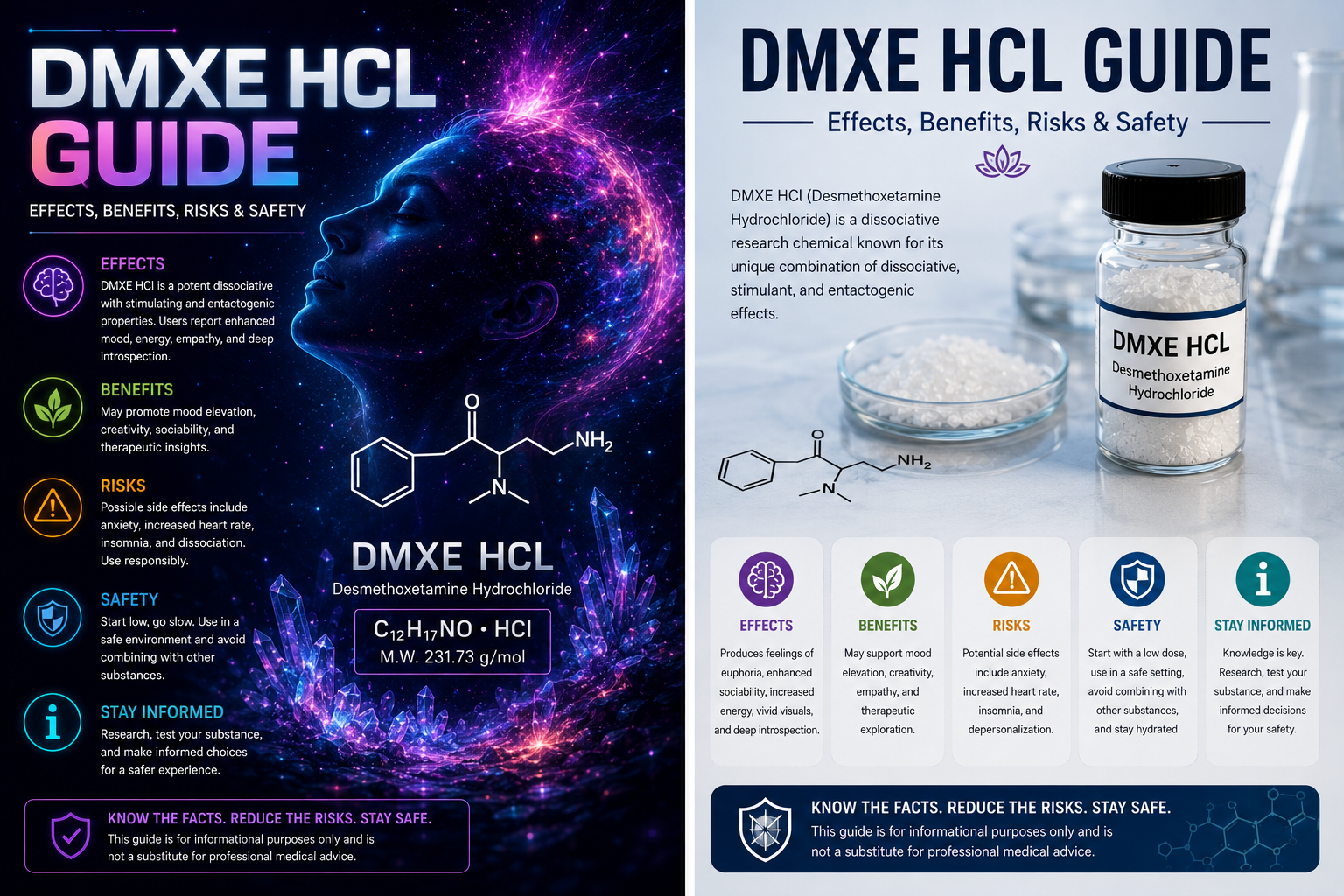
DMXE HCl Guide:
DMXE HCl ist die Hydrochloridsalzform von DMXE, a synthetic arylcyclohexylamine and dissociative compound related to ketamine and other NMDA receptor antagonists. DMXE is commonly expanded as desmethoxetamine, although chemical naming can vary across databases and research literature.
The compound belongs to a broader group of novel psychoactive substances developed or encountered as analogues of established dissociatives. Interest in DMXE has largely centered on its chemistry, pharmacology, analytical identification, and relationship to other arylcyclohexylamines.
Despite similarities to ketamine and other dissociatives, DMXE is a besondere chemische Verbindung. It has not undergone the extensive clinical development and safety evaluation associated with approved medicines. Much of the available information comes from chemical databases, laboratory research, forensic toxicology, and observational reports.
This DMXE HCl guide provides an educational overview of the compound, including its chemical identity, molecular structure, pharmacology, reported effects, potential risks, analytical considerations, legal questions, and current research limitations.
Wichtig: This article is intended for educational and scientific purposes. It does not provide instructions for synthesizing, preparing, dosing, obtaining, or using DMXE HCl. Because controlled human safety data are limited, claims about its safety or therapeutic potential should be treated cautiously.
What Is DMXE?
DMXE is a synthetic Arylcyclohexylamin associated with the dissociative class of psychoactive compounds.
The compound is structurally related to other arylcyclohexylamines, including ketamine and methoxetamine. The name desmethoxetamine reflects its relationship to methoxetamine, another ketamine-related compound.
Arylcyclohexylamines are characterized by a molecular framework that combines an aromatic ring with a cyclohexane-derived structure and an amine-containing group. Changes to different portions of this framework can produce compounds with substantially different pharmacological properties.
DMXE has attracted scientific and forensic interest because compounds within this structural family can interact with the N-Methyl-D-Aspartat (NMDA)-Rezeptor, a glutamate receptor involved in excitatory neurotransmission and neural signaling.
However, structural similarity should not be mistaken for identical pharmacology. DMXE, ketamine, methoxetamine, and related compounds each have distinct molecular structures and potentially different pharmacokinetic and toxicological profiles.
What Does DMXE HCl Mean?
Die Abkürzung HCl generally indicates the hydrochloride salt form.
DMXE contains an amine group capable of forming an acid-addition salt. When associated with hydrochloric acid, the resulting material can be described as DMXE hydrochloride or DMXE HCl.
Salt formation is common in pharmaceutical and chemical chemistry. Converting an amine-containing compound into a hydrochloride salt can alter physical properties such as:
- Molekulargewicht
- Kristallinität
- Löslichkeit
- Stabilität
- Handhabungseigenschaften
The underlying psychoactive molecule remains DMXE, but the salt form has a different chemical composition than the corresponding free base.
This distinction becomes important when interpreting laboratory data, chemical databases, or analytical results.
Chemical Classification of DMXE
DMXE belongs to the Arylcyclohexylamin Familie.
This group includes several well-known compounds with dissociative pharmacology. The family is particularly interesting to researchers because modifications to the aromatic ring, cyclohexyl portion, or amine group can influence receptor binding and biological activity.
Examples of related compounds include:
- Ketamin
- Methoxetamin (MXE)
- Deschlorketamin (DCK)
- 2F-DCK
- PCP and related analogues
DMXE should not be assumed to have identical effects or risks to any of these substances simply because they share a chemical family.
One of the central principles of medicinal chemistry is that relatively small structural changes can produce meaningful differences in receptor affinity, selectivity, metabolism, distribution, and toxicity.
DMXE and Methoxetamine
DMXE is often discussed in connection with Methoxtamin (MXE) because of their structural relationship.
Methoxetamine was developed as a ketamine analogue and became associated with the novel psychoactive substance market. DMXE represents another structural variation within the same broad chemical family.
The relationship can be understood conceptually as:
Ketamine → methoxetamine-related chemistry → additional arylcyclohexylamine analogues
However, chemical relationships do not mean that one compound can be used to predict the safety or clinical properties of another.
This distinction is particularly important when information about ketamine is used to describe DMXE.
Ketamine is a pharmaceutical drug with extensive clinical and toxicological literature. DMXE does not have an equivalent body of controlled clinical evidence.
How Does DMXE Work?
Research into DMXE and related arylcyclohexylamines focuses heavily on their interaction with NMDA-Rezeptoren.
NMDA receptors are glutamate-gated ion channels that play major roles in:
- Lernen
- Memory
- Synaptische Plastizität
- Erregende Neurotransmission
- Sensorische Verarbeitung
- Neuronale Entwicklung
Compounds that inhibit NMDA receptor signaling can produce dissociative states. These states may involve changes in sensory integration, body perception, cognition, memory, and awareness of the environment.
This pharmacological mechanism is shared by several important dissociatives, including ketamine and PCP.
However, NMDA receptor activity is only one component of a compound’s complete pharmacological profile. Other factors include receptor subtype selectivity, ion-channel kinetics, metabolism, active metabolites, transporter interactions, and brain distribution.
Consequently, describing DMXE simply as an “NMDA antagonist” does not provide a complete picture of its biological effects.
The NMDA Receptor and Dissociation
Understanding the NMDA receptor helps explain why DMXE is classified as a dissociative.
Glutamate is the brain’s primary excitatory neurotransmitter, and NMDA receptors participate in transmitting excitatory signals between neurons.
When an NMDA antagonist interferes with these signals, the normal integration of sensory and cognitive information can change.
This may produce experiences commonly described as:
- Ablösung
- Altered body awareness
- Verzerrte Wahrnehmung
- Changes in time perception
- Reduced environmental integration
- Kognitive Störung
- Dream-like states
At stronger levels of dissociation, a person’s awareness of their surroundings and physical body can become substantially impaired.
This pharmacology also explains why dissociative compounds can create hazards unrelated to direct toxicity, including impaired coordination, poor judgment, accidents, and inability to respond normally to the environment.
Reported Effects of DMXE
Reliable controlled human research on DMXE remains limited. Much of the information available publicly comes from observational reports and comparisons with other dissociative arylcyclohexylamines.
Reported effects associated with DMXE may include changes in:
- Sensorische Wahrnehmung
- Körperbewusstsein
- Zeit Wahrnehmung
- Stimmung
- Gedankenmuster
- Memory
- Umweltbewusstsein
- Klangwahrnehmung
- Visuelle Wahrnehmung
- Emotionale Reaktionsfähigkeit
Some descriptions characterize the experience as dissociative, immersive, dream-like, or cognitively unusual.
However, subjective reports should not be treated as standardized pharmacological data.
The experience of a psychoactive substance can vary considerably according to individual physiology, mental state, environment, other substances, medications, and the chemical composition of the material involved.
Furthermore, reports posted online cannot reliably establish potency, purity, toxicity, or long-term safety.
Why Human Research Matters
A major limitation in understanding DMXE is the lack of extensive controlled human research.
Human clinical studies are essential for establishing:
- Pharmacokinetic parameters
- Pharmacodynamic effects
- Dosis-Wirkungs-Beziehungen
- Adverse-event frequencies
- Wechselwirkungen mit anderen Medikamenten
- Stoffwechselwege
- Langfristige Ergebnisse
- Therapeutische Wirksamkeit
Without these studies, researchers cannot confidently determine how findings from related compounds translate to DMXE.
For example, evidence that ketamine has medical applications does not demonstrate that DMXE has the same therapeutic properties.
Likewise, an animal study showing NMDA receptor activity does not establish that DMXE is safe or effective in humans.
Mögliche physische Risiken
The safety profile of DMXE remains incompletely characterized.
Potential concerns associated with dissociative arylcyclohexylamines include physiological, neurological, and behavioral effects.
Herz-Kreislauf-Effekte
Dissociative compounds can influence cardiovascular variables such as heart rate and blood pressure.
The specific magnitude and frequency of these effects with DMXE have not been adequately established through large controlled human studies.
Impaired Koordination
Altered motor control can increase the risk of falls, accidents, drowning, traffic injuries, and other environmental hazards.
Kognitive Beeinträchtigung
Dissociation can interfere with short-term memory, attention, judgment, and the ability to interpret sensory information normally.
Nausea and physical discomfort
Some dissociative compounds can produce nausea, dizziness, headache, or other physical discomfort. The frequency and severity of such effects with DMXE remain insufficiently documented.
Unknown organ toxicity
One of the major unanswered questions is the long-term effect of repeated DMXE exposure on organs and physiological systems.
A lack of documented toxicity does not establish that a substance is non-toxic.
Psychologische Risiken
Dissociative states can also create significant psychological challenges.
Mögliche Probleme können sein:
- Ängste
- Panik
- Verwechslung
- Desorientierung
- Paranoia
- Emotionale Instabilität
- Gedächtnisstörungen
- Disturbing perceptual changes
A person’s psychological response may be difficult to predict.
An experience that one person describes as manageable may be overwhelming for another.
Repeated exposure may also raise questions about tolerance, psychological reinforcement, compulsive patterns, and other aspects of substance use that have not been sufficiently studied specifically for DMXE.
Langzeiteffekte
There is not enough evidence to confidently establish the long-term consequences of DMXE Exposition.
Important unanswered questions include whether repeated exposure can produce:
- Anhaltende kognitive Veränderungen
- Stimmungsstörungen
- Abhängigkeit
- Toleranz
- Schlafstörung
- Neurologische Wirkungen
- Herz-Kreislauf-Effekte
- Urinary or renal problems
- Andere Organtoxizität
These questions are particularly important because evidence from ketamine cannot automatically be transferred to a chemically distinct analogue.
The absence of long-term studies should therefore be regarded as a research limitation rather than evidence of safety.
DMXE and Drug Interactions
Drug interactions represent another significant area of uncertainty.
DMXE affects the central nervous system, and combining psychoactive substances can make the resulting effects substantially less predictable.
Potentially concerning categories include other:
- Dissoziative
- Beruhigungsmittel
- Depressiva für das zentrale Nervensystem
- Psychoaktive Medikamente
- Substanzen, die das Bewusstsein verändern
Combining substances can amplify impairment, increase the risk of confusion or loss of consciousness, and complicate medical assessment if an adverse event occurs.
Because controlled interaction studies involving DMXE are limited, there is no scientifically established list of combinations that can be considered universally safe.
DMXE vs. Ketamine
DMXE and ketamine belong to the same broad arylcyclohexylamine family, but they are different chemical substances.
Ketamine has been extensively studied in humans and has established medical applications under appropriate clinical supervision.
DMXE does not have an equivalent clinical evidence base.
The comparison can be summarized conceptually:
| Funktion | DMXE | Ketamin |
|---|---|---|
| Chemische Familie | Arylcyclohexylamin | Arylcyclohexylamin |
| Dissociative activity | Reported/researched | Gut etabliert |
| NMDA receptor involvement | Relevant | Gut etabliert |
| Pharmaceutical approval | No established medical approval | Yes, for specific indications |
| Human clinical evidence | Begrenzt | Umfassendem |
| Long-term safety database | Begrenzt | Viel größer |
| Therapeutic status | Experimental/unapproved | Established medical uses |
The key takeaway is that pharmacological similarity does not make DMXE a substitute for ketamine.
DMXE vs. DCK
DMXE is also frequently compared with Deschloroketamin (DCK).
Both belong to the arylcyclohexylamine family and are associated with dissociative pharmacology. Nevertheless, they are structurally different compounds.
DCK is formally described as 2-(Methylamino)-2-phenylcyclohexan-1-on, while DMXE has a different substitution pattern.
These structural differences can affect:
- Rezeptorinteraktionen
- Stoffwechsel
- Pharmacokinetics
- Potenz
- Dauer
- Toxikologie
- Analytische Detektion
Consequently, information about DCK should not automatically be presented as direct evidence about DMXE.
Analytical Identification of DMXE
DMXE is particularly relevant to forensic and analytical chemistry because novel psychoactive substances can be difficult to identify using routine screening methods.
Specialized analytical techniques may include:
- Flüssigkeitschromatographie-Massenspektrometrie (LC-MS)
- Hochauflösende Massenspektrometrie (HRMS)
- Gaschromatographie-Massenspektrometrie (GC-MS)
- Kernspinresonanz (NMR)
- Chromatographic comparison with authenticated reference materials
Analytical laboratories use these methods to determine molecular identity and distinguish related compounds.
This is especially important when several arylcyclohexylamines can have similar physical appearances.
A material labeled “DMXE HCl” cannot be scientifically verified merely by its color, texture, crystal appearance, or packaging.
Why Purity and Identity Are Important
Novel psychoactive substances can present analytical challenges because labeling does not necessarily establish chemical identity or purity.
Mögliche Probleme können sein:
- Falsche Kennzeichnung
- Substitution
- Kreuzkontamination
- Herstellungsverunreinigungen
- Restlösungsmittel
- Degradierung
- Falsche Konzentration
- Mixtures of multiple compounds
Professional analytical testing is therefore far more reliable than visual inspection.
This issue is particularly important for structurally related compounds because minor chemical substitutions can produce substances with substantially different biological properties.
Is DMXE HCl the Same as DMXE?
DMXE HCl refers to a hydrochloride salt form of DMXE, whereas “DMXE” can refer more generally to the underlying compound.
The distinction is similar to other amine-containing compounds that exist in both free-base and salt forms.
The hydrochloride designation can influence chemical and physical properties but does not turn DMXE into a different pharmacological class.
When comparing laboratory records, it is therefore important to determine whether a reported molecular formula refers to the free base or the hydrochloride salt.
Is DMXE HCl a Medical Drug?
DMXE HCl is not an established FDA-approved medication.
This distinction is important because chemical databases, research publications, and forensic reports often contain information about substances that have never been approved as medicines.
A compound can have:
- A CAS number
- A molecular structure
- Wissenschaftliche Veröffentlichungen
- Laboratory receptor studies
- Analytical reference data
without having undergone the clinical development required for pharmaceutical approval.
Accordingly, DMXE should not be represented as an established treatment for depression, anxiety, PTSD, chronic pain, addiction, or other medical conditions.
Is DMXE HCl Legal?
The legal status of DMXE varies according to jurisdiction.
Drug-control systems differ internationally, and some jurisdictions regulate specific substances by name while others use broader laws covering chemical analogues or novel psychoactive substances.
Legal classifications can also change.
Therefore, it is not scientifically or legally responsible to describe DMXE as universally legal or illegal.
Anyone researching its regulatory status should consult current official legislation and government sources applicable to the relevant jurisdiction.
Online availability does not prove that possession, sale, importation, or distribution is lawful.
DMXE and Forensic Toxicology
Novel arylcyclohexylamines have become increasingly relevant to forensic toxicology.
Traditional drug-screening systems are often designed around established substances. New analogues can therefore require specialized analytical workflows.
Forensic laboratories may use high-resolution mass spectrometry and chromatographic techniques to identify novel compounds in biological or seized-material samples.
This allows analysts to distinguish DMXE from related substances such as:
- Ketamin
- Methoxetamine
- Deschloroketamin
- 2F-DCK
- Other arylcyclohexylamines
Accurate identification is important because treatment, toxicological interpretation, and legal investigations can depend on knowing which substance was actually present.
Current Research Questions
Scientific interest in DMXE reflects broader research into arylcyclohexylamine pharmacology.
Wichtige Fragen sind:
Rezeptorpharmakologie
Researchers need to better characterize DMXE’s affinity and activity across NMDA receptor subtypes and other biological targets.
Pharmacokinetics
The absorption, distribution, metabolism, and elimination of DMXE require substantially more investigation.
Stoffwechsel
Identifying major metabolites can improve forensic detection and help researchers understand biological activity.
Toxikologie
Controlled studies are needed to characterize acute and chronic toxicity.
Abhängigkeitspotenzial
The possibility of tolerance, reinforcement, and dependence requires further investigation.
Therapeutisches Potenzial
Although structural similarities to ketamine may generate scientific interest, therapeutic claims require controlled clinical research rather than analogy.
How to Evaluate Information About DMXE
Because online information about novel psychoactive substances can be inconsistent, readers should evaluate sources carefully.
Eine sinnvolle Hierarchie ist:
- Peer-reviewed human clinical research
- Peer-reviewed pharmacological and toxicological research
- Validated analytical and forensic studies
- Government and scientific databases
- Tierversuche
- Historische Berichte
- Unverified anecdotal accounts
Anecdotes may provide useful clues for researchers, but they cannot establish safety, efficacy, or predictable pharmacology.
Similarly, a vendor description should never be treated as equivalent to independent laboratory evidence.
Frequently Asked Questions About DMXE HCl
What is DMXE HCl?
DMXE HCl refers to the hydrochloride salt form of DMXE, a synthetic arylcyclohexylamine associated with dissociative pharmacology.
What does DMXE stand for?
DMXE is commonly associated with the name desmethoxetamine and is discussed as a ketamine-related arylcyclohexylamine.
Is DMXE a psychedelic?
DMXE is generally classified as a dissoziativ rather than a classic serotonergic psychedelic. Its pharmacological interest centers largely on NMDA receptor activity.
Is DMXE the same as ketamine?
No. DMXE and ketamine belong to the same broad chemical family but have different molecular structures and different evidence bases.
Is DMXE the same as DCK?
No. DCK and DMXE are separate arylcyclohexylamine compounds.
Was bedeutet HCl?
HCl indicates that the compound is present as a hydrochloride salt.
Is DMXE HCl FDA approved?
No established FDA-approved medical indication exists for DMXE HCl.
Is DMXE safe?
Its safety profile has not been adequately established through extensive controlled human research. Significant uncertainty remains regarding acute and long-term risks.
Can DMXE be identified by appearance?
Nein. Für eine zuverlässige Identifizierung sind geeignete analytische Tests erforderlich.
Why is DMXE studied?
DMXE is of interest because it belongs to the arylcyclohexylamine family and may help researchers understand the relationship between molecular structure, NMDA receptor activity, dissociation, and other pharmacological effects.
Fazit
DMXE HCl is the hydrochloride salt form of DMXE, a synthetic arylcyclohexylamine associated with dissociative pharmacology and the broader family of ketamine-related compounds.
Its scientific importance comes from the way structural modifications within the arylcyclohexylamine framework can influence receptor activity, pharmacokinetics, metabolism, and subjective effects.
However, substantial uncertainty remains.
Unlike ketamine, DMXE has not undergone the same extensive clinical development, regulatory review, and human safety evaluation. Much of the available information comes from chemical research, forensic analysis, related-compound studies, and observational evidence.
This makes careful interpretation particularly important.
DMXE should not be described as an established medicine or assumed to share ketamine’s clinical benefits or safety profile. The lack of extensive human evidence means that questions concerning long-term toxicity, drug interactions, dependence, metabolism, and therapeutic potential remain open.
For researchers and readers interested in novel psychoactive substances, DMXE provides an instructive example of the complexity of arylcyclohexylamine chemistry. Small changes to a molecular scaffold can produce distinct compounds, which is why rigorous analytical, pharmacological, and toxicological research is essential.
The most reliable understanding of DMXE HCl comes from verified chemical databases, peer-reviewed research, forensic analytical studies, and a clear distinction between established evidence and anecdotal claims.