- Your cart is empty
- Continue Shopping


4-HO-MiPT Guide: Chemistry, Effects, Pharmacology, Risks, and Research Overview
- Guides
- Posted on
-
by admin
- 0 comments
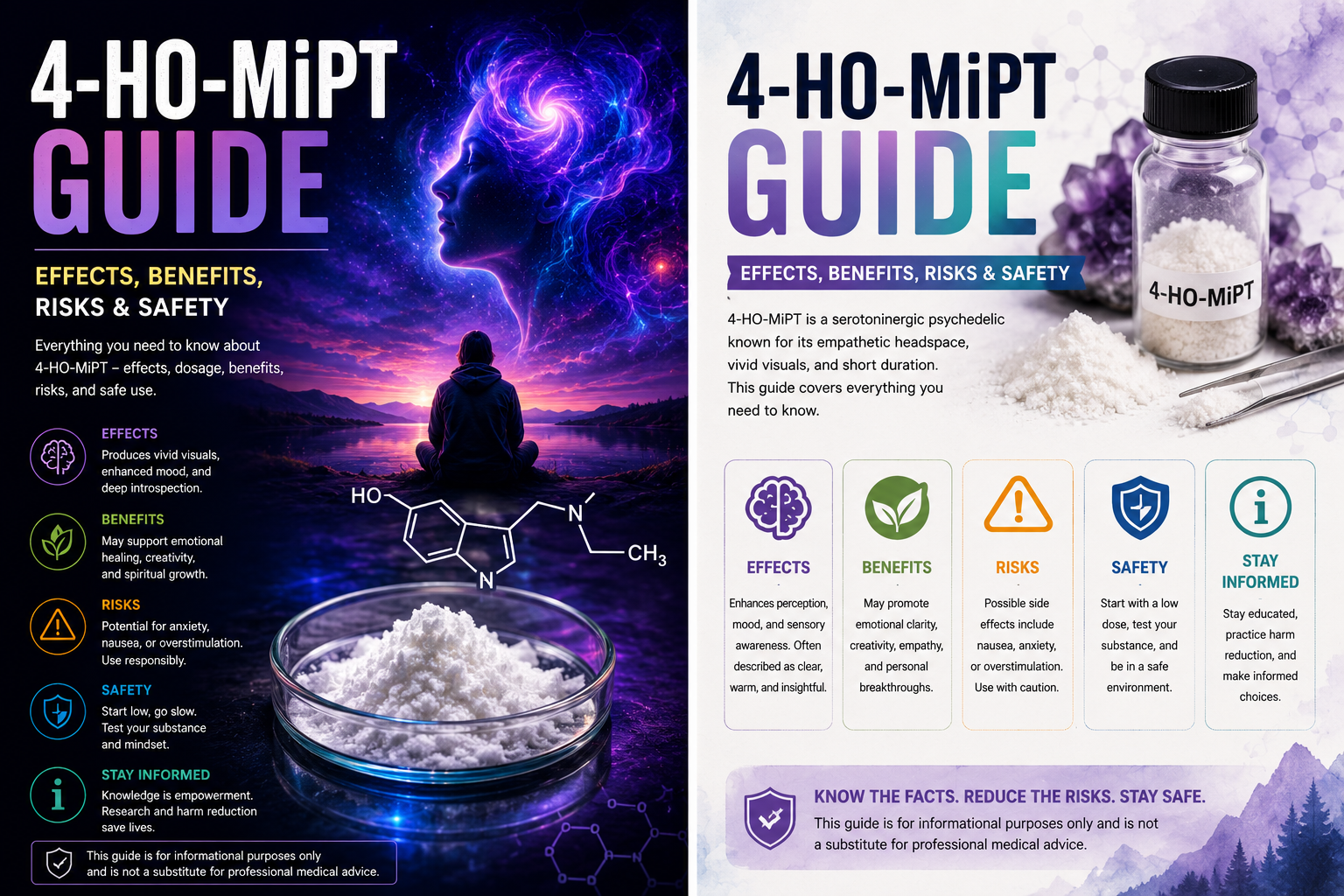
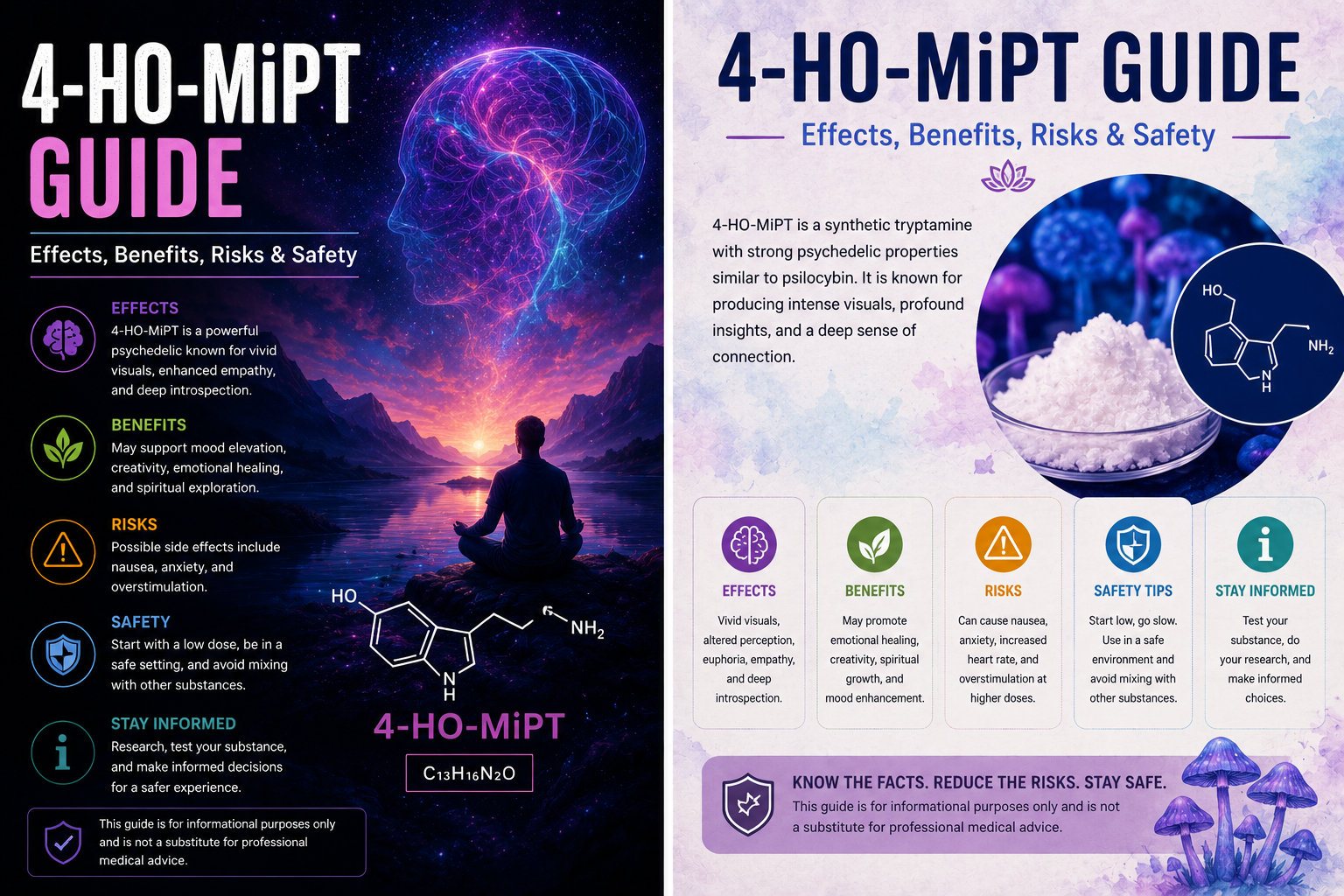
4-HO-MiPT Guide:
4-HO-MiPT, short for 4-hydroxy-N-methyl-N-isopropyltryptamine, is a synthetic psychedelic tryptamine that has attracted interest in medicinal chemistry, forensic science, and the broader study of serotonin-receptor-active compounds. It is also known by the name miprocin and is structurally related to psilocin and other 4-substituted tryptamines.
Unlike established medicines or approved psychedelic therapies, 4-HO-MiPT remains a relatively poorly characterized research compound. Much of the available information comes from chemical literature, receptor studies, analytical databases, historical reports, and observational accounts rather than large, controlled human clinical trials. Consequently, claims about its effects, safety, therapeutic potential, or long-term consequences should be treated cautiously.
This 4-HO-MiPT guide examines what is currently known about the compound, including its chemical identity, relationship to other tryptamines, pharmacological research, reported effects, potential risks, analytical identification, legal considerations, and important research limitations.
Research and safety note: This article is intended for educational and informational purposes. It does not provide instructions for synthesizing, preparing, obtaining, dosing, or using 4-HO-MiPT. Because human safety data are limited, experimentation with an unapproved psychoactive research chemical can involve substantial uncertainty.
What Is 4-HO-MiPT?
4-HO-MiPT is a synthetic substituted tryptamine belonging to the 4-hydroxytryptamine family. Its systematic chemical name is 3-[2-[methyl(propan-2-yl)amino]ethyl]-1H-indol-4-ol.
The compound has the molecular formula C14H20N2O and a molecular weight of approximately 232.32 g/mol. PubChem lists it under CID 10082683 and records several alternative names, including 4-hydroxy-N-methyl-N-isopropyltryptamine and 4-hydroxy-MiPT. (PubChem)
The name itself describes important elements of the molecule:
- 4-HO refers to a hydroxy group at the fourth position of the indole ring.
- MiPT refers to the N-methyl-N-isopropyl substitution pattern.
- Tryptamine describes the underlying indole-ethylamine chemical framework.
4-HO-MiPT is sometimes compared with psilocin, the principal psychoactive metabolite associated with psilocybin. Both compounds contain a 4-hydroxy substitution on the indole system, but their nitrogen substitution patterns differ.
Those relatively small structural changes can substantially influence receptor interactions, pharmacological activity, metabolism, and subjective effects.
Chemical Identity and Classification
Reliable chemical databases provide a useful starting point for distinguishing 4-HO-MiPT from similarly named compounds.
According to PubChem, its identifiers include:
| Property | Information |
|---|---|
| Common name | 4-HO-MiPT |
| Alternative name | 4-Hydroxy-N-methyl-N-isopropyltryptamine |
| Other name | Miprocin |
| Molecular formula | C14H20N2O |
| Molecular weight | 232.32 g/mol |
| PubChem CID | 10082683 |
| CAS Registry Number | 77872-43-6 |
| Chemical class | Substituted tryptamine |
PubChem also provides its IUPAC name as 3-[2-[methyl(propan-2-yl)amino]ethyl]-1H-indol-4-ol. (PubChem)
Analytical databases such as mzCloud independently list the same molecular formula, structural identifiers, CAS number, and chemical names, providing additional support for the compound’s identity. (MzCloud)
This distinction is important because 4-HO-MiPT can easily be confused with related substances such as 4-HO-MET, 4-HO-DiPT, 4-AcO-MiPT, and 4-MeO-MiPT. Similar abbreviations do not mean that these compounds have identical pharmacology or safety profiles.
History of 4-HO-MiPT Research
The chemistry of 4-HO-MiPT dates back several decades.
Historical literature identifies work by David Repke and colleagues in 1981 describing the compound as part of investigations into substituted 4-hydroxyindoles and tryptamine analogues. Later work involving Alexander Shulgin expanded the documentation of its effects and relationship to other substituted tryptamines. (Wikipedia)
Research into the pharmacology of 4-HO-MiPT subsequently examined its interactions with serotonin receptors. The compound therefore belongs to a broader scientific effort to understand how modifications to the tryptamine structure affect psychedelic activity.
More recent research continues to examine 4-HO-MiPT alongside related compounds. For example, a 2024 Journal of Pharmacology and Experimental Therapeutics conference abstract described investigations comparing the receptor profiles, monoamine transporter activity, and psychedelic-like effects of 4-HO-MiPT, 4-AcO-MiPT, and 4-MeO-MiPT. (ScienceDirect)
This continued interest illustrates that these substances remain relevant to contemporary pharmacology even though they are not established medical treatments.
How Is 4-HO-MiPT Related to Psilocin?
One of the most useful ways to understand 4-HO-MiPT is to compare it with psilocin.
Psilocin and 4-HO-MiPT share the 4-hydroxyindole framework characteristic of several psychedelic tryptamines. However, the side-chain nitrogen substitutions are different.
In simple terms, the chemical framework can be thought of as:
Indole ring + ethylamine side chain + 4-hydroxy group + specific N-substituents
For 4-HO-MiPT, the nitrogen carries methyl and isopropyl groups. These structural features distinguish it from psilocin and influence how the molecule interacts with biological targets.
This is an important principle in medicinal chemistry: two compounds can have similar molecular frameworks while producing meaningfully different pharmacological profiles.
For that reason, it is inappropriate to assume that information about psilocybin or psilocin automatically establishes the safety, potency, therapeutic properties, or duration of 4-HO-MiPT.
Pharmacology of 4-HO-MiPT
The pharmacology of 4-HO-MiPT is primarily associated with the serotonergic system, particularly serotonin receptors involved in psychedelic effects.
The 5-HT2A receptor is especially important in psychedelic pharmacology. Many classic serotonergic psychedelics exert psychedelic-like effects partly through agonist or partial agonist activity at this receptor.
Research involving 4-HO-MiPT and related compounds has investigated interactions with 5-HT2A as well as other serotonin targets. Contemporary studies have also considered transporter interactions, demonstrating why it is overly simplistic to describe these compounds as acting through a single receptor. (ScienceDirect)
A 2026 publication in ACS Chemical Neuroscience compared 4-MeO-MiPT, 4-HO-MiPT, and related analogues while examining the relationship between serotonin receptor activity, serotonin transporter activity, and psychedelic-like effects. (pubs.acs.org)
This research is valuable because receptor activity alone does not completely predict the human experience. Pharmacokinetics, metabolism, receptor selectivity, brain distribution, individual biology, and interactions with other substances can all influence outcomes.
Reported Effects
Descriptions of 4-HO-MiPT’s effects largely originate from historical reports, observational accounts, and research literature rather than extensive controlled clinical trials.
Reported psychedelic-type effects can include changes in:
- Visual perception
- Color and pattern perception
- Sound and music appreciation
- Mood
- Thought patterns
- Sense of time
- Emotional responsiveness
- Sensory intensity
- Self-perception
- Cognitive associations
Some reports describe a combination of psychedelic, stimulating, relaxing, or emotionally immersive qualities. However, these descriptions should not be treated as predictable effects for every individual.
A scientific review of tryptamine-based compounds notes that reported experiences associated with 4-HO-MiPT can include mood changes, increased appreciation of music, creative thinking, altered sensory perception, and other subjective effects. (ScienceDirect)
Importantly, individual experiences can vary considerably. Factors such as psychological state, environment, expectations, underlying health conditions, medications, and exposure to other psychoactive substances can all affect the outcome.
Physical and Psychological Risks
The limited human evidence surrounding 4-HO-MiPT is one of the most important reasons to approach the compound cautiously.
Because it is not an approved medicine with a well-established clinical safety profile, researchers cannot confidently define its long-term risks in humans.
Potential concerns associated with serotonergic psychedelic compounds can include:
Psychological distress
Altered perception and cognition can sometimes be accompanied by anxiety, confusion, panic, paranoia, or emotional distress.
A person’s mental state and surroundings can influence whether an altered state feels manageable or overwhelming.
Cardiovascular effects
Serotonergic psychoactive compounds may influence physiological variables such as heart rate and blood pressure. The magnitude and clinical significance of these effects can vary between substances and individuals.
People with cardiovascular conditions may therefore face additional uncertainty when exposed to poorly characterized psychoactive compounds.
Nausea and gastrointestinal effects
Changes in gastrointestinal comfort, nausea, appetite, or other physical sensations have been reported across psychedelic tryptamine classes. Such effects are not necessarily specific to 4-HO-MiPT.
Confusion and impaired judgment
During an altered state, perception and decision-making may be significantly different from baseline. This creates indirect risks, particularly around driving, operating machinery, heights, water, traffic, or other hazardous environments.
Unknown long-term effects
Perhaps the largest research gap concerns long-term exposure.
There is insufficient high-quality evidence to establish the long-term neurological, psychiatric, cardiovascular, reproductive, or developmental consequences of 4-HO-MiPT exposure.
That absence of evidence should not be interpreted as evidence that the compound is safe.
Drug Interactions and Serotonergic Concerns
Another important issue is interaction with other substances.
Because 4-HO-MiPT affects serotonin-related signaling, combining it with other psychoactive or serotonergic substances may create unpredictable pharmacological interactions.
Particular caution is warranted around combinations involving substances that strongly alter serotonin signaling, monoamine metabolism, or central nervous system activity.
Potential interaction risks are difficult to quantify because controlled interaction studies involving 4-HO-MiPT are limited.
For this reason, it is not scientifically responsible to provide a list of combinations that are supposedly “safe.” The absence of documented interaction reports does not establish safety.
Anyone experiencing severe agitation, confusion, loss of consciousness, seizures, chest pain, dangerously abnormal temperature, or other serious symptoms after exposure to an unknown psychoactive substance should seek emergency medical attention.
4-HO-MiPT vs. 4-HO-MET
4-HO-MET is another synthetic 4-hydroxytryptamine and is sometimes confused with 4-HO-MiPT because of the similar abbreviations.
However, their molecular structures differ.
PubChem identifies 4-HO-MET as 3-[2-[ethyl(methyl)amino]ethyl]-1H-indol-4-ol, with the molecular formula C13H18N2O and molecular weight of approximately 218.29 g/mol. (PubChem)
By contrast, 4-HO-MiPT contains an isopropyl group alongside the methyl group on the terminal nitrogen and has the molecular formula C14H20N2O. (PubChem)
These seemingly modest structural differences are scientifically significant. They can alter receptor affinity, selectivity, metabolism, and biological effects.
4-HO-MiPT vs. 4-AcO-MiPT
Another commonly discussed comparison is between 4-HO-MiPT and 4-AcO-MiPT.
The “HO” and “AcO” portions of the names refer to different functional groups at the 4-position of the indole system.
4-HO-MiPT is the hydroxy compound, whereas 4-AcO-MiPT contains an acetoxy substitution.
Researchers have specifically studied these compounds side by side because structural modifications can influence receptor activity and pharmacological behavior. A 2024 research abstract examined 4-HO-MiPT, 4-AcO-MiPT, and 4-MeO-MiPT using receptor, transporter, and animal-model approaches. (ScienceDirect)
Consequently, users should not assume that two similarly named compounds are interchangeable.
Analytical Identification
Forensic and analytical chemistry is another important area in which 4-HO-MiPT appears.
Chemical databases document multiple analytical identifiers for the compound, including its:
- Molecular formula
- Exact structural representation
- InChI
- InChIKey
- Canonical SMILES
- CAS number
- Mass-spectral information
mzCloud, for example, provides curated mass-spectrometry information for 4-hydroxy-MiPT, while PubChem aggregates identifiers and records from multiple scientific databases. (MzCloud)
Laboratory identification is particularly important because appearance alone cannot reliably establish the identity or purity of an unknown research chemical.
A powder, tablet, capsule, blotter, or other material labeled “4-HO-MiPT” could potentially contain a different substance, contaminants, degradation products, or an inaccurately represented concentration.
Professional analytical testing therefore provides substantially more reliable information than visual inspection or packaging claims.
Why Purity and Identity Matter
Research chemicals can present a special analytical challenge because commercial products may not be subject to the same manufacturing controls as approved pharmaceuticals.
Even when a material is correctly labeled, factors such as:
- Manufacturing impurities
- Cross-contamination
- Degradation
- Incorrect labeling
- Inconsistent concentration
- Substitution with another compound
can affect the risk profile.
This is one reason scientific laboratories rely on validated analytical methods rather than relying solely on supplier descriptions.
PubChem’s database demonstrates that 4-HO-MiPT has well-established structural identifiers, but the existence of a chemical record does not certify the quality or contents of any particular physical sample. (PubChem)
Is 4-HO-MiPT Legal?
The legal status of 4-HO-MiPT depends heavily on jurisdiction.
Drug laws differ between countries, states, provinces, and territories. Some jurisdictions specifically list particular tryptamines as controlled substances, while others regulate broader chemical classes or apply analogue laws.
Legal status can also change over time.
Therefore, it is not appropriate to claim that 4-HO-MiPT is universally legal, illegal, or a “legal psychedelic.”
Anyone researching the compound should consult current legislation and official regulatory sources applicable to their jurisdiction. A compound’s availability from an online seller does not establish that possession, importation, sale, or use is lawful.
Is 4-HO-MiPT FDA Approved?
No established FDA-approved medical indication exists for 4-HO-MiPT.
The fact that PubChem includes information from government and scientific databases does not mean that the substance has been approved as a medicine. PubChem is a chemical information resource and contains records for many compounds that are experimental, industrial, environmental, or otherwise not approved therapeutics. (PubChem)
Accordingly, claims describing 4-HO-MiPT as an established treatment for depression, anxiety, PTSD, addiction, or other medical conditions should be viewed critically unless supported by appropriate clinical evidence.
Current State of Scientific Research
Research into substituted tryptamines remains active.
Modern studies are increasingly interested in understanding how structural changes affect:
- 5-HT2A receptor activity
- Other serotonin receptors
- Serotonin transporter interactions
- Receptor selectivity
- Metabolism
- Pharmacokinetics
- Behavioral effects
- Potential therapeutic mechanisms
Recent research comparing 4-HO-MiPT with related compounds demonstrates that the field is moving beyond simple descriptions of psychedelic effects toward more detailed pharmacological characterization. (ScienceDirect)
Nevertheless, there remains a substantial gap between laboratory findings and evidence needed to establish a drug as a safe and effective human medicine.
Common Questions About 4-HO-MiPT
What does 4-HO-MiPT stand for?
4-HO-MiPT stands for 4-hydroxy-N-methyl-N-isopropyltryptamine. It is also known as miprocin.
Is 4-HO-MiPT a tryptamine?
Yes. It belongs to the family of synthetic substituted tryptamines and contains an indole-based tryptamine structure.
Is 4-HO-MiPT the same as psilocybin?
No. Although 4-HO-MiPT shares structural similarities with psilocin and belongs to a related chemical family, it is a distinct compound.
Is 4-HO-MiPT the same as 4-HO-MET?
No. The two compounds have different chemical structures and molecular formulas. (PubChem)
Does 4-HO-MiPT have psychedelic properties?
Research and historical reports associate 4-HO-MiPT with psychedelic-like effects. However, the human evidence base is considerably smaller than that available for established psychedelic research compounds such as psilocybin.
Has 4-HO-MiPT been clinically approved?
No. It is not an established FDA-approved medication or approved treatment.
Is 4-HO-MiPT safe?
Its safety profile has not been adequately established in controlled human research. Limited evidence means that significant uncertainties remain regarding both short- and long-term risks.
Can the identity of 4-HO-MiPT be confirmed visually?
No. Appearance is not a scientifically reliable method of identifying a chemical. Laboratory analytical techniques are substantially more reliable.
Final Thoughts
4-HO-MiPT is a scientifically interesting member of the substituted tryptamine family with a history extending back to research conducted in the early 1980s. Its structure is related to psilocin, while its N-methyl-N-isopropyl substitution pattern gives it a distinct chemical and pharmacological profile.
Modern research continues to investigate how 4-HO-MiPT and related compounds interact with serotonin receptors and transporters. Chemical databases provide well-established identifiers for the molecule, while contemporary pharmacological studies are helping researchers understand how small structural differences influence psychedelic-like activity. (PubChem)
At the same time, 4-HO-MiPT should not be confused with an approved medication or a thoroughly characterized therapeutic compound. Controlled human research remains limited, and questions concerning toxicity, drug interactions, long-term effects, pharmacokinetics, and individual variability remain incompletely answered.
For researchers, educators, and readers interested in psychedelic chemistry, 4-HO-MiPT provides a useful example of how modifications to the classic tryptamine framework can produce substantially different pharmacological profiles.
The most responsible way to understand compounds such as 4-HO-MiPT is therefore through verified chemical data, peer-reviewed research, analytical science, and careful acknowledgment of what remains unknown.