- Your cart is empty
- Continue Shopping


Pharmaceutical Development: The Science, Innovation, and Future of Modern Medicine
- Guides
- Posted on
-
by admin
- 0 comments

Pharmaceutical development is one of the most critical pillars of modern healthcare. Every medication that reaches a pharmacy shelf or hospital formulary undergoes a rigorous journey involving years of research, testing, manufacturing, and regulatory review. From identifying promising compounds in a laboratory to producing safe and effective treatments for patients worldwide, pharmaceutical development serves as the bridge between scientific innovation and public health.
As healthcare challenges continue to evolve, pharmaceutical companies, biotechnology firms, research institutions, and regulatory agencies work together to develop new therapies that improve patient outcomes, extend life expectancy, and enhance quality of life. Whether addressing chronic diseases, infectious illnesses, rare genetic disorders, or emerging health threats, it remains at the forefront of medical advancement.
What Is Pharmaceutical Development?
Pharmaceutical development refers to the comprehensive process of designing, testing, manufacturing, and commercializing medications for human use. It encompasses multiple scientific disciplines, including chemistry, biology, pharmacology, toxicology, engineering, regulatory science, and quality assurance.
The primary objective is to ensure that new medicines are:
- Safe for patients
- Effective for intended medical conditions
- Consistently manufactured to high-quality standards
- Compliant with regulatory requirements
- Accessible to healthcare providers and patients
This process can take anywhere from 10 to 15 years and often requires billions of dollars in investment before a single product reaches the market.
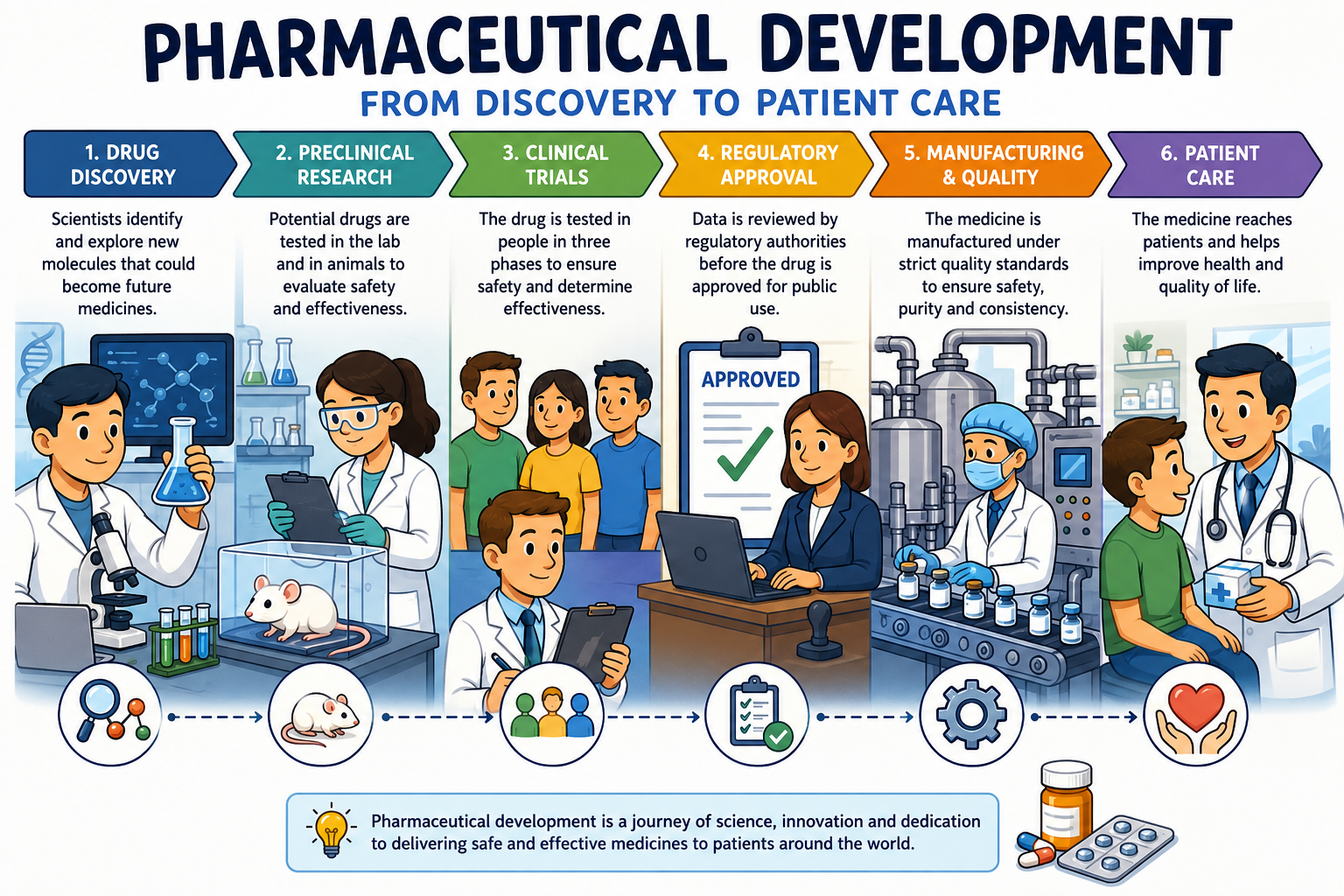
The Pharmaceutical Development Lifecycle
1. Drug Discovery and Research
The pharmaceutical development journey begins with drug discovery. Researchers identify biological targets associated with specific diseases and search for compounds capable of influencing those targets.
Drug discovery activities include:
- Target identification
- Target validation
- Compound screening
- Lead optimization
- Molecular modeling
- Structure-activity relationship studies
Advanced technologies such as artificial intelligence, machine learning, genomics, and high-throughput screening have dramatically accelerated this phase.
Scientists may evaluate thousands of potential compounds before identifying a candidate suitable for further development.
2. Preclinical Development
Before testing a drug in humans, extensive laboratory and animal studies are conducted to evaluate safety and biological activity.
Preclinical research helps determine:
- Toxicity profiles
- Pharmacokinetics
- Pharmacodynamics
- Dosage ranges
- Potential side effects
- Drug metabolism pathways
These studies provide crucial data that regulators use to determine whether human clinical trials can proceed safely.
3. Clinical Trials
Clinical trials represent one of the most important phases. Human studies are conducted in carefully controlled environments to assess safety and effectiveness.
Phase I Trials
Phase I trials involve a small number of healthy volunteers or patients.
Objectives include:
- Evaluating safety
- Determining dosage levels
- Studying drug absorption and metabolism
- Identifying side effects
Phase II Trials
Phase II trials involve a larger group of patients who have the targeted condition.
Researchers assess:
- Treatment effectiveness
- Optimal dosing
- Short-term side effects
- Therapeutic benefits
Phase III Trials
Phase III studies involve hundreds or thousands of participants across multiple sites.
These trials help confirm:
- Clinical effectiveness
- Long-term safety
- Comparative performance
- Risk-benefit profiles
Successful Phase III trials often provide the evidence necessary for regulatory approval.
4. Regulatory Submission and Approval
Once clinical development is completed, pharmaceutical companies compile extensive documentation for regulatory agencies.
The submission includes:
- Clinical trial data
- Manufacturing information
- Quality control procedures
- Safety evaluations
- Product labeling
Major regulatory agencies include:
- U.S. Food and Drug Administration (FDA)
- European Medicines Agency (EMA)
- Medicines and Healthcare products Regulatory Agency (MHRA)
- Health Canada
- Therapeutic Goods Administration (TGA)
Regulators review all available evidence before deciding whether the medicine can be marketed.
Pharmaceutical Formulation Development
Formulation development is a specialized area focused on creating the final dosage form of a medicine.
Scientists determine how active pharmaceutical ingredients (APIs) are combined with excipients to create products such as:
- Tablets
- Capsules
- Injectables
- Oral liquids
- Topical creams
- Inhalers
- Transdermal patches
The formulation must ensure:
- Stability
- Bioavailability
- Patient compliance
- Manufacturing efficiency
- Product safety
Innovative drug delivery technologies continue to improve treatment outcomes and patient experiences.
Pharmaceutical Manufacturing and Scale-Up
Developing an effective medicine is only part of the challenge. Manufacturers must also produce it consistently and efficiently on a commercial scale.
Pharmaceutical manufacturing involves:
- Process development
- Equipment qualification
- Quality assurance
- Process validation
- Supply chain management
- Regulatory compliance
Modern facilities operate under Good Manufacturing Practice (GMP) standards to ensure every batch meets strict quality requirements.
Automation, digital monitoring systems, and advanced analytics are increasingly being used to optimize production efficiency and product quality.
Quality Control in Pharmaceutical Development
Quality control is integrated throughout every stage.
Key quality activities include the following:
Raw Material Testing
Manufacturers verify the identity, purity, and quality of incoming materials.
In-Process Monitoring
Production processes are continuously monitored to ensure consistency.
Finished Product Testing
Products undergo extensive testing for:
- Potency
- Purity
- Stability
- Dissolution
- Microbial contamination
Stability Studies
Long-term testing evaluates how products perform under various storage conditions.
Quality assurance systems help maintain patient safety and regulatory compliance throughout the product lifecycle.
Emerging Technologies Transforming Pharmaceutical Development
The pharmaceutical industry is experiencing rapid technological advancement.
Artificial Intelligence
AI is accelerating:
- Drug target identification
- Molecule design
- Clinical trial optimization
- Predictive analytics
Precision Medicine
Personalized therapies based on genetic information allow treatments to be tailored to individual patients.
Gene Therapy
Gene therapies offer new possibilities for treating previously untreatable genetic disorders.
mRNA Technology
The success of mRNA vaccines has demonstrated the potential of this platform for numerous therapeutic applications.
Continuous Manufacturing
Continuous production systems improve efficiency, quality control, and scalability.
These innovations are helping reduce development timelines while improving treatment effectiveness.
Challenges Facing Pharmaceutical Development
Despite remarkable progress, it remains complex and demanding.
Common challenges include:
Rising Costs
Bringing a new medicine to market requires substantial financial investment.
Regulatory Complexity
Global regulatory requirements continue to evolve, requiring ongoing compliance efforts.
Clinical Trial Recruitment
Finding suitable trial participants can significantly impact development timelines.
Scientific Uncertainty
Many promising candidates fail during development due to safety or efficacy concerns.
Market Competition
Rapid innovation creates competitive pressure to develop superior therapies.
Organizations that successfully navigate these challenges often gain significant competitive advantages.
The Future of Pharmaceutical Development
The future will be shaped by collaboration, technology, and patient-centered innovation.
Industry trends include:
- Digital health integration
- Artificial intelligence-driven research
- Advanced biologics
- Cell and gene therapies
- Real-world evidence utilization
- Decentralized clinical trials
- Sustainable manufacturing practices
These developments have the potential to accelerate medical breakthroughs while improving accessibility and affordability.
Why Pharmaceutical Development Matters
Every medical advancement begins with a commitment to scientific discovery and rigorous development. Pharmaceutical development not only creates treatments for existing diseases but also prepares society to address future healthcare challenges.
The impact extends beyond individual patients, influencing healthcare systems, economies, and global public health initiatives. Successful pharmaceutical development contributes to longer life expectancy, improved disease management, and enhanced quality of life for millions of people worldwide.
Conclusion
It is a highly sophisticated process that combines scientific expertise, technological innovation, regulatory oversight, and manufacturing excellence. From drug discovery and clinical trials to commercial production and post-market monitoring, every step is designed to ensure that patients receive safe, effective, and high-quality medications.
As emerging technologies continue to reshape the healthcare landscape, they will remain a driving force behind medical innovation. Organizations that invest in research, quality systems, and advanced development strategies will play a crucial role in shaping the future of global healthcare and delivering transformative therapies for generations to come.
