- Your cart is empty
- Continue Shopping


Psychedelic Compounds for Research: Advancing Neuroscience, Psychology, and Mental Health Studies
- Guides
- Posted on
-
by admin
- 0 comments
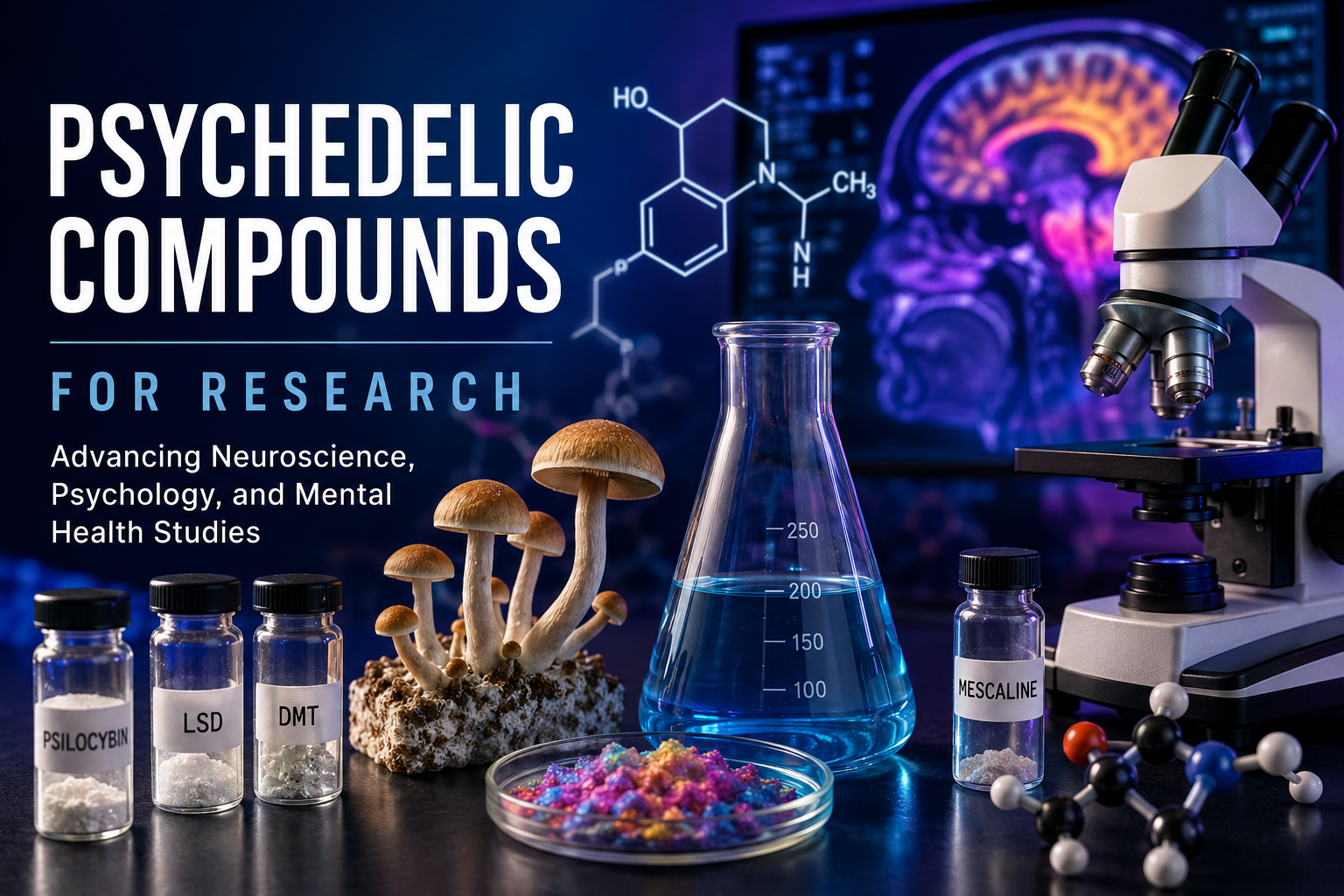
Psychedelic Compounds for Research
The scientific exploration of psychedelic compounds for research has experienced a remarkable resurgence over the past decade. Once primarily associated with countercultural movements, these compounds are now at the forefront of groundbreaking research in neuroscience, psychology, psychiatry, and cognitive science.
Researchers worldwide are investigating how psychedelic compounds interact with the human brain, influence perception, alter consciousness, and potentially contribute to innovative approaches for understanding mental health disorders. Universities, research institutions, and pharmaceutical companies are investing substantial resources into studying these fascinating molecules to uncover their mechanisms of action and therapeutic potential.
As scientific interest continues to grow, psychedelic compounds for research have become an important focus within modern biomedical and psychological studies. This article explores the significance of psychedelic research, the compounds commonly studied, current scientific findings, and future directions in this rapidly evolving field.
Understanding Psychedelic Compounds
Psychedelic compounds are substances that can profoundly influence perception, cognition, mood, and consciousness. These compounds primarily interact with serotonin receptors in the brain, particularly the 5-HT2A receptor, which plays a critical role in sensory processing and cognitive function.
Researchers study psychedelics to better understand:
- Brain connectivity
- Neural plasticity
- Consciousness
- Emotional processing
- Cognitive flexibility
- Learning and memory mechanisms
- Psychological resilience
The unique effects of psychedelic compounds provide scientists with valuable tools for investigating how the brain constructs subjective experiences and processes information.
Common Psychedelic Compounds Studied in Research
Psilocybin
Psilocybin is one of the most extensively researched psychedelic compounds. Found naturally in certain mushroom species, psilocybin is converted into psilocin after ingestion, producing alterations in perception and cognition.
Research involving psilocybin focuses on:
- Neural network activity
- Brain plasticity
- Emotional regulation
- Consciousness studies
- Cognitive processing
Its predictable pharmacological profile makes it particularly valuable in controlled laboratory environments.
LSD (Lysergic Acid Diethylamide)
LSD remains one of the most influential compounds in psychedelic science. Researchers use LSD to investigate:
- Perception mechanisms
- Sensory integration
- Consciousness alteration
- Creativity and cognition
- Brain connectivity patterns
Modern neuroimaging technologies have allowed scientists to observe how LSD affects communication between various brain regions.
DMT (N,N-Dimethyltryptamine)
DMT is known for producing intense and short-lasting psychedelic experiences. Research interest in DMT includes:
- Consciousness studies
- Near-death experience models
- Rapid neural adaptation
- Altered perception mechanisms
The brief duration of DMT effects makes it particularly useful in controlled experimental settings.
Mescaline
Mescaline has been studied for decades due to its distinctive pharmacological properties. Researchers investigate:
- Visual processing
- Cognitive flexibility
- Emotional perception
- Neurochemical interactions
Mescaline continues to provide valuable insights into how psychedelic compounds influence brain function.
Novel Psychedelic Analogues
Scientific research increasingly examines newly synthesized compounds that may provide unique opportunities to study:
- Receptor selectivity
- Structure-activity relationships
- Neuropharmacology
- Molecular mechanisms of consciousness
These compounds help researchers better understand how specific molecular structures influence psychological and neurological outcomes.
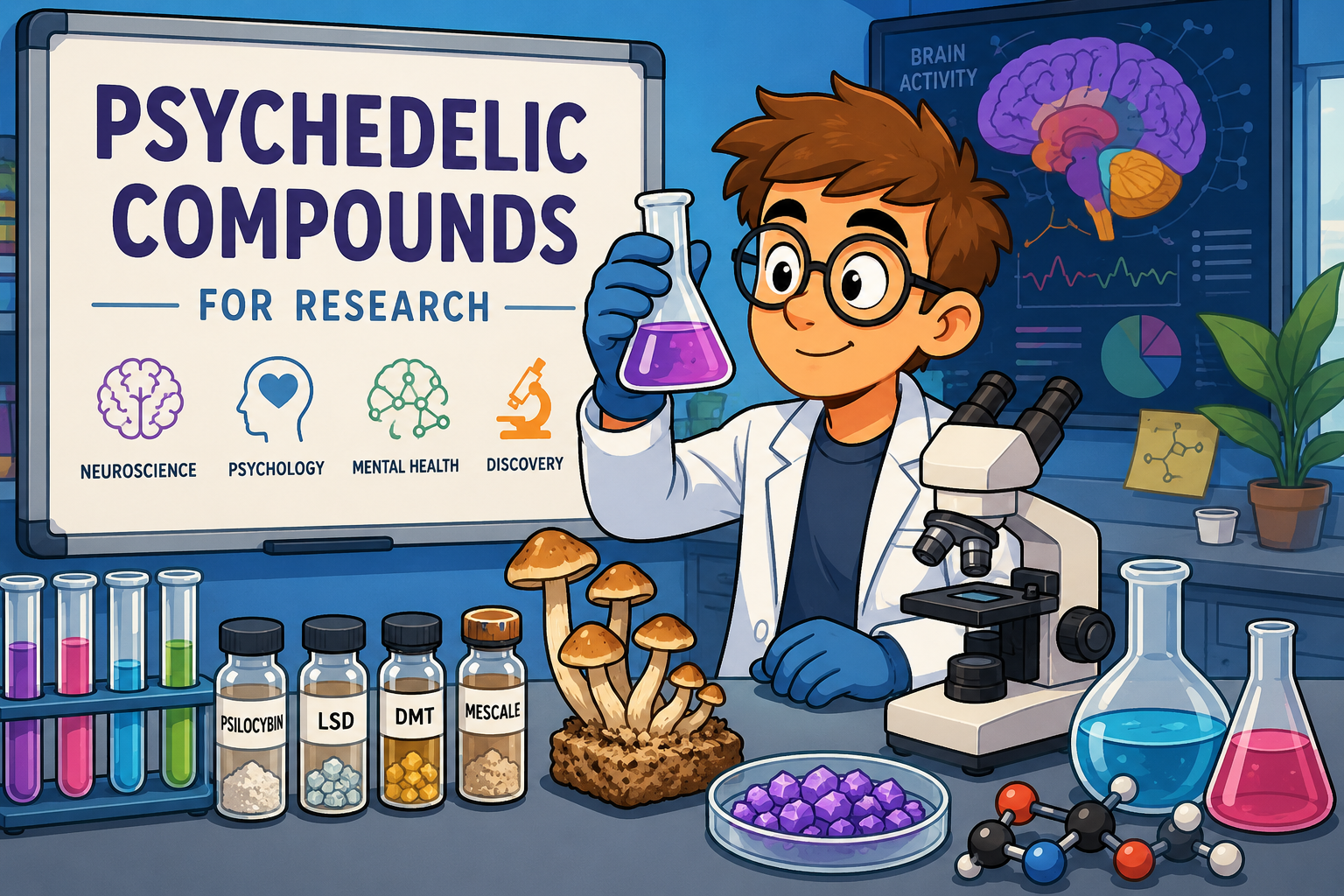
How Psychedelic Research Advances Neuroscience
One of the most significant contributions of psychedelic research is its impact on neuroscience.
Mapping Brain Networks
Advanced imaging technologies such as:
- Functional MRI (fMRI)
- PET scans
- EEG monitoring
- Magnetoencephalography (MEG)
allow researchers to observe changes in brain activity during altered states of consciousness.
Studies suggest that psychedelic compounds can temporarily modify communication patterns between different brain regions, providing insights into how consciousness emerges from neural activity.
Investigating Neuroplasticity
Neuroplasticity refers to the brain’s ability to reorganize itself by forming new neural connections.
Researchers are exploring how psychedelic compounds influence:
- Synaptic growth
- Neural adaptation
- Learning mechanisms
- Memory formation
Understanding these processes could contribute to broader knowledge of brain development and cognitive flexibility.
Studying the Default Mode Network
The Default Mode Network (DMN) is associated with self-referential thinking and internal mental processes.
Psychedelic compounds have been shown to affect DMN activity, offering researchers valuable opportunities to study:
- Self-awareness
- Identity formation
- Cognitive processing
- Consciousness dynamics
Applications in Psychological Research
Psychology researchers are increasingly utilizing psychedelic compounds to investigate human behavior and mental processes.
Emotional Processing
Psychedelic compounds provide a unique model for studying:
- Emotional regulation
- Fear responses
- Empathy
- Social cognition
Researchers can observe how changes in neural activity correspond to emotional experiences.
Cognitive Flexibility
Cognitive flexibility is the ability to adapt thinking and behavior in response to changing circumstances.
Studies suggest psychedelic compounds may temporarily enhance:
- Divergent thinking
- Problem-solving abilities
- Creative cognition
- Adaptive learning
These findings contribute to broader psychological theories regarding human cognition.
Consciousness Research
Few scientific fields have generated as much interest as the study of consciousness.
Psychedelic compounds allow researchers to examine:
- Subjective experience
- Self-perception
- Awareness states
- Perceptual integration
By studying altered states, scientists gain valuable information about the fundamental nature of conscious experience.
The Growing Importance of Psychedelic Pharmacology
Psychedelic pharmacology focuses on understanding how these compounds interact with biological systems.
Researchers investigate:
Receptor Binding
Many psychedelic compounds interact primarily with serotonin receptors.
Studying receptor activity helps scientists understand:
- Signal transmission
- Neurochemical regulation
- Perception mechanisms
- Cognitive processing pathways
Molecular Structure Analysis
Comparing different psychedelic compounds allows researchers to identify:
- Structural similarities
- Receptor preferences
- Pharmacological profiles
- Biological activity patterns
This information contributes to drug discovery and neuropharmacological research.
Ethical Considerations in Psychedelic Research
As psychedelic science expands, ethical considerations remain a central priority.
Responsible research requires:
- Institutional oversight
- Ethical review board approval
- Participant safety monitoring
- Informed consent procedures
- Rigorous scientific protocols
Maintaining high ethical standards ensures the integrity and credibility of psychedelic research efforts.
Challenges Facing Psychedelic Research
Despite growing scientific interest, several challenges remain.
Regulatory Requirements
Researchers often face complex regulatory frameworks governing psychedelic compounds.
Funding Limitations
Although investment is increasing, funding opportunities remain more limited than in many other scientific disciplines.
Public Perception
Historical misconceptions can sometimes influence public understanding of psychedelic science.
Continued education and transparent research practices are essential for promoting informed discussion.
Future Directions of Psychedelic Research
The future of psychedelic research appears highly promising.
Emerging areas of investigation include:
Precision Neuropharmacology
Scientists aim to develop compounds with specific receptor-targeting properties that enhance research precision.
Advanced Brain Imaging
Next-generation imaging technologies will provide deeper insights into how psychedelic compounds influence neural activity.
Artificial Intelligence and Data Analysis
Machine learning systems are increasingly being used to analyze large datasets generated by psychedelic studies.
Consciousness Mapping
Researchers continue working toward a more comprehensive understanding of consciousness, one of science’s greatest mysteries.
Why Psychedelic Research Matters
The scientific study of psychedelic compounds extends far beyond the compounds themselves. These molecules serve as powerful tools for exploring some of the most fundamental questions in neuroscience and psychology.
Research involving psychedelic compounds contributes to:
- Understanding brain function
- Exploring consciousness
- Advancing cognitive science
- Improving neuropharmacological knowledge
- Expanding psychological research methodologies
As scientific interest continues to grow, psychedelic compounds are likely to remain an important area of investigation for researchers seeking to unlock new insights into the human mind.
Conclusion
Psychedelic compounds for research represent one of the most exciting frontiers in contemporary science. Through rigorous investigation, researchers are uncovering valuable information about brain connectivity, consciousness, neuroplasticity, emotional processing, and cognitive function.
The renewed scientific focus on psychedelic research is helping reshape our understanding of the brain and human experience. As technology advances and research methodologies continue to improve, these compounds will undoubtedly play an increasingly important role in expanding the boundaries of neuroscience, psychology, and consciousness studies.
The future of psychedelic research holds immense potential for advancing scientific knowledge and deepening our understanding of the complex mechanisms that shape human perception, cognition, and consciousness.
