- Your cart is empty
- Continue Shopping


Psychedelic Research Chemicals: Understanding Their Role in Modern Scientific Discovery
- Psychedelics Guide
- Posted on
-
by admin
- 0 comments
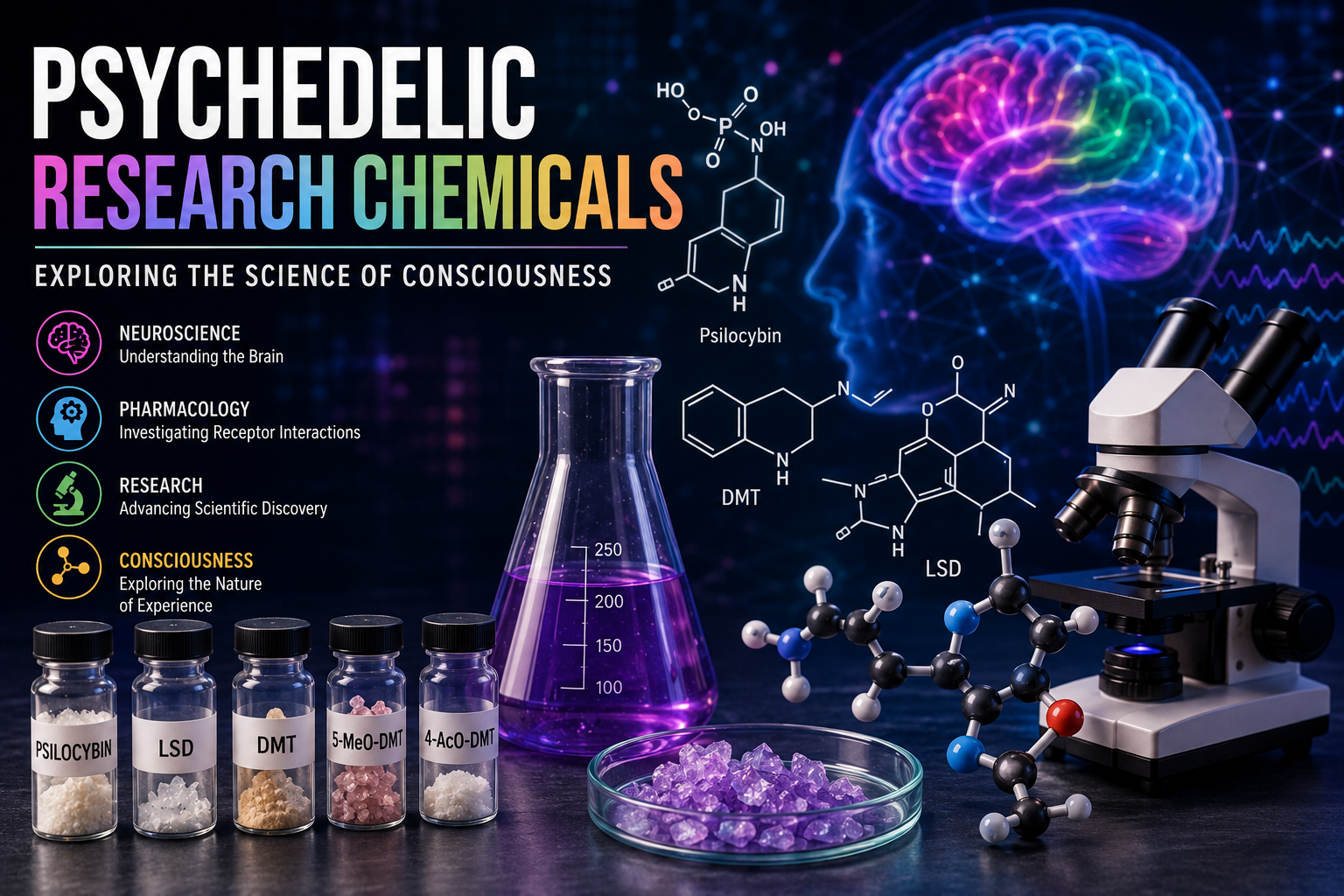
Psychedelic research chemicals have emerged as one of the most fascinating areas of modern scientific investigation. As researchers seek deeper insights into the human brain, consciousness, cognition, and neurochemistry, these compounds provide valuable tools for understanding complex biological and psychological processes.
Over the past decade, interest in psychedelic science has expanded significantly. Universities, research institutions, biotechnology companies, and pharmaceutical organizations are conducting studies aimed at exploring how psychedelic compounds interact with neural pathways and influence human perception.
While public discussions often focus on the cultural history of psychedelics, the scientific community views psychedelic research chemicals as important instruments for advancing knowledge in neuroscience, psychology, pharmacology, and cognitive science. Through carefully controlled research environments, scientists are uncovering new information about brain function, neural connectivity, and the mechanisms underlying consciousness itself.
What Are Psychedelic Research Chemicals?
Psychedelic research chemicals are compounds studied primarily for scientific and educational purposes to investigate their pharmacological, neurological, and psychological properties.
These substances may include:
- Naturally occurring psychedelic compounds
- Synthetic analogues
- Novel molecular structures
- Experimental compounds developed for laboratory research
- Receptor-selective molecules designed for neuroscience studies
Researchers utilize these compounds to examine how specific molecular interactions influence cognition, perception, emotional processing, and neural communication.
Unlike conventional pharmaceutical compounds that are often developed for a specific medical purpose, research chemicals frequently serve as investigative tools that help scientists understand broader biological mechanisms.
The Scientific Importance of Psychedelic Research Chemical
The renewed interest in psychedelic science is driven by several important scientific objectives.
Understanding Brain Function
One of the primary goals of psychedelic research is to better understand how the brain processes information.
Scientists use psychedelic compounds to investigate:
- Neural communication networks
- Information integration
- Sensory perception
- Cognitive processing
- Memory formation
- Emotional regulation
These studies contribute to a broader understanding of how the brain generates conscious experience.
Exploring Consciousness
Consciousness remains one of science’s greatest mysteries.
Psychedelic compounds create temporary alterations in perception and awareness that allow researchers to examine:
- Self-awareness
- Subjective experience
- Sense of identity
- Perception of time
- Sensory integration
By studying these altered states, researchers gain valuable insights into the biological foundations of consciousness.
Investigating Neuroplasticity
Neuroplasticity refers to the brain’s ability to adapt, reorganize, and form new neural connections.
Modern studies suggest that certain psychedelic compounds may influence:
- Synaptic connectivity
- Neural growth pathways
- Learning mechanisms
- Cognitive flexibility
Understanding these effects helps researchers explore how the brain responds to novel experiences and environmental changes.
Common Categories of Psychedelic Research Chemicals
Tryptamines
Tryptamines are among the most widely studied psychedelic compounds.
Examples include molecules structurally related to naturally occurring neurotransmitters and compounds found in nature.
Researchers study tryptamines to investigate:
- Serotonin receptor interactions
- Perception mechanisms
- Brain network connectivity
- Cognitive processing
Phenethylamines
Phenethylamines represent another major class of psychedelic compounds.
Research involving these molecules focuses on:
- Sensory perception
- Emotional processing
- Neurotransmitter regulation
- Cognitive flexibility
The structural diversity within this class allows scientists to examine how subtle molecular modifications affect biological activity.
Lysergamides
Lysergamides are well known for their potent interactions with serotonin receptors.
These compounds are valuable tools for studying:
- Consciousness
- Neural connectivity
- Information processing
- Visual perception
Their strong receptor affinity makes them particularly useful in neuropharmacological research.
Novel Research Analogues
Advances in medicinal chemistry continue to produce new compounds designed specifically for scientific investigation.
These molecules help researchers understand:
- Structure-activity relationships
- Receptor selectivity
- Pharmacokinetics
- Neurochemical signaling pathways
How Psychedelic Research Chemicals Are Studied
Scientific investigations involving psychedelic compounds follow rigorous protocols designed to ensure accuracy, safety, and reproducibility.
In Vitro Research
Laboratory studies often begin with cell-based experiments.
Researchers evaluate:
- Receptor binding
- Molecular interactions
- Signal transduction pathways
- Cellular responses
These studies provide foundational information before more complex investigations are conducted.
Animal Models
Animal research helps scientists understand how compounds influence:
- Brain activity
- Behavioral responses
- Learning mechanisms
- Neurochemical systems
These studies contribute essential data regarding pharmacological properties.
Human Research
In approved research environments, scientists may study psychedelic compounds using carefully controlled methodologies.
Researchers employ:
- Functional MRI (fMRI)
- Electroencephalography (EEG)
- PET imaging
- Cognitive assessments
- Psychological evaluations
These techniques allow investigators to observe how compounds influence neural activity and cognitive processes.
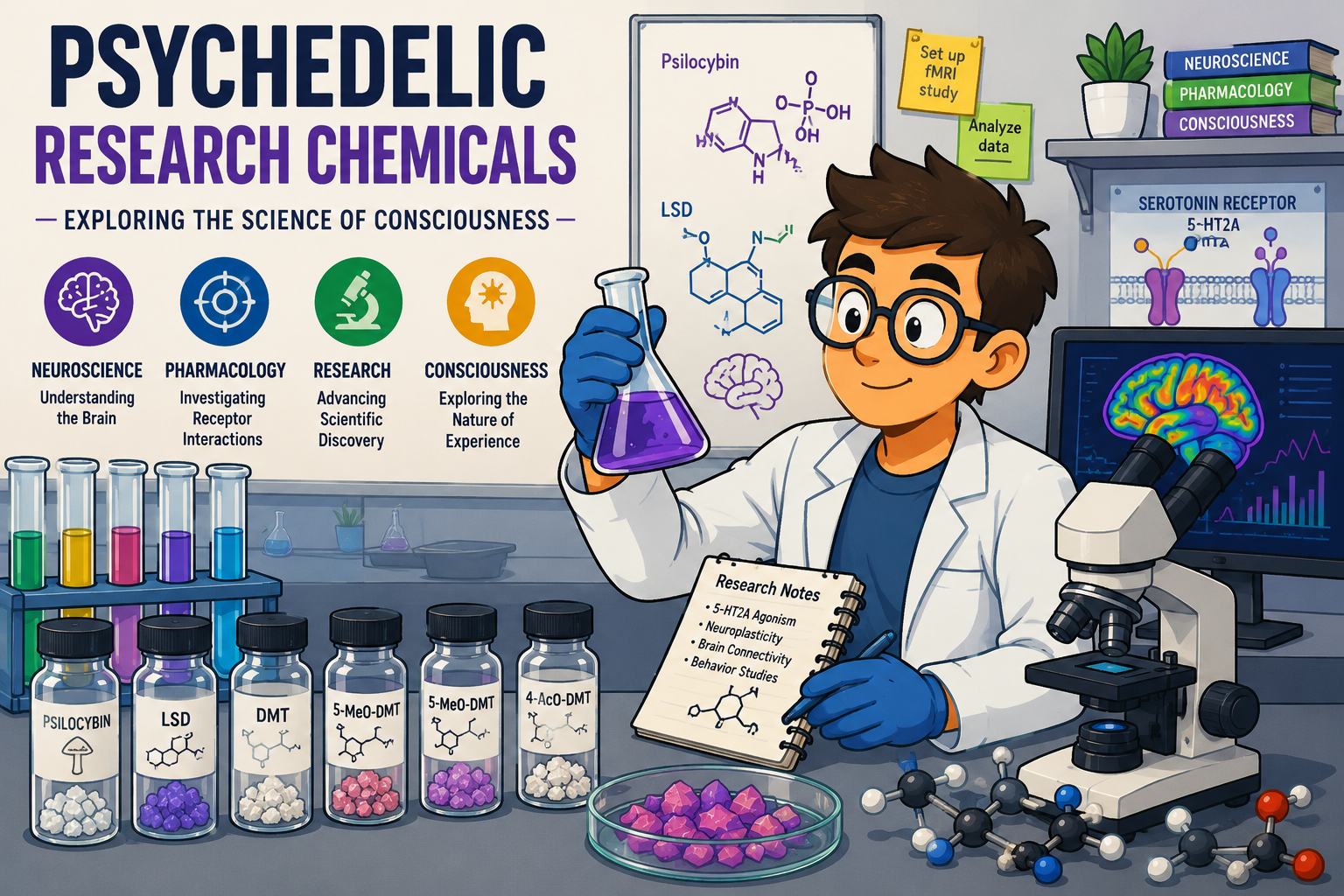
Advances in Neuroscience Through Psychedelic Research
The field of neuroscience has benefited significantly from psychedelic research.
Brain Connectivity Mapping
Studies suggest that psychedelic compounds can temporarily alter communication between different brain regions.
Researchers use these effects to investigate:
- Network dynamics
- Information flow
- Functional connectivity
- Cognitive integration
Understanding these mechanisms may help reveal how complex mental experiences emerge from neural activity.
Default Mode Network Research
The Default Mode Network (DMN) is associated with self-referential thought and internal mental processing.
Research indicates that psychedelic compounds can influence DMN activity, providing insights into:
- Self-awareness
- Introspection
- Identity formation
- Conscious experience
Cognitive Flexibility Studies
Scientists are particularly interested in how psychedelic compounds affect adaptability in thinking.
Research explores:
- Creative problem-solving
- Learning processes
- Pattern recognition
- Behavioral flexibility
These findings contribute to broader cognitive science theories.
The Role of Psychedelic Research Chemical in Pharmacology
Pharmacologists use psychedelic compounds to better understand neurotransmitter systems.
Key areas of study include:
Serotonin Receptor Function
Many psychedelic compounds interact with serotonin receptors, especially the 5-HT2A subtype.
Studying these interactions helps researchers understand:
- Mood regulation
- Perception
- Cognitive processing
- Neural signaling
Drug Discovery Research
Novel psychedelic analogues can provide valuable information for pharmaceutical development.
Researchers investigate:
- Molecular targets
- Receptor selectivity
- Biological activity
- Pharmacodynamic properties
These discoveries often influence broader drug development efforts.
Ethical and Regulatory Considerations
As scientific interest grows, ethical responsibility remains a fundamental component of psychedelic research.
Key considerations include:
- Institutional review board approval
- Participant safety
- Scientific transparency
- Regulatory compliance
- Data integrity
Responsible research practices ensure that scientific investigations maintain the highest standards of quality and credibility.
Challenges Facing Psychedelic Research
Although progress has accelerated, researchers continue to face several challenges.
Regulatory Complexity
Scientific studies often require extensive regulatory approvals and oversight.
Funding Limitations
Research funding remains competitive despite increasing public and institutional interest.
Public Misunderstanding
Many misconceptions regarding psychedelic compounds can influence public perception of legitimate scientific research.
Educational outreach and transparent communication remain essential for promoting informed discussion.
The Future of Psychedelic Research Chemical
The future of psychedelic science appears exceptionally promising.
Several emerging trends are shaping the field.
Precision Neuropharmacology
Scientists are designing increasingly selective compounds that target specific neural pathways.
Artificial Intelligence in Drug Discovery
Machine learning technologies are helping researchers identify promising molecular structures more efficiently.
Advanced Brain Imaging
Next-generation imaging systems will provide deeper insights into how psychedelic compounds influence neural activity.
Consciousness Science
Researchers continue to use psychedelic compounds as tools for investigating one of the most profound questions in science: how consciousness arises from biological processes.
Why Psychedelic Research Matters
Psychedelic research chemicals are valuable because they provide unique opportunities to study the brain in ways that would otherwise be difficult or impossible.
Through rigorous scientific investigation, researchers can:
- Explore consciousness
- Understand neural communication
- Examine cognitive flexibility
- Investigate perception mechanisms
- Advance neuropharmacology
- Improve scientific understanding of human cognition
These contributions extend far beyond psychedelic science and influence numerous areas of neuroscience, psychology, and biomedical research.
Conclusion
Psychedelic research chemicals represent an exciting frontier in modern scientific discovery. By providing researchers with powerful tools for exploring brain function, consciousness, and neurobiology, these compounds continue to expand our understanding of the human mind.
As technology advances and scientific methodologies evolve, psychedelic research is likely to play an increasingly important role in neuroscience, pharmacology, psychology, and cognitive science. Through responsible and rigorous investigation, researchers are unlocking new insights that may shape the future of brain research and deepen our understanding of consciousness itself.
The growing body of scientific evidence demonstrates that they are not merely subjects of curiosity—they are valuable instruments driving some of the most important discoveries in contemporary neuroscience and psychological science.
