- Your cart is empty
- Continue Shopping


DCK HCl Guide: Chemistry, Pharmacology, Effects, Risks, and Research
- Guides
- Posted on
-
by admin
- 0 comments
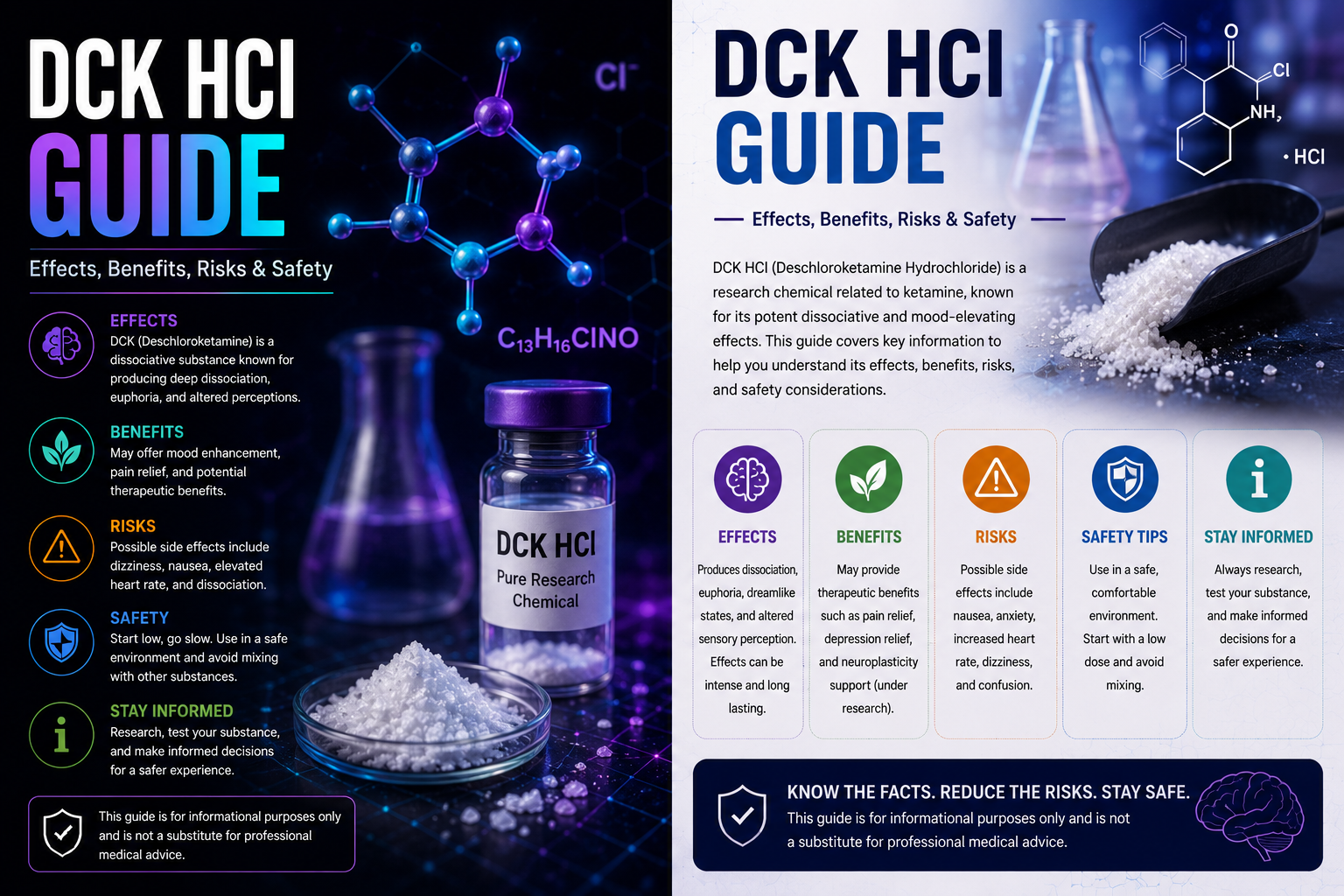
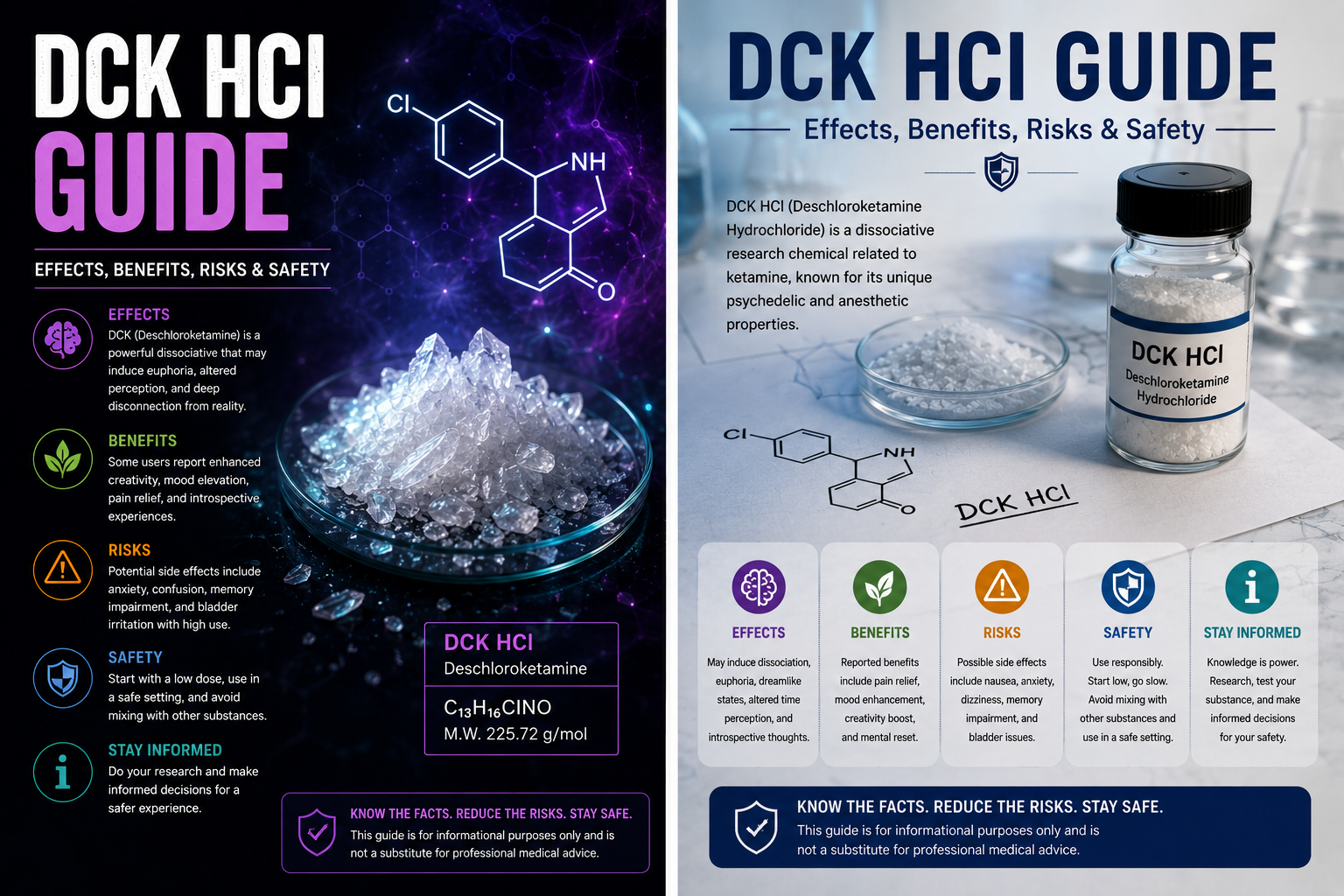
DCK HCl Guide:
DCK HCl, commonly referring to the hydrochloride salt form of deschloroketamine (DCK), is a synthetic arylcyclohexylamine and dissociative compound structurally related to ketamine. It has appeared in forensic toxicology and research-chemical literature as a non-medical psychoactive substance.
Although DCK shares important structural and pharmacological characteristics with ketamine, it is not the same compound, and information about medically supervised ketamine treatment cannot simply be transferred to DCK. Scientific research into deschloroketamine remains comparatively limited, particularly in humans.
This DCK HCl guide examines the compound’s chemistry, relationship to ketamine, pharmacology, reported effects, research history, analytical identification, potential risks, legal considerations, and the major gaps in current scientific knowledge.
Important: This article is for educational and scientific information only. It does not provide instructions for synthesizing, preparing, dosing, obtaining, or using DCK HCl. DCK is not an established medical treatment, and its safety profile in humans has not been adequately characterized.
What Is DCK HCl?
DCK stands for deschloroketamine, also known as 2-(methylamino)-2-phenylcyclohexan-1-one. It is an arylcyclohexylamine that was developed as a chemical analogue of ketamine.
The “deschloro” portion of the name refers to the absence of the chlorine atom found on ketamine’s phenyl ring. This seemingly small structural difference creates a distinct chemical compound with its own pharmacological properties.
PubChem identifies deschloroketamine with the molecular formula C13H17NO, a molecular weight of approximately 203.28 g/mol, and CAS Registry Number 7063-30-1. Its IUPAC name is 2-(methylamino)-2-phenylcyclohexan-1-one. (PubChem)
DCK HCl refers to a hydrochloride salt form. In general chemistry, converting an amine-containing compound into a hydrochloride salt produces a protonated form associated with chloride. Salt formation can influence properties such as molecular weight, crystallinity, handling, and solubility.
It is therefore important to distinguish between:
- DCK/free-base deschloroketamine
- DCK hydrochloride
- DCK analogues, such as 2F-DCK
- Ketamine hydrochloride
These are chemically related but are not interchangeable substances.
DCK HCl Chemical Classification
DCK belongs to the arylcyclohexylamine family.
Arylcyclohexylamines include several well-known dissociative compounds, including ketamine, phencyclidine (PCP), and various newer analogues. A major structural feature of this family is the combination of an aromatic ring with a cyclohexanone or related cyclic structure and an amine-containing group.
A scientific review of arylcyclohexylamine derivatives identifies DCK as 2-(methylamino)-2-phenylcyclohexan-1-one and places it among ketamine-like compounds. (PubMed Central (PMC))
The compound’s key identifiers include:
| Property | Deschloroketamine |
|---|---|
| Common abbreviation | DCK |
| Chemical name | Deschloroketamine |
| IUPAC name | 2-(methylamino)-2-phenylcyclohexan-1-one |
| Molecular formula | C13H17NO |
| Molecular weight | 203.28 g/mol |
| CAS number | 7063-30-1 |
| Chemical family | Arylcyclohexylamine |
| Pharmacological class | Dissociative anesthetic analogue |
| Structural relationship | Ketamine analogue |
These identifiers describe the parent compound. A hydrochloride salt has a different molecular composition and molecular weight because of the associated hydrochloride component.
What Does “HCl” Mean?
The abbreviation HCl stands for hydrochloride in the context of drug and chemical salts.
Many amine-containing compounds can exist as free bases or acid-addition salts. When the amine is protonated with hydrochloric acid, the resulting material can be described as a hydrochloride.
For DCK, the parent molecule contains a secondary amine. The hydrochloride form can therefore be represented as a protonated DCK species paired with chloride.
This distinction matters when interpreting chemical databases, laboratory results, product documentation, or molecular-weight calculations.
It also explains why two records describing apparently the same active compound may show different formulas or molecular weights.
The hydrochloride designation does not mean that DCK HCl is ketamine hydrochloride. Ketamine hydrochloride is a different molecule containing a chlorine substituent on the phenyl ring in addition to the hydrochloride counterion. PubChem lists ketamine hydrochloride separately with the formula C13H17Cl2NO. (PubChem)
DCK vs. Ketamine
DCK is often described as a deschloro analogue of ketamine.
The two molecules share a closely related core structure. The most obvious difference is that ketamine has a chlorine substituent on its phenyl ring, whereas DCK does not.
That distinction is chemically meaningful.
Ketamine has a long-established history in medicine as an anesthetic and, in some jurisdictions and formulations, as a treatment associated with specific clinical indications. DCK does not have the same clinical evidence base or regulatory status.
The comparison can be summarized as follows:
| Feature | DCK | Ketamine |
|---|---|---|
| Full name | Deschloroketamine | Ketamine |
| Core family | Arylcyclohexylamine | Arylcyclohexylamine |
| Phenyl chlorine | Absent | Present |
| NMDA activity | Demonstrated in research | Well established |
| Medical approval | No established approved indication | Yes, for specific medical uses |
| Human research | Limited | Extensive compared with DCK |
| Clinical safety database | Limited | Substantial relative to DCK |
The structural similarity helps explain why DCK can show ketamine-like pharmacological characteristics, but it should never be interpreted as evidence that DCK is simply “ketamine without chlorine.”
How Was DCK Developed?
Deschloroketamine is not a newly invented substance.
Chemical literature indicates that DCK was synthesized decades ago. However, it did not become prominent in recreational drug markets until much later.
A review of arylcyclohexylamines reports that DCK was synthesized by Stevens in 1962, while misuse and forensic reports emerged much later, particularly during the 2010s. The same review identifies DCK and 2F-DCK as among the less extensively characterized ketamine-related arylcyclohexylamines. (PubMed Central (PMC))
This distinction between chemical discovery and modern recreational emergence is important.
A compound can exist in chemical literature for decades without having undergone the extensive toxicological, pharmacokinetic, and clinical testing expected of an approved pharmaceutical.
Pharmacology of DCK
The most important known pharmacological characteristic of DCK is its activity at the N-methyl-D-aspartate (NMDA) receptor.
The NMDA receptor is a type of glutamate receptor found throughout the central nervous system. It plays an important role in excitatory neurotransmission, learning, memory, synaptic plasticity, and sensory processing.
Blocking NMDA receptor signaling can produce dissociative effects, including alterations in perception, cognition, body awareness, and the sense of connection between the individual and their surroundings.
Research published in the British Journal of Pharmacology investigated the pharmacokinetic, pharmacodynamic, and behavioral characteristics of DCK in rats. The researchers found that DCK crossed the blood-brain barrier rapidly and demonstrated antagonist activity at NMDA receptors comparable to ketamine in the experimental model. (PubMed)
The same study reported differences between DCK’s enantiomers, with S-DCK showing greater activity in several experimental measures. (PubMed)
These findings help explain why DCK is classified pharmacologically alongside ketamine-like dissociatives.
However, animal research cannot establish that the same effects, potency, duration, or risks will occur in humans.
DCK and NMDA Receptor Antagonism
Understanding NMDA antagonism provides useful context for the subjective effects associated with DCK.
Under normal conditions, glutamate can activate NMDA receptors and contribute to neuronal signaling. An NMDA antagonist reduces signaling through these receptors.
Ketamine is a well-known example of an NMDA receptor antagonist, and DCK has demonstrated similar activity in experimental research.
The consequences can include altered integration of sensory information and changes in perception and cognition.
Researchers are particularly interested in NMDA receptor antagonists because they can produce unusual combinations of:
- Dissociation
- Analgesia
- Altered perception
- Changes in sensory processing
- Cognitive disruption
- Changes in consciousness
At the same time, these pharmacological effects can also create significant risks, particularly when a person becomes confused, physically uncoordinated, or unable to accurately judge their surroundings.
Reported Effects of DCK
Information about the subjective effects of DCK comes primarily from observational reports, forensic literature, and limited experimental research.
Reported effects associated with DCK and related dissociatives may include:
- Feelings of detachment from the body
- Altered perception of surroundings
- Distortion of time
- Changes in sound and visual perception
- Reduced awareness of physical sensations
- Cognitive disorganization
- Sedation or stimulation
- Impaired coordination
- Memory disruption
- Changes in mood
- Strong dissociative experiences
The exact experience can vary significantly.
A particularly important limitation is that there are not enough controlled human studies to establish a reliable, standardized profile of DCK’s effects.
A 2021 animal study found that DCK produced behavioral effects broadly comparable with ketamine and reported a somewhat slower pharmacokinetic profile, which the authors noted was consistent with reports of a longer duration of action. (PubMed)
That finding should not be interpreted as establishing a predictable duration in humans.
DCK Duration and Pharmacokinetics
One reason DCK has attracted attention is its reported duration relative to ketamine.
In animal research, DCK demonstrated a pharmacokinetic profile that was somewhat slower than ketamine. Researchers observed rapid brain penetration, with maximum brain concentrations occurring approximately 30 minutes after administration in the rat model and remaining elevated at two hours. (PubMed)
However, translating animal pharmacokinetic findings into human timelines is scientifically inappropriate without controlled human studies.
Factors that can influence drug disposition include:
- Route of exposure
- Absorption
- Metabolism
- Liver enzyme activity
- Age
- Body composition
- Other medications
- Genetic differences
- Kidney and liver function
- Individual physiology
Therefore, claims online describing DCK as having a specific universal onset, peak, or duration should be treated cautiously.
DCK Enantiomers
DCK has a stereochemical dimension that is particularly relevant to pharmacology.
The molecule can exist as different enantiomers, which are mirror-image forms of the same molecular structure.
Research has investigated both S-DCK and R-DCK. The 2021 Wistar-rat study found that S-DCK generally showed greater activity than its R-enantiomer in several experimental measures. (PubMed)
This is an important reminder that chemical identity alone does not always describe the complete pharmacological profile.
Two stereoisomers can interact differently with biological targets despite having the same molecular formula.
Modern medicinal chemistry therefore considers:
- Molecular structure
- Stereochemistry
- Receptor affinity
- Receptor efficacy
- Metabolism
- Distribution
- Clearance
when evaluating psychoactive compounds.
DCK vs. 2F-DCK
DCK is also frequently confused with 2F-DCK, or 2-fluorodeschloroketamine.
Both are arylcyclohexylamines and both are ketamine-related dissociatives, but 2F-DCK contains an additional fluorine atom on the aromatic ring.
PubChem identifies 2F-DCK hydrochloride as 2-(2-fluorophenyl)-2-(methylamino)cyclohexan-1-one hydrochloride and lists a molecular formula of C13H17ClFNO for the hydrochloride salt. (PubChem)
DCK itself does not contain that aromatic fluorine substituent.
This difference can affect pharmacology, metabolism, analytical detection, and biological activity.
Forensic laboratories therefore need analytical techniques capable of distinguishing closely related compounds rather than relying solely on broad drug-class screening.
DCK in Forensic Toxicology
DCK has become relevant to forensic and clinical toxicology because of its appearance among novel psychoactive substances.
The expansion of synthetic drug markets has created a continuing challenge for laboratories because new analogues may appear faster than conventional screening assays can be updated.
An Interpol review of drug-analysis literature describes analytical identification of DCK and other ketamine analogues using advanced methods. These include techniques such as LC-MS/MS, LC-HRMS, GC-MS, and nuclear magnetic resonance (NMR) depending on the analytical context. (PubMed Central (PMC))
This is important because conventional immunoassay screening may not reliably identify every emerging analogue.
Specialized mass-spectrometric and chromatographic techniques can provide much stronger evidence of chemical identity.
Why Laboratory Identification Matters
The appearance of an unknown powder or crystalline material cannot establish that it is DCK HCl.
Even substances sold under a specific chemical name can potentially contain:
- Another psychoactive compound
- A related analogue
- Manufacturing impurities
- Residual solvents
- Degradation products
- An incorrect concentration
- Multiple compounds
Forensic laboratories therefore use validated analytical methods rather than relying on color, texture, crystal appearance, or labeling.
This distinction is particularly important with novel psychoactive substances because closely related arylcyclohexylamines can have similar physical appearances but different molecular structures.
Potential Risks of DCK
DCK presents several areas of concern because its human safety profile remains incompletely understood.
Dissociation and impaired judgment
Strong dissociation can interfere with awareness, coordination, memory, and environmental judgment.
This can create indirect physical risks even when the substance itself does not directly produce severe toxicity.
Cognitive impairment
NMDA receptor antagonism can disrupt normal cognitive processing.
Confusion, impaired short-term memory, and difficulty interpreting sensory information may occur with dissociative substances.
Cardiovascular and autonomic effects
Ketamine-like compounds can affect physiological variables such as heart rate and blood pressure. The exact profile of DCK in humans remains insufficiently characterized.
Loss of coordination
Altered balance and motor control can increase the risk of falls, accidents, drowning, traffic injuries, and other environmental hazards.
Psychological effects
Dissociative states can sometimes involve anxiety, agitation, panic, confusion, or disturbing perceptual experiences.
Unknown long-term consequences
One of the most important unanswered questions concerns repeated or prolonged exposure.
There is insufficient high-quality human evidence to establish the long-term neurological, psychiatric, cardiovascular, urinary, or other health consequences of DCK.
DCK and Dependence Potential
DCK should not be considered risk-free simply because it is described as a “research chemical.”
The animal study published in the British Journal of Pharmacology specifically investigated addictive potential and found that DCK produced place-preference effects in rats, alongside other behavioral changes. (PubMed)
Animal findings do not establish that humans will develop dependence in exactly the same way, but they provide a scientific reason to take the possibility of reinforcement and repeated use seriously.
Frequent exposure to psychoactive dissociatives can also produce tolerance and escalating patterns of use, although the specific characteristics of DCK dependence in humans require substantially more research.
DCK Drug Interactions
Interactions represent another major area of uncertainty.
DCK affects the central nervous system, and combining it with other psychoactive substances can produce effects that are difficult to predict.
Particular concern exists with combinations involving other:
- Central nervous system depressants
- Dissociatives
- Sedatives
- Psychoactive drugs
- Substances that alter consciousness
Combining multiple psychoactive compounds can make it difficult to determine which substance is responsible for an adverse reaction and may amplify impairment.
Because controlled interaction research on DCK is limited, there is no scientifically reliable list of combinations that can be considered universally safe.
Is DCK HCl the Same as Ketamine HCl?
No.
This is one of the most important distinctions to understand.
DCK HCl is the hydrochloride salt of deschloroketamine.
Ketamine HCl is the hydrochloride salt of ketamine.
Although both compounds belong to the arylcyclohexylamine family and interact with NMDA receptors, their molecular structures are different.
Ketamine contains a chlorine substituent on its phenyl ring. DCK does not.
Furthermore, ketamine has undergone extensive clinical development and regulatory review, whereas DCK has not undergone an equivalent clinical development pathway.
The existence of pharmacological similarities therefore does not make the substances medically interchangeable.
Is DCK HCl FDA Approved?
DCK HCl is not an established FDA-approved medication.
This distinction is particularly important when reading online descriptions of research chemicals.
A chemical can have a PubChem entry, a CAS number, scientific publications, and documented receptor activity without being an approved therapeutic drug.
The existence of laboratory research does not establish clinical efficacy or safety.
DCK should therefore not be marketed or described as an approved treatment for depression, anxiety, PTSD, chronic pain, addiction, or other medical conditions without appropriate clinical evidence.
Legal Status of DCK
The legal status of DCK varies by jurisdiction and can change over time.
Some countries regulate individual novel psychoactive substances by name, while others use broader analogue or psychoactive-substance laws.
In some locations, DCK may be controlled directly; elsewhere, its legal status may depend on how local law defines analogues, psychoactive substances, or intended use.
For this reason, it is not accurate to make a universal statement that DCK is “legal” or “illegal.”
Anyone researching the regulatory status of DCK should consult current legislation and official government sources in the relevant jurisdiction.
Online availability does not establish legality.
Research Limitations
The biggest challenge in understanding DCK is the relatively small amount of high-quality human evidence.
Research has established several important facts about its chemistry and pharmacology, including its structural relationship to ketamine and its NMDA receptor antagonist activity.
However, major questions remain.
Researchers still need better evidence concerning:
- Human pharmacokinetics
- Human pharmacodynamics
- Metabolic pathways
- Toxicity
- Long-term neurological effects
- Cardiovascular effects
- Psychiatric effects
- Dependence potential
- Drug interactions
- Therapeutic potential
- Differences between enantiomers
- Effects of repeated exposure
Until more research is available, online claims about DCK should be evaluated according to the quality of their evidence.
A laboratory experiment, an animal study, an anecdotal report, and a controlled human clinical trial do not provide equivalent levels of evidence.
Frequently Asked Questions About DCK HCl
What does DCK stand for?
DCK stands for deschloroketamine, a synthetic arylcyclohexylamine structurally related to ketamine.
What does HCl mean in DCK HCl?
HCl refers to the hydrochloride salt form of DCK. It indicates that the amine-containing compound has been converted into an acid-addition salt.
What is the molecular formula of DCK?
PubChem lists deschloroketamine with the molecular formula C13H17NO and molecular weight approximately 203.28 g/mol. (PubChem)
Is DCK the same as ketamine?
No. DCK is a structural analogue of ketamine but is chemically distinct.
Does DCK act on NMDA receptors?
Yes. Experimental research has demonstrated NMDA receptor antagonist activity for DCK. (PubMed)
Is DCK a psychedelic?
DCK is more accurately classified as a dissociative rather than a classic serotonergic psychedelic. Its primary pharmacological association is with NMDA receptor antagonism.
Is DCK HCl medically approved?
No established medical approval exists for DCK HCl.
Is DCK the same as 2F-DCK?
No. 2F-DCK contains a fluorine substitution that DCK does not have. (PubChem)
Can DCK be identified by appearance?
No. Reliable identification requires appropriate chemical analysis.
Is DCK safe?
Its safety profile has not been adequately established in controlled human studies. Research indicates pharmacological similarities to ketamine but does not establish DCK as a safe medical substitute. (PubMed)
Conclusion
DCK HCl, the hydrochloride salt form of deschloroketamine, is a synthetic arylcyclohexylamine that has attracted attention because of its structural and pharmacological relationship to ketamine.
DCK is chemically defined as 2-(methylamino)-2-phenylcyclohexan-1-one, with PubChem reporting a molecular formula of C13H17NO for the parent compound. (PubChem)
Research indicates that DCK acts as an NMDA receptor antagonist and can produce dissociative-like effects in experimental models. Animal pharmacology research has also found meaningful similarities to ketamine while identifying differences in pharmacokinetics and activity between DCK enantiomers. (PubMed)
Its emergence as a novel psychoactive substance has also made DCK relevant to forensic science. Modern analytical methods such as mass spectrometry and chromatography are increasingly important for distinguishing DCK from ketamine, 2F-DCK, and other structurally related compounds. (PubMed Central (PMC))
However, the most important conclusion is that DCK remains poorly characterized compared with established pharmaceutical compounds. Limited human evidence means that its long-term safety, interaction profile, dependence potential, and broader health consequences remain uncertain.
For anyone researching DCK HCl, the most reliable approach is to distinguish established chemical facts from anecdotal claims and to recognize the difference between laboratory pharmacology and clinically demonstrated safety.
DCK is scientifically interesting precisely because it illustrates how a relatively small structural change to a known pharmaceutical scaffold can produce a distinct psychoactive compound—and why rigorous pharmacological and toxicological research is essential before drawing conclusions about its effects or medical potential.