- Your cart is empty
- Continue Shopping


Does PRP Treatment Block DHT? Understanding the Science Behind PRP and Hair Loss
- Guides
- Posted on
-
by admin
- 0 comments

Does PRP Treatment Block DHT?
Platelet-Rich Plasma (PRP) therapy has become one of the most discussed non-surgical hair restoration treatments in recent years. Men and women experiencing hair thinning often turn to PRP because it uses the body’s own growth factors to support hair follicle health and encourage hair growth.
However, one common question continues to arise:
Does PRP treatment block DHT?
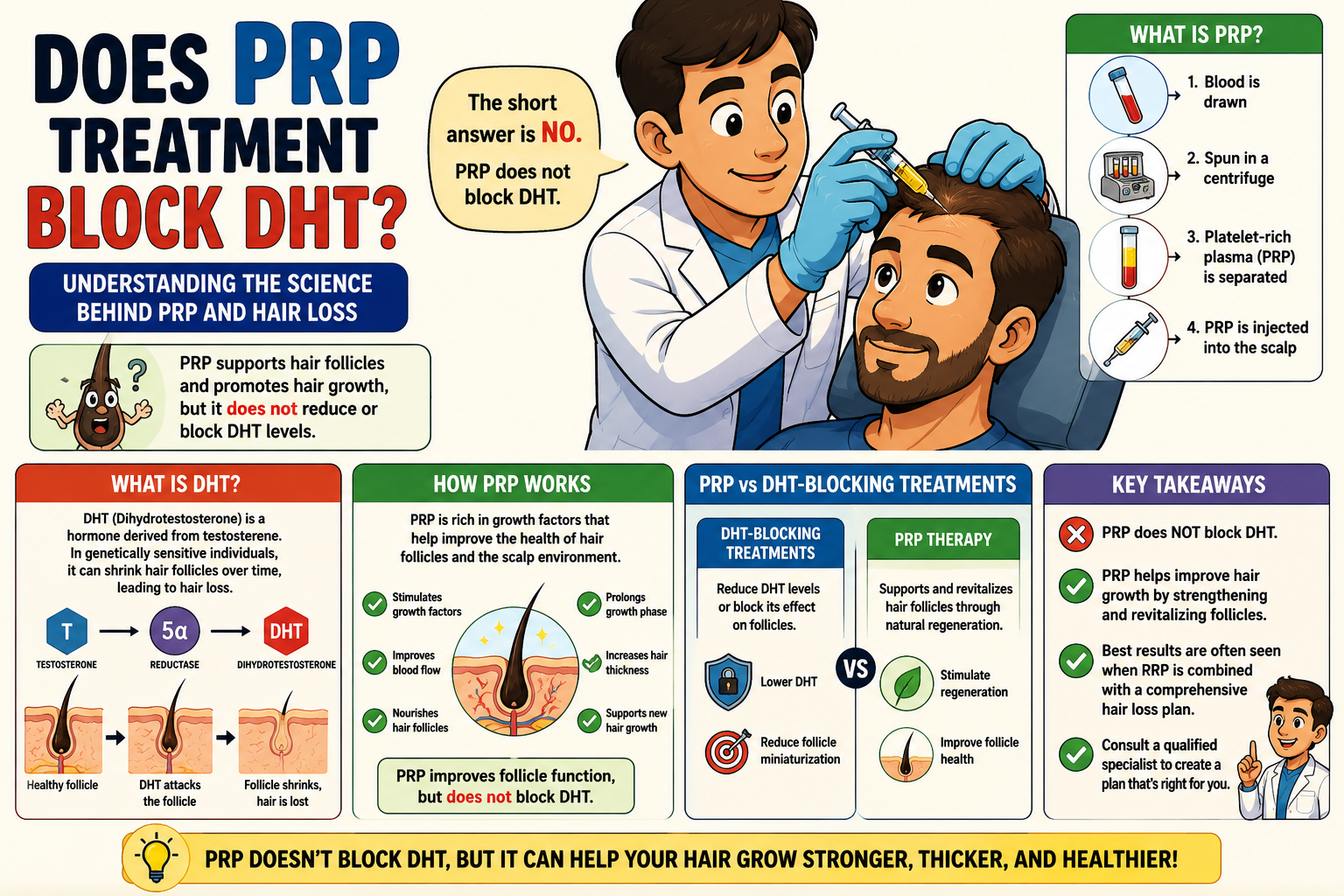
The short answer is no. PRP therapy does not directly block dihydrotestosterone (DHT), the hormone most commonly associated with androgenetic alopecia, also known as male and female pattern hair loss.
Instead, PRP works through a different mechanism. Rather than reducing DHT levels, PRP aims to improve the health, activity, and survival of hair follicles by delivering concentrated growth factors derived from the patient’s own blood.
Understanding this distinction is important for anyone considering PRP as part of a comprehensive hair restoration strategy.
What Is DHT?
Dihydrotestosterone (DHT) is a hormone derived from testosterone through the action of an enzyme called 5-alpha reductase.
DHT plays important roles in:
- Male development
- Sexual maturation
- Hair growth patterns
- Prostate function
While DHT is a normal and necessary hormone, some individuals possess genetically sensitive hair follicles that react negatively to DHT exposure.
Over time, this sensitivity can lead to:
- Follicle miniaturization
- Thinner hair strands
- Reduced hair density
- Progressive hair loss
This process is known as androgenetic alopecia.
Why Is DHT Important in Hair Loss?
In genetically susceptible individuals, DHT binds to androgen receptors within hair follicles.
This interaction may cause:
Shortened Growth Cycles
Hair spends less time in the active growth phase.
Follicle Miniaturization
Hair follicles gradually become smaller.
Thinner Hair Production
Each new hair strand may emerge finer and weaker.
Eventual Follicle Dormancy
In advanced stages, affected follicles may stop producing visible hair.
Because DHT is a primary contributor to androgenetic hair loss, many treatments specifically target DHT production or activity.
What Is PRP Therapy?
Platelet-Rich Plasma (PRP) therapy is a regenerative treatment that utilizes concentrated platelets obtained from a patient’s blood.
The process generally involves:
- Drawing a small blood sample.
- Processing the blood in a centrifuge.
- Separating platelet-rich plasma.
- Injecting the concentrated plasma into targeted areas of the scalp.
Platelets contain numerous growth factors and signaling molecules that support tissue repair and regeneration.
How Does PRP Work for Hair Loss?
PRP therapy focuses on improving follicular function rather than altering hormone levels.
Researchers believe PRP may help by:
Stimulating Growth Factors
Platelets release biologically active proteins that support cellular repair and regeneration.
Improving Blood Supply
Enhanced circulation may improve nutrient delivery to hair follicles.
Supporting Follicle Survival
Growth factors may help strengthen weakened follicles.
Extending the Growth Phase
PRP may encourage hair follicles to remain in the active growth phase longer.
Promoting Cellular Activity
The treatment may stimulate stem cells and other follicular components involved in hair production.
Does PRP Reduce DHT Levels?
Current evidence suggests that PRP does not directly lower DHT levels.
Unlike medications designed to inhibit 5-alpha reductase activity, PRP does not appear to:
- Block DHT production
- Prevent testosterone conversion to DHT
- Reduce systemic androgen levels
- Directly interfere with androgen receptors
Therefore, DHT remains present in the scalp following PRP treatment.
If PRP Doesn’t Block DHT, Why Does It Help Hair Growth?
This is one of the most important concepts to understand.
PRP addresses hair loss from a regenerative perspective.
Instead of removing the hormonal trigger, it attempts to improve the follicle’s ability to survive and function despite ongoing DHT exposure.
Think of it as supporting the health of vulnerable follicles rather than eliminating the hormone that contributes to their decline.
For many patients, this approach may improve:
- Hair thickness
- Hair density
- Hair quality
- Overall scalp health
PRP vs DHT-Blocking Treatments
Understanding the difference between PRP and DHT-targeted therapies can help set realistic expectations.
DHT-Blocking Approaches
These treatments aim to reduce the impact of DHT on hair follicles.
Their primary goal is hormone management.
PRP Therapy
PRP focuses on:
- Regeneration
- Follicular stimulation
- Tissue repair
- Growth factor delivery
Its primary goal is follicle support and revitalization.
Because the mechanisms differ, some hair restoration specialists use PRP alongside other evidence-based treatments as part of a comprehensive management strategy.
What Does the Research Say?
Clinical studies investigating PRP for androgenetic alopecia have reported encouraging findings.
Research has examined:
- Hair density
- Hair thickness
- Hair count
- Patient satisfaction
- Follicular activity
Many studies suggest that PRP may improve several hair growth parameters in appropriately selected patients.
However, outcomes can vary depending on:
- Genetics
- Age
- Hair loss severity
- Treatment protocol
- Individual biological response
Additional long-term studies continue to evaluate optimal treatment approaches.
Who May Benefit From PRP?
PRP may be considered for individuals experiencing:
Early Hair Thinning
Patients with active follicles often achieve better results.
Male Pattern Hair Loss
PRP is frequently used as part of androgenetic alopecia treatment plans.
Female Pattern Hair Loss
Women experiencing diffuse thinning may also benefit.
Hair Restoration Support
PRP is sometimes used alongside hair transplant procedures to support recovery and follicle health.
Advantages of PRP Therapy
Potential benefits include:
- Minimally invasive procedure
- Uses the patient’s own blood
- No surgical incisions
- Relatively short treatment sessions
- Supports natural regenerative processes
Because PRP is derived from the patient’s blood, concerns regarding allergic reactions are generally reduced.
Limitations of PRP
While PRP has gained popularity, it is important to recognize its limitations.
Not a DHT Blocker
PRP does not eliminate the hormonal cause of androgenetic alopecia.
Variable Results
Not every patient responds equally.
Maintenance Treatments
Results may require periodic follow-up sessions.
Advanced Hair Loss Challenges
Patients with extensive follicle loss may experience more limited outcomes.
Frequently Asked Questions
Does PRP stop male pattern baldness?
PRP may help improve hair growth and follicle health, but it does not directly stop the hormonal mechanisms involved in male pattern hair loss.
Can PRP regrow lost hair?
Some studies suggest PRP may stimulate growth in weakened follicles, although results vary among individuals.
Is PRP better than DHT-blocking treatments?
PRP and DHT-targeted therapies work through different mechanisms and address different aspects of hair loss.
How long do PRP results last?
Results vary depending on the individual, treatment schedule, and ongoing hair loss progression.
Conclusion
PRP therapy has become a valuable tool in modern hair restoration because it supports follicle health through regenerative mechanisms. However, it is important to understand that PRP does not directly block DHT. Instead, it works by delivering concentrated growth factors that may improve follicular function, circulation, and hair growth activity.
For individuals experiencing androgenetic alopecia, PRP offers a unique approach focused on regeneration rather than hormone suppression. Understanding the distinction between DHT-blocking therapies and PRP can help patients make informed decisions and develop realistic expectations regarding treatment outcomes.
As research in regenerative medicine continues to evolve, PRP remains an important area of investigation for improving hair restoration and follicular health.
