- Your cart is empty
- Continue Shopping


Flunitazene Guide: Chemistry, Pharmacology, Effects, Risks, and Research
- Guides
- Posted on
-
by admin
- 0 comments
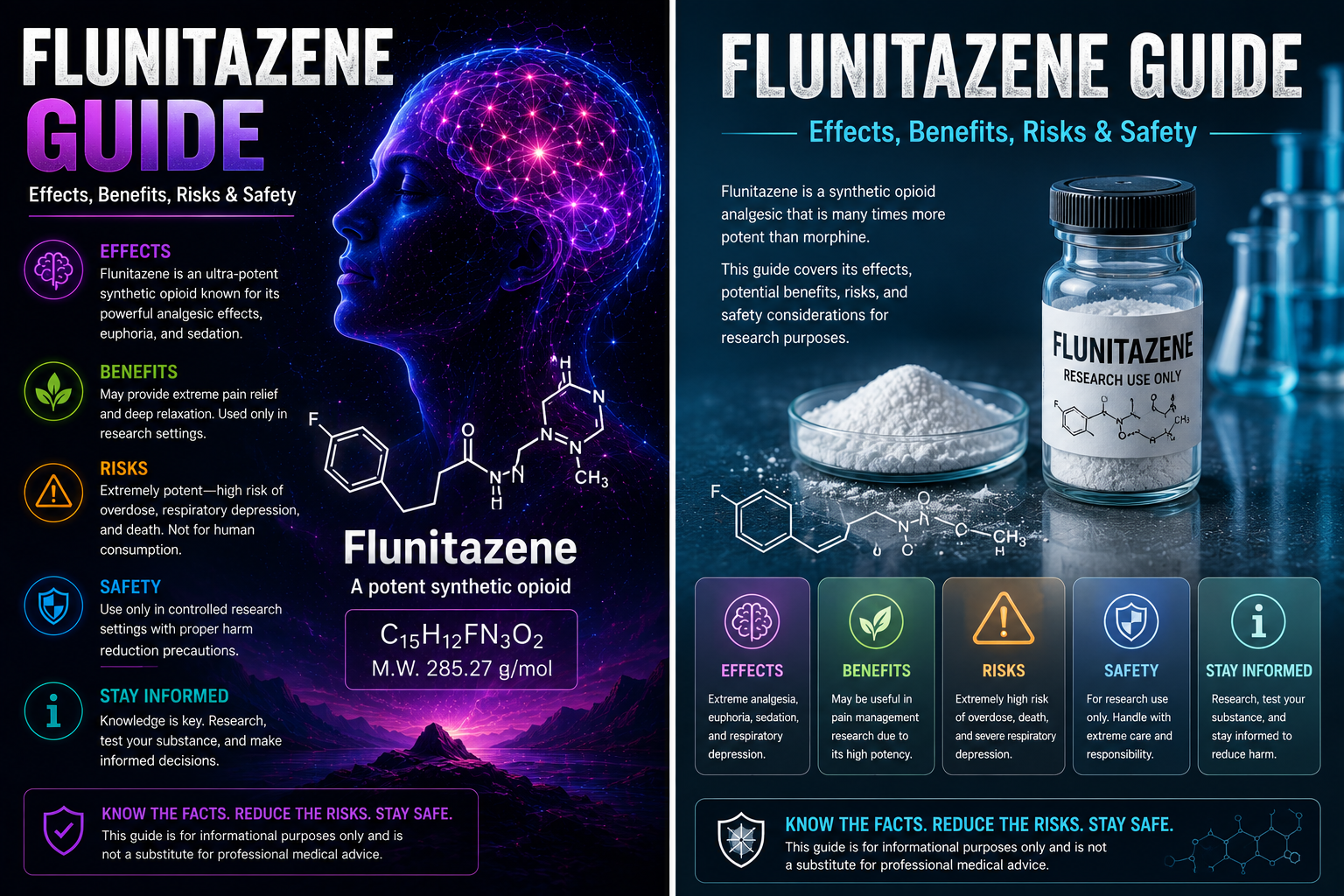
Flunitazene Guide:
Flunitazene is a synthetic opioid belonging to the benzimidazole opioid family. It is structurally related to other nitazene compounds, a group of potent synthetic opioids that have become increasingly important in forensic toxicology and public-health research.
Flunitazene is particularly relevant because nitazene opioids can produce powerful opioid receptor activity while differing significantly from conventional pharmaceutical opioids. The class includes compounds such as isotonitazene, metonitazene, protonitazene, and etonitazene.
Unlike approved opioid medicines, flunitazene has not been established as a standard therapeutic drug. Human pharmacological and toxicological data remain limited, while evidence from laboratory studies, forensic investigations, and broader nitazene research indicates that these substances can present serious overdose and respiratory-depression risks.
This Flunitazene guide examines the compound’s chemical classification, molecular structure, pharmacology, relationship to other nitazenes, reported effects, health risks, overdose concerns, analytical identification, legal considerations, and current research.
Important: This article is provided for educational and scientific purposes. It does not provide instructions for synthesizing, preparing, obtaining, dosing, or using flunitazene. Synthetic opioids in the nitazene family can be extremely dangerous, and their potency and toxicity may be difficult to predict.
What Is Flunitazene?
Flunitazene is a synthetic opioid belonging to the 2-benzylbenzimidazole, or nitazene, family.
Nitazene opioids were originally investigated decades ago during pharmaceutical research into potential analgesic compounds. Although some nitazene structures demonstrated substantial opioid activity, they did not become mainstream pharmaceutical medicines in the same way as morphine, oxycodone, fentanyl, or other established opioids.
In recent years, several nitazene analogues have emerged as novel synthetic opioids (NSOs) in illicit drug markets.
Flunitazene is one member of this broader family.
The term “nitazene” refers to a structural class rather than one single drug. Individual compounds differ according to substitutions attached to the benzimidazole and benzyl portions of the molecular framework.
These structural differences can significantly influence:
- Opioid receptor affinity
- Receptor efficacy
- Potency
- Pharmacokinetics
- Metabolism
- Duration of action
- Toxicity
- Analytical detection
Consequently, information about one nitazene should not automatically be treated as definitive evidence about another.
Chemical Classification
Flunitazene belongs to the benzimidazole opioid family.
The central chemical framework contains a benzimidazole ring system connected to a benzyl group, with additional substituents that distinguish the compound from related nitazenes.
Nitazene chemistry is particularly important because small changes to the molecular structure can produce substantial differences in opioid activity.
The broader family includes compounds such as:
- Etonitazene
- Metonitazene
- Isotonitazene
- Protonitazene
- Butonitazene
- Clonitazene
- N-Desethyl derivatives
- Other substituted benzimidazole opioids
Each is a distinct chemical substance.
The existence of a shared chemical scaffold does not mean that all nitazenes have equivalent potency or toxicological properties.
What Does the Name Flunitazene Mean?
The name flunitazene reflects the compound’s position within the nitazene family.
The “nitazene” portion identifies the broader benzimidazole opioid scaffold.
The “flu” portion is associated with the presence of a fluorine-containing substitution in the molecule.
Chemical nomenclature can be complicated because different databases, forensic reports, and publications may use systematic names, abbreviated names, or historical names.
For this reason, laboratories rely on chemical identifiers, reference standards, chromatographic behavior, and mass-spectrometric data rather than names alone.
This is particularly important with novel synthetic opioids because similarly named compounds may have different pharmacological profiles.
History of Nitazene Opioids
The history of nitazenes extends back to pharmaceutical research in the twentieth century.
Nitazene compounds were first investigated in the 1950s as potential analgesics. Researchers explored the benzimidazole scaffold in an effort to identify compounds with opioid activity.
Some early nitazenes demonstrated very strong analgesic properties in experimental models.
However, most did not progress into widely used medicines.
Decades later, several nitazene analogues began appearing in illicit drug markets.
The modern resurgence of nitazenes has created significant concern among forensic scientists and public-health authorities because some compounds can produce very strong µ-opioid receptor activity.
The emergence of nitazenes demonstrates how historical pharmaceutical research can later become relevant to the modern novel-psychoactive-substance landscape.
How Does Flunitazene Work?
The principal pharmacological target associated with flunitazene is the µ-opioid receptor (MOR).
µ-opioid receptors are widely distributed throughout the central and peripheral nervous systems and play important roles in:
- Pain perception
- Reward
- Respiration
- Consciousness
- Gastrointestinal function
- Stress responses
When an opioid activates these receptors, it can reduce pain signaling and produce sedation or euphoria.
However, excessive µ-opioid receptor activation can suppress the neural mechanisms responsible for normal breathing.
This creates the central danger associated with potent synthetic opioids.
A person experiencing severe opioid toxicity may become unconscious while breathing progressively more slowly and shallowly.
If untreated, respiratory depression can progress to respiratory arrest and death.
Why Nitazenes Are a Public-Health Concern
Nitazenes are concerning because several compounds in the class have demonstrated high opioid receptor activity.
The European Monitoring Centre for Drugs and Drug Addiction has reported the emergence of nitazene opioids across European drug markets and highlighted their potential to cause severe intoxication and overdose.
Nitazenes can also appear unexpectedly in drug samples sold as other substances.
This creates an additional risk because people may not know that they have been exposed to a potent synthetic opioid.
Forensic laboratories have increasingly developed specialized analytical methods to identify nitazenes and their metabolites.
Reported Effects of Flunitazene
Because controlled human studies involving flunitazene are limited, descriptions of its subjective effects must be interpreted cautiously.
Opioid-type effects associated with nitazene compounds may include:
- Analgesia
- Sedation
- Euphoria
- Relaxation
- Drowsiness
- Reduced alertness
- Slowed breathing
- Nausea
- Vomiting
- Itching
- Constipation
- Impaired coordination
The same pharmacological mechanisms responsible for analgesia and euphoria can also produce potentially fatal respiratory depression.
This is one reason it is inappropriate to evaluate a synthetic opioid solely according to its desirable subjective effects.
Respiratory Depression
Respiratory depression is the most important acute risk associated with potent opioids.
Normally, the brain automatically regulates breathing in response to changing oxygen and carbon dioxide concentrations.
Strong µ-opioid receptor activation can reduce this respiratory drive.
As poisoning progresses, a person may:
- Become unusually sleepy.
- Become difficult or impossible to wake.
- Develop slow, shallow, or irregular breathing.
- Develop reduced oxygen levels.
- Lose consciousness.
- Stop breathing.
Severe oxygen deprivation can cause permanent brain injury or death.
If an opioid overdose is suspected, emergency medical services should be contacted immediately. Where available, naloxone is an opioid antagonist used in emergency overdose response and can temporarily reverse opioid-induced respiratory depression while emergency medical care is obtained.
Signs of a Possible Opioid Overdose
Recognizing opioid toxicity can be lifesaving.
Warning signs can include:
- Very slow or absent breathing
- Extreme sleepiness
- Inability to wake the person
- Blue, gray, or pale lips or skin
- Gurgling or abnormal breathing
- Limpness
- Loss of consciousness
- Very small pupils
An apparently unconscious person should not simply be allowed to “sleep it off.”
Opioid poisoning can worsen rapidly, particularly when the substance’s identity or concentration is unknown.
Emergency medical assistance is appropriate when overdose is suspected.
Flunitazene and Dependence
Like other µ-opioid receptor agonists, nitazene compounds can raise concerns about tolerance, dependence, and addiction.
Repeated opioid exposure can cause neuroadaptations that reduce the effect of the same exposure over time.
This can produce tolerance, while continued exposure can lead to physical dependence.
When opioid exposure is suddenly stopped, withdrawal symptoms may occur.
Potential opioid withdrawal symptoms include:
- Restlessness
- Anxiety
- Sweating
- Muscle aches
- Insomnia
- Runny nose
- Gastrointestinal distress
- Irritability
- Strong cravings
The specific dependence profile of flunitazene is not as well characterized as that of established opioids.
Nevertheless, its classification as a synthetic opioid makes dependence an important safety consideration.
Flunitazene and Overdose Risk
Overdose risk is particularly concerning when dealing with novel synthetic opioids.
Several factors can make an individual exposure difficult to predict:
- Unknown concentration
- Mislabeling
- Variable purity
- Different opioid receptor activity
- Unknown metabolites
- Individual tolerance
- Co-exposure to other depressants
A person who believes they are taking a familiar substance may unknowingly encounter a nitazene analogue.
This is especially dangerous because opioid tolerance is substance-dependent and does not necessarily provide predictable protection against a novel opioid.
Combining Flunitazene With Other Depressants
Combining opioids with other central nervous system depressants can substantially increase the risk of respiratory depression.
Particular concern exists with:
- Alcohol
- Benzodiazepines
- Other opioids
- Sedative-hypnotic medicines
- Other drugs capable of suppressing consciousness or breathing
Multiple depressants can interact in ways that produce greater impairment than expected.
Because flunitazene has limited human interaction research, the safest scientific assumption is that combinations involving other respiratory depressants can be unpredictable and potentially dangerous.
Flunitazene vs. Fentanyl
Flunitazene and fentanyl are both synthetic opioids, but they belong to completely different chemical families.
Fentanyl belongs to the anilidopiperidine family.
Flunitazene belongs to the benzimidazole nitazene family.
Both can activate µ-opioid receptors, but their molecular structures and pharmacological profiles differ.
This distinction is important because the potency of one opioid cannot be used to calculate the potency of another simply from chemical similarity.
Nitazenes have generated particular concern because some members of the class demonstrate very strong opioid activity.
Therefore, claims that one nitazene is “equivalent to” a particular fentanyl dose should be treated with extreme skepticism unless supported by validated pharmacological evidence.
Flunitazene vs. Isotonitazene
Isotonitazene is another nitazene opioid that has received considerable attention in forensic toxicology.
Both compounds belong to the benzimidazole opioid family, but they have different substitution patterns.
These structural differences can influence:
- Receptor affinity
- Receptor efficacy
- Metabolism
- Pharmacokinetics
- Potency
- Analytical detection
Forensic laboratories therefore need methods capable of distinguishing closely related nitazenes.
Evidence about isotonitazene should not automatically be presented as direct evidence about flunitazene.
Flunitazene vs. Metonitazene
Metonitazene is another member of the nitazene family.
Both substances share the same broad benzimidazole opioid scaffold, but their molecular substitutions differ.
This illustrates a fundamental concept in medicinal chemistry:
A shared scaffold does not guarantee identical biological behavior.
Even small changes can alter how a molecule interacts with opioid receptors and how it is metabolized.
For this reason, researchers study individual nitazenes separately.
Analytical Identification of Flunitazene
Forensic identification of novel opioids is an increasingly important area of analytical chemistry.
Laboratories may use:
- Liquid chromatography-mass spectrometry (LC-MS)
- High-resolution mass spectrometry (HRMS)
- Gas chromatography-mass spectrometry (GC-MS)
- Tandem mass spectrometry (LC-MS/MS)
- Nuclear magnetic resonance (NMR)
- Chromatographic reference standards
These techniques can identify molecular characteristics and distinguish flunitazene from structurally related nitazenes.
This is particularly important because many nitazenes can share similar physical appearances.
Why Appearance Is Not Enough
An unknown powder or tablet cannot be reliably identified by:
- Color
- Texture
- Crystal shape
- Packaging
- Labeling
- Taste
- Smell
Many different chemicals can look similar.
A substance sold or labeled as flunitazene could potentially contain another nitazene, fentanyl, another synthetic opioid, adulterants, or non-opioid compounds.
Professional analytical testing is therefore the appropriate scientific method for determining chemical identity.
Flunitazene Metabolism
Understanding metabolism is important for both pharmacology and forensic toxicology.
After entering the body, drugs are often transformed into metabolites through enzymatic processes.
These metabolites may:
- Be inactive
- Retain pharmacological activity
- Be more easily eliminated
- Remain detectable after the parent compound decreases
The metabolic pathways of novel nitazenes are still being investigated.
This creates challenges for laboratories because identifying only the parent compound may not always be sufficient for interpreting biological exposure.
Researchers therefore investigate both parent substances and characteristic metabolites.
Flunitazene in Forensic Toxicology
Nitazenes have become increasingly relevant to forensic toxicology because they may be involved in unexplained intoxications or overdose deaths.
Advanced laboratory techniques have allowed toxicologists to identify nitazenes in:
- Blood
- Urine
- Postmortem specimens
- Seized materials
- Drug products
- Environmental samples
The rapid emergence of new analogues creates an ongoing challenge.
A laboratory method developed to detect one nitazene may not automatically detect every new analogue.
High-resolution mass spectrometry can be particularly valuable because it allows researchers to search for unexpected compounds based on accurate molecular mass and fragmentation patterns.
Drug Testing for Nitazenes
Routine opioid screening tests may not reliably identify every synthetic opioid.
Many immunoassays are designed around specific molecular targets, meaning a novel benzimidazole opioid may not produce the same response as morphine or other traditional opioids.
Specialized laboratory testing can provide more comprehensive identification.
This is important for clinicians because a negative routine opioid screen does not necessarily exclude exposure to a novel synthetic opioid.
In forensic settings, comprehensive analytical testing can also help determine which specific compound was present.
Is Flunitazene a Prescription Medicine?
No.
Flunitazene is not an established prescription opioid or FDA-approved pharmaceutical.
Nitazene compounds were historically investigated as potential analgesics, but this does not mean modern nitazene analogues are approved medicines.
The historical pharmaceutical research surrounding nitazenes should therefore be separated from the modern emergence of individual analogues as novel psychoactive substances.
Is Flunitazene FDA Approved?
No established FDA-approved medical indication exists for flunitazene.
A compound can appear in scientific publications, chemical databases, or forensic reports without being approved as a medicine.
FDA approval requires extensive evidence concerning:
- Quality
- Manufacturing
- Safety
- Pharmacology
- Clinical efficacy
- Risk-benefit balance
Flunitazene has not undergone the clinical development necessary to establish it as an approved therapeutic drug.
Legal Status of Flunitazene
The legal status of flunitazene depends on jurisdiction and can change over time.
Nitazene opioids have attracted increasing regulatory attention internationally because of their potential for severe harm.
Some jurisdictions specifically control individual nitazenes, while others may use broader laws covering analogue substances or synthetic opioids.
The legal status of a particular nitazene should therefore be checked using current government legislation rather than relying on outdated research-chemical websites.
Online availability does not establish legality.
International Regulation of Nitazenes
International drug-control organizations have increasingly addressed nitazene opioids.
The United Nations Commission on Narcotic Drugs has placed several nitazene compounds under international control following recommendations from the World Health Organization’s Expert Committee on Drug Dependence.
These controls reflect growing concern about the appearance of potent synthetic opioids in illicit drug markets.
However, international scheduling does not necessarily produce identical domestic laws immediately in every country.
Individual governments must implement their own regulations.
Why Nitazenes Are Difficult for Regulators
Novel synthetic opioids can be challenging to regulate because chemical innovation can move faster than legislative processes.
A new compound may appear that is structurally similar to an already controlled opioid but is not explicitly named in existing legislation.
Governments can respond by:
- Adding individual compounds to controlled-substance schedules
- Controlling broader chemical families
- Implementing analogue laws
- Strengthening forensic monitoring
- Expanding public-health surveillance
The regulatory history of nitazenes demonstrates this continuing challenge.
Current Scientific Research
Research into flunitazene is part of the broader effort to understand the nitazene family.
Scientists are investigating:
Receptor pharmacology
Researchers seek to understand how individual nitazenes interact with µ-opioid receptors and other opioid receptor subtypes.
Metabolism
Identifying metabolites can improve forensic detection and clarify biological activity.
Toxicology
Laboratory and postmortem studies can help characterize acute toxicity and overdose mechanisms.
Epidemiology
Public-health agencies monitor where and how nitazenes appear in drug markets.
Analytical chemistry
Researchers continue developing methods capable of detecting increasingly diverse synthetic opioids.
These areas are important because the clinical evidence available for individual novel nitazenes is often extremely limited.
Research Limitations
Several major uncertainties remain regarding flunitazene.
Researchers need better evidence concerning:
- Human pharmacokinetics
- Human receptor pharmacology
- Dose-response relationships
- Metabolic pathways
- Acute toxicity
- Chronic toxicity
- Dependence potential
- Withdrawal
- Drug interactions
- Long-term health effects
These gaps are particularly important because the consequences of opioid receptor activation can be severe.
Limited evidence should therefore be interpreted as uncertainty, not as proof of safety.
How to Evaluate Information About Flunitazene
Readers researching flunitazene should consider the reliability of the source.
A useful evidence hierarchy is:
- Controlled human clinical research
- Peer-reviewed pharmacological research
- Forensic toxicology studies
- Government and public-health reports
- Animal studies
- Historical scientific literature
- Anecdotal reports
- Vendor descriptions
These categories provide very different levels of evidence.
A government toxicology report may provide strong evidence about detection and public-health risks.
An animal study may reveal pharmacological mechanisms but cannot establish a human dose-response relationship.
An anecdotal report may describe an individual’s experience but cannot establish safety.
Frequently Asked Questions About Flunitazene
What is flunitazene?
Flunitazene is a synthetic opioid belonging to the nitazene or benzimidazole opioid family.
Is flunitazene an opioid?
Yes. Flunitazene belongs to the synthetic opioid class and is associated with µ-opioid receptor activity.
Is flunitazene the same as fentanyl?
No. Flunitazene and fentanyl are chemically distinct synthetic opioids belonging to different structural families.
Is flunitazene the same as isotonitazene?
No. They are separate nitazene compounds with different molecular substitutions.
Is flunitazene medically approved?
No established FDA-approved medical indication exists for flunitazene.
Can flunitazene cause respiratory depression?
Synthetic opioids in the nitazene family can cause severe respiratory depression. Because flunitazene is a novel synthetic opioid with limited human safety data, respiratory toxicity is an important concern.
Can flunitazene cause dependence?
As an opioid, flunitazene raises concerns about tolerance, dependence, and addiction. The specific human dependence profile is not as thoroughly characterized as that of established prescription opioids.
Can naloxone reverse a flunitazene overdose?
Naloxone is an opioid antagonist used in emergency treatment of opioid overdose and can reverse opioid-induced respiratory depression. Emergency medical services should always be contacted when an overdose is suspected.
Can flunitazene be identified by appearance?
No. Reliable identification requires appropriate analytical testing.
Is flunitazene legal?
Legal status varies by jurisdiction and may change as governments introduce new controls on nitazene opioids.
Conclusion
Flunitazene is a synthetic opioid belonging to the nitazene family of benzimidazole opioids. Its significance today comes primarily from forensic toxicology, public-health monitoring, and research into novel synthetic opioids.
Nitazenes have a fascinating history in medicinal chemistry, beginning with mid-twentieth-century investigations into potent analgesic compounds. However, the modern appearance of nitazene analogues in illicit drug markets has generated serious concern because some members of the class can produce powerful µ-opioid receptor activity and potentially life-threatening respiratory depression.
Flunitazene should therefore be distinguished carefully from both established prescription opioids and other nitazenes. Fentanyl, isotonitazene, metonitazene, and flunitazene may all interact with opioid receptors, but their structures, metabolism, pharmacological profiles, and toxicological characteristics can differ.
The most important safety issue is opioid-induced respiratory depression. A person experiencing severe opioid toxicity can become unconscious and stop breathing, making rapid emergency medical intervention critical. Naloxone is an important emergency opioid antagonist where available.
Scientific understanding of flunitazene remains incomplete. More research is needed to establish its human pharmacokinetics, metabolism, receptor pharmacology, toxicity, dependence potential, interactions, and long-term effects.
For researchers and readers, the most reliable approach is to rely on peer-reviewed pharmacology, forensic toxicology, government health reports, analytical chemistry, and current regulatory information rather than anecdotal claims or commercial descriptions.
Ultimately, flunitazene illustrates a major challenge in modern drug policy: novel synthetic opioids can appear in drug markets before researchers and regulators have enough evidence to fully characterize their dangers. Treating these substances as ordinary “research chemicals” can therefore underestimate the serious risks associated with synthetic opioid pharmacology.
