- Your cart is empty
- Continue Shopping


Laboratory Psychedelics: Exploring the Science Behind Modern Psychedelic Research
- Psychedelics Guide
- Posted on
-
by admin
- 0 comments

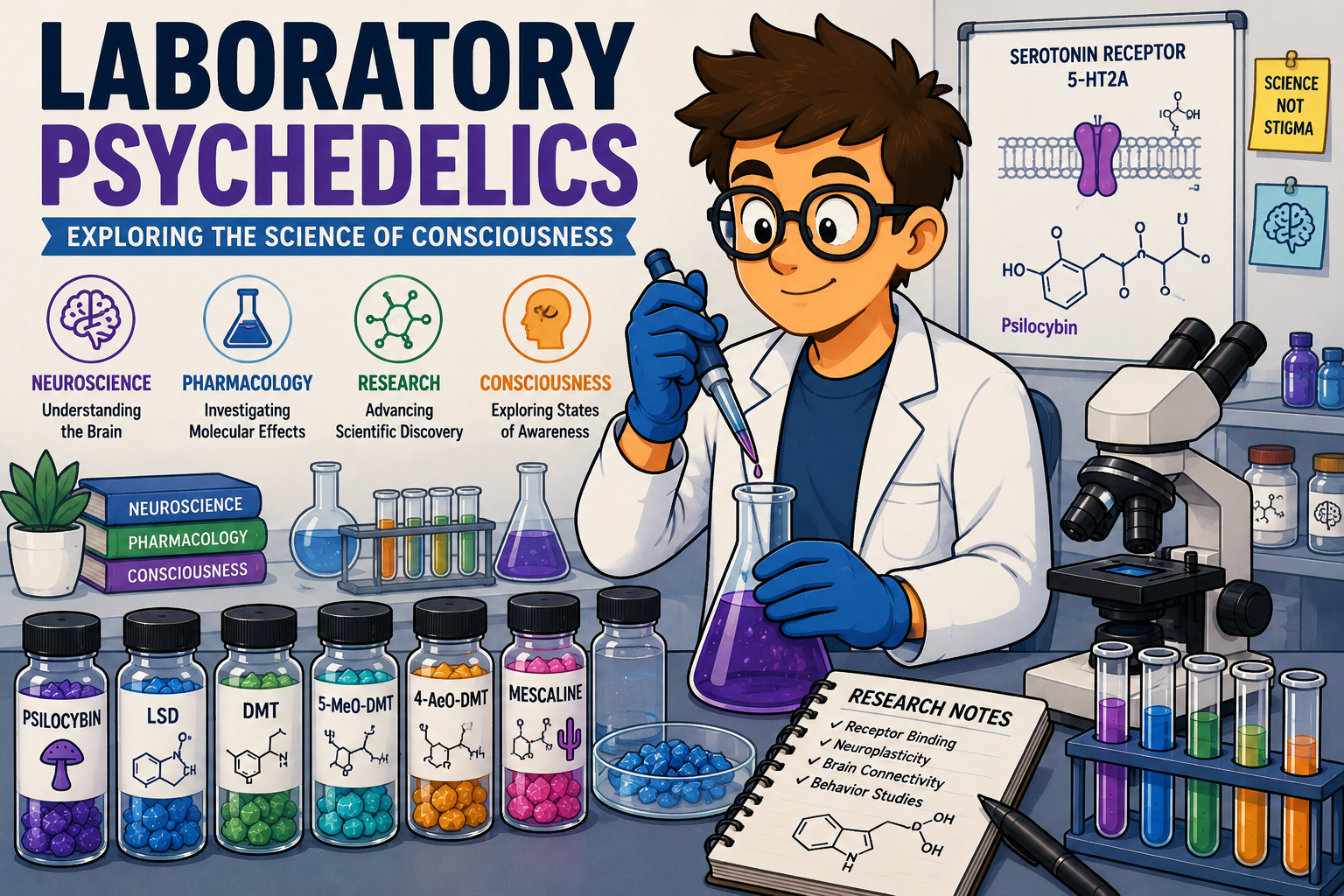
Laboratory psychedelics have become a major focus of scientific research in recent years, attracting attention from neuroscientists, pharmacologists, psychologists, and cognitive scientists around the world. As technology advances and researchers gain access to increasingly sophisticated analytical tools, laboratory-created psychedelic compounds are helping scientists explore some of the most complex questions about the human brain.\
From understanding consciousness and perception to investigating neural communication and receptor interactions, laboratory psychedelics provide valuable insights into how the brain processes information and generates subjective experiences.
While naturally occurring psychedelic substances continue to be studied, laboratory-developed compounds offer researchers greater precision, consistency, and control, making them essential tools in modern neuroscience and pharmacological research.
What Are Laboratory Psychedelics?
Laboratory psychedelics are compounds synthesized or modified in controlled scientific environments for research and educational purposes. These compounds may be structurally similar to naturally occurring psychedelics or entirely novel molecules developed to investigate specific biological mechanisms.
Researchers study laboratory psychedelics to better understand:
- Brain function
- Neurotransmitter systems
- Consciousness
- Perception
- Learning and memory
- Emotional processing
- Neural plasticity
These compounds serve as powerful research tools that help scientists explore the relationship between chemistry, cognition, and human experience.
Why Scientists Study Laboratory Psychedelics
The renewed interest in psychedelic science is largely driven by advances in neuroscience and brain imaging technologies.
Understanding Consciousness
Consciousness remains one of the greatest mysteries in science. Laboratory psychedelics allow researchers to study how changes in neural activity influence awareness, perception, and subjective experience.
Scientists use these compounds to investigate:
- Self-awareness
- Cognitive integration
- Sensory perception
- Internal thought processes
- States of consciousness
By observing how neural networks change under controlled experimental conditions, researchers gain valuable insights into the foundations of conscious experience.
Mapping Brain Networks
Modern imaging technologies such as fMRI, PET scans, and EEG systems enable scientists to observe how laboratory psychedelics influence communication between different regions of the brain.
Research focuses on:
- Neural connectivity
- Information flow
- Brain network dynamics
- Functional organization
- Cognitive flexibility
These findings contribute to a broader understanding of how the brain processes information.
Investigating Neuroplasticity
Neuroplasticity refers to the brain’s ability to reorganize and form new neural connections.
Researchers examine how lab psychedelics affect:
- Synaptic activity
- Neural adaptation
- Learning processes
- Memory mechanisms
- Cognitive development
Understanding neuroplasticity is critical for advancing neuroscience and cognitive science research.
Common Categories of Laboratory Psychedelics
Synthetic Tryptamines
Synthetic tryptamines are among the most frequently studied laboratory psychedelics.
Researchers use these compounds to investigate:
- Serotonin receptor activity
- Perception mechanisms
- Brain connectivity
- Cognitive processing
Their structural similarity to naturally occurring neurotransmitters makes them valuable tools in neuroscience.
Phenethylamine-Based Compounds
Phenethylamines represent another major category of lab psychedelics.
Research involving these compounds focuses on:
- Sensory processing
- Neurochemical signaling
- Emotional cognition
- Receptor interactions
Their diverse molecular structures provide opportunities to explore how small chemical modifications influence biological effects.
Lysergamide Analogues
Lysergamide compounds continue to play an important role in psychedelic science.
Scientists study these molecules to better understand:
- Consciousness
- Neural communication
- Cognitive integration
- Brain network activity
These compounds remain valuable tools for investigating complex psychological processes.
The Role of Laboratory Psychedelics in Neuroscience
Modern neuroscience has benefited significantly from laboratory psychedelic research.
The Default Mode Network
Researchers have identified a brain network known as the Default Mode Network (DMN), which is involved in self-referential thinking and internal mental processes.
Laboratory psychedelic studies help scientists investigate:
- Self-perception
- Identity formation
- Introspection
- Cognitive awareness
Understanding the DMN contributes to broader theories of consciousness and cognition.
Brain Connectivity Studies
It provides unique opportunities to observe how different regions of the brain interact.
Researchers analyze:
- Network flexibility
- Functional connectivity
- Signal transmission
- Cognitive coordination
These findings improve scientific understanding of how complex mental experiences emerge from neural activity.
Laboratory Psychedelics and Neuropharmacology
Neuropharmacology examines how compounds interact with the nervous system.
Laboratory psychedelic research focuses on:
Serotonin Receptors
Many psychedelic compounds interact with serotonin receptors, particularly the 5-HT2A receptor.
Scientists study these interactions to understand:
- Cognitive processing
- Perception
- Mood regulation
- Information integration
Structure-Activity Relationships
Researchers compare molecular structures to determine how chemical modifications influence biological activity.
These studies help identify:
- Receptor preferences
- Molecular targets
- Pharmacological profiles
- Signaling mechanisms
Research Methods Used in Psychedelic Science
Scientific investigations involving utilize rigorous methodologies.
In Vitro Studies
Researchers examine compounds in controlled laboratory environments to study:
- Receptor binding
- Cellular responses
- Molecular interactions
- Signal transduction pathways
Neuroimaging Research
Advanced imaging technologies allow scientists to observe changes in brain activity.
Common techniques include:
- Functional MRI
- EEG monitoring
- PET imaging
- Magnetoencephalography
These methods provide detailed insights into neural activity patterns.
Computational Modeling
Artificial intelligence and computational neuroscience are increasingly used to analyze large datasets generated by psychedelic research.
Researchers employ machine learning to identify:
- Brain activity patterns
- Molecular relationships
- Network dynamics
- Predictive models
Safety and Ethical Standards
Scientific research is conducted under strict ethical guidelines and regulatory oversight.
Research institutions prioritize:
- Participant safety
- Scientific integrity
- Data transparency
- Regulatory compliance
- Ethical review procedures
These safeguards ensure that research remains responsible and scientifically credible.
Challenges in Psychedelic Research
Although psychedelic science has experienced significant growth, several challenges remain.
Regulatory Complexity
Researchers often navigate extensive approval processes before conducting studies.
Funding Limitations
Competition for research funding remains significant despite growing scientific interest.
Public Misconceptions
Educational efforts continue to play an important role in improving public understanding of legitimate psychedelic research.
Future Directions of Laboratory Psychedelic Research
The future of laboratory psychedelic science is exceptionally promising.
Emerging research areas include:
Precision Neuropharmacology
Scientists are developing increasingly selective compounds that target specific neural pathways.
Advanced Brain Mapping
New imaging technologies continue to reveal how psychedelic compounds influence brain networks.
Artificial Intelligence Integration
Machine learning systems are helping researchers analyze complex neurological and pharmacological data.
Consciousness Research
It remains among the most powerful tools available for studying the nature of conscious experience.
Why Laboratory Psychedelics Matter
It contributes to scientific discovery by providing researchers with precise tools for exploring the brain and nervous system.
Their value extends across multiple disciplines, including:
- Neuroscience
- Psychology
- Cognitive science
- Pharmacology
- Neurobiology
- Consciousness studies
These compounds help researchers investigate some of the most important unanswered questions about the human mind.
Conclusion
Laboratory psychedelics represent a rapidly evolving field at the intersection of neuroscience, pharmacology, psychology, and cognitive science. Through rigorous research and advanced technologies, scientists are gaining unprecedented insights into consciousness, brain connectivity, neuroplasticity, and human cognition.
As scientific understanding continues to expand, they are likely to remain essential tools for exploring the biological foundations of perception, awareness, and neural function. Their ongoing study promises to advance our knowledge of the brain and contribute to some of the most significant discoveries in modern science.
