- Your cart is empty
- Continue Shopping


Andractim and Its Impact on Sperm: Understanding DHT, Fertility, and Male Reproductive Health
- Guides
- Posted on
-
by admin
- 0 comments
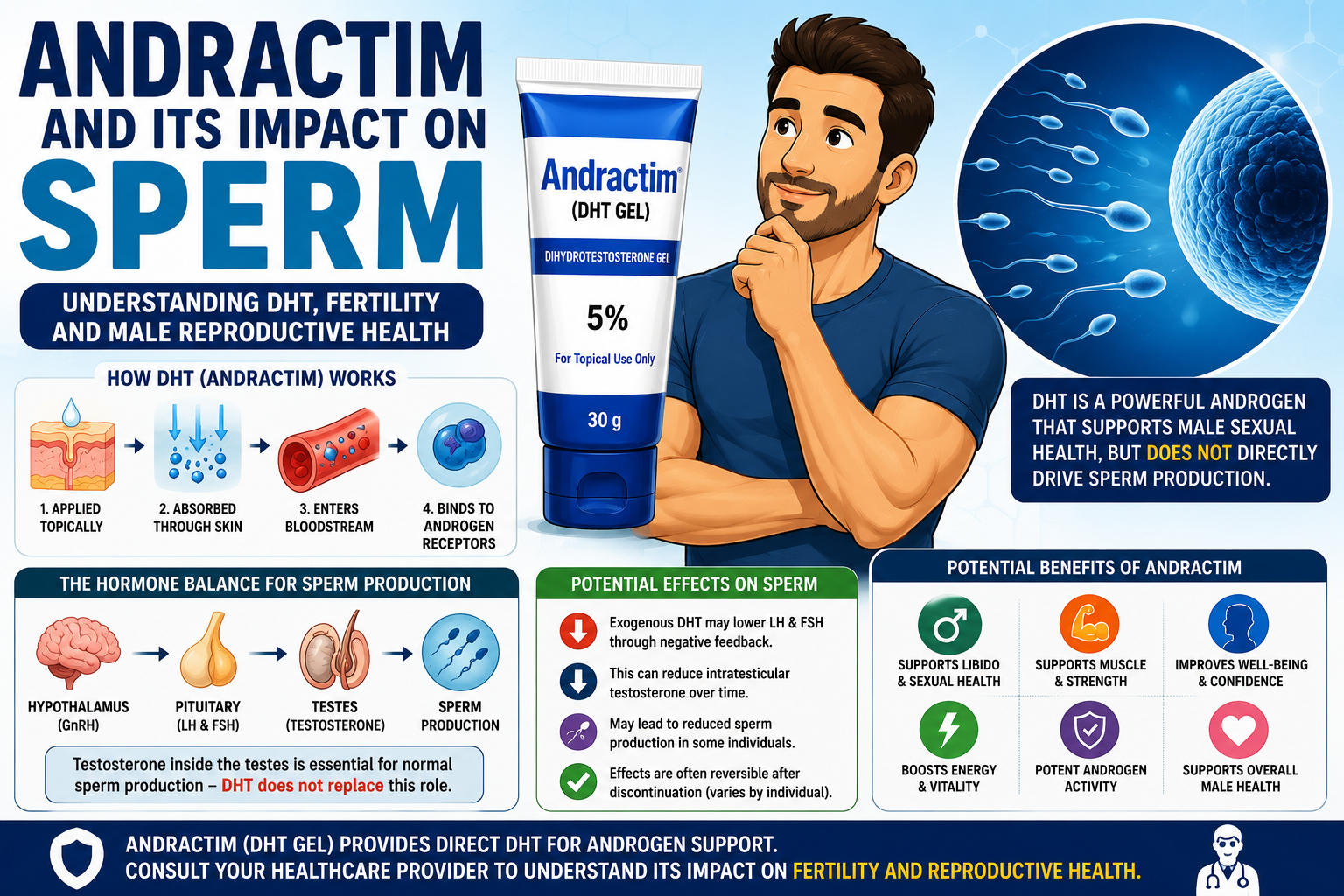
Andractim and Its Impact on Sperm:
Male fertility depends on a complex interaction between hormones, healthy sperm production, testicular function, and overall reproductive health. While testosterone often receives most of the attention, another important androgen—dihydrotestosterone (DHT)—also plays an essential role in male sexual development and androgen activity.
One question frequently asked by patients, researchers, and healthcare professionals is:
Does Andractim affect sperm production?
The answer is more nuanced than a simple yes or no.
Andractim is a topical DHT (dihydrotestosterone) gel that delivers DHT directly through the skin. Unlike testosterone replacement therapy (TRT), Andractim does not contain testosterone, nor does it require conversion by the enzyme 5-alpha reductase. Because DHT and testosterone perform different biological functions, understanding their relationship is essential when evaluating the potential effects of Andractim on fertility and sperm production.
This article explores current scientific knowledge regarding Andractim, DHT, sperm health, fertility, reproductive hormones, and male endocrine function.
What Is Andractim?
Andractim is a transdermal gel containing dihydrotestosterone (DHT), the most potent naturally occurring androgen in the male body.
After topical application, DHT is absorbed through the skin and binds directly to androgen receptors in tissues throughout the body.
Unlike testosterone therapy, Andractim:
- Delivers DHT directly
- Does not require conversion from testosterone
- Cannot be converted into estrogen
- Primarily enhances androgen receptor activity rather than increasing circulating testosterone levels
Understanding DHT and Male Fertility
DHT is produced naturally when testosterone is converted by the enzyme 5-alpha reductase.
Although DHT is one of the body’s strongest androgens, it serves different biological purposes than testosterone.
DHT primarily influences:
- Development of male external genitalia
- Facial and body hair growth
- Libido
- Prostate development
- Androgen receptor activation
- Secondary male sexual characteristics
However, testosterone—not DHT—is the principal hormone required inside the testes to support spermatogenesis (the production of sperm).
How Sperm Is Produced
Healthy sperm production depends on coordinated activity of the hypothalamic-pituitary-gonadal (HPG) axis.
Key hormones include:
Gonadotropin-Releasing Hormone (GnRH)
Stimulates the pituitary gland.
Luteinizing Hormone (LH)
Stimulates Leydig cells to produce testosterone.
Follicle-Stimulating Hormone (FSH)
Supports Sertoli cells responsible for nurturing developing sperm.
Testosterone
Maintains very high concentrations inside the testes, which are essential for normal sperm development.
Without adequate intratesticular testosterone, sperm production may decline.
Does Andractim Affect Sperm Production
Current evidence suggests that DHT therapy does not directly stimulate sperm production.
Because DHT cannot be converted back into testosterone, increasing circulating DHT alone does not necessarily increase intratesticular testosterone, which is required for spermatogenesis.
In fact, exogenous androgen therapy—including DHT in some settings—may suppress the hypothalamic-pituitary-gonadal axis through negative feedback, potentially lowering LH and FSH secretion. Reduced LH and FSH can decrease testicular testosterone production and may reduce sperm production in some individuals. The extent of this effect depends on dose, duration, and individual physiology.
Can Andractim Cause Infertility?
There is no strong evidence that appropriately supervised Andractim therapy permanently causes infertility.
However, androgen therapy can temporarily influence reproductive hormone signaling.
Possible changes include:
- Reduced LH secretion
- Reduced FSH secretion
- Lower endogenous testosterone production
- Temporary reduction in sperm count
- Changes in semen parameters
For many men, these effects are reversible after discontinuation, although recovery time varies. Decisions about androgen therapy should always consider future fertility goals.
DHT vs Testosterone: Different Roles
Although DHT is derived from testosterone, the two hormones are not interchangeable.
| Testosterone | DHT |
|---|---|
| Supports sperm production | Does not directly drive spermatogenesis |
| Required for intratesticular hormone balance | Primarily activates androgen receptors |
| Can convert into DHT | Cannot convert back into testosterone |
| Can convert into estrogen | Cannot aromatize into estrogen |
Understanding these differences helps explain why increasing DHT does not necessarily improve fertility.
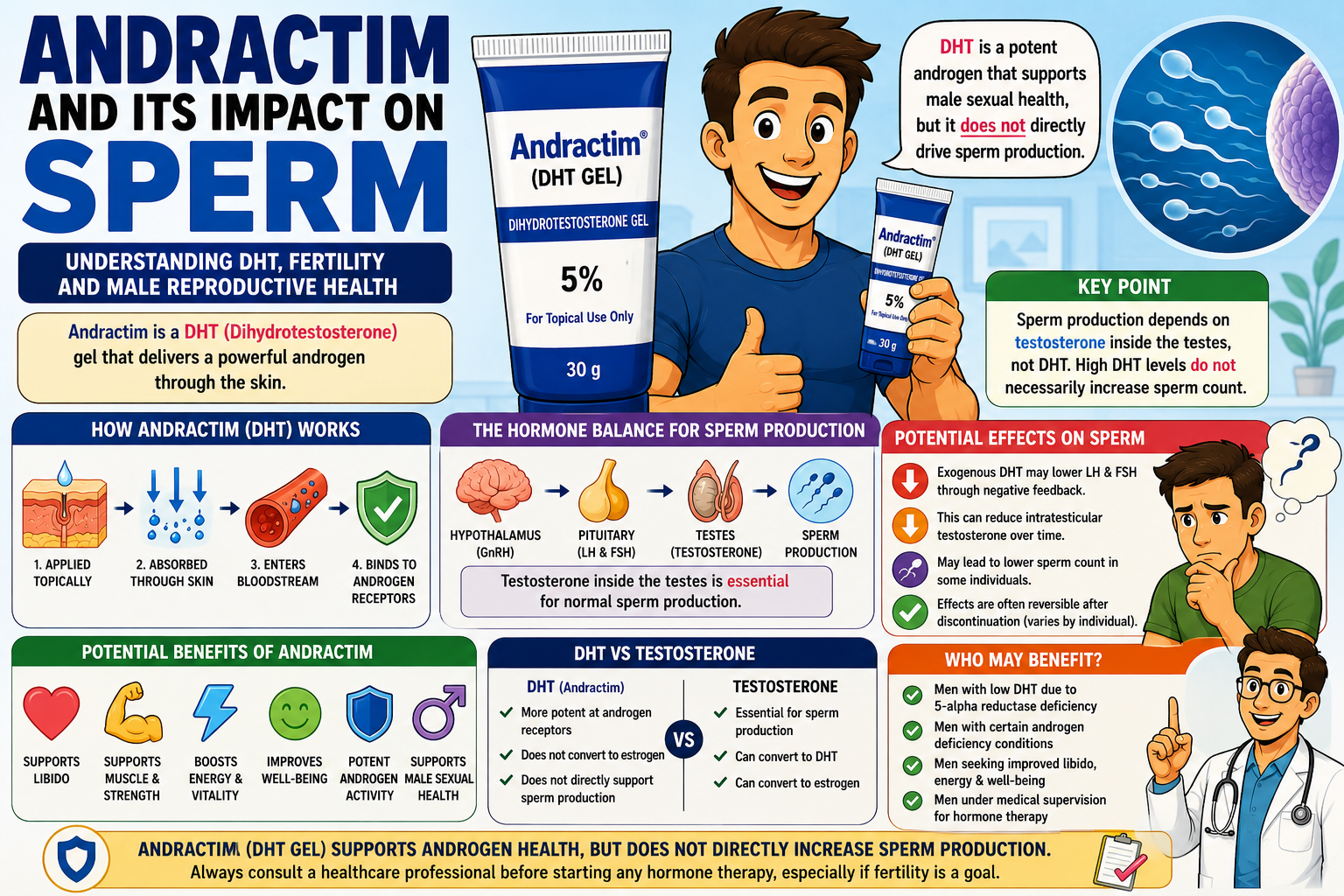
Does DHT Improve Male Sexual Function?
Research has shown that DHT contributes to several androgen-dependent functions.
These include:
- Libido
- Erectile physiology
- Male sexual characteristics
- Muscle maintenance
- Psychological well-being
- Energy
Because of these effects, some men report improvements in sexual health while using DHT-based therapies, even though sperm production may not increase.
What Research Shows About DHT Therapy
Clinical studies involving transdermal DHT have demonstrated:
- Significant increases in serum DHT levels
- Reduced circulating testosterone due to feedback effects
- Little evidence that DHT therapy increases sperm production
- No increase in intratesticular testosterone concentrations
These findings support the understanding that DHT and testosterone fulfill distinct physiological roles.
Who May Benefit from Andractim?
Researchers have investigated DHT therapy in conditions including:
- Certain androgen deficiency disorders
- Disorders involving impaired DHT production
- Selected developmental conditions
- Men with reduced 5-alpha reductase activity
The suitability of DHT therapy depends on individual medical evaluation.
Potential Benefits of Andractim
Potential androgen-related benefits investigated in clinical settings include:
- Enhanced androgen receptor activation
- Improved libido
- Better sexual well-being
- Support for muscle maintenance
- Increased confidence
- Improved energy in androgen-deficient individuals
Because DHT does not convert to estrogen, some patients may prefer this characteristic in specific therapeutic situations.
Potential Side Effects
Like other androgen therapies, DHT treatment may be associated with adverse effects.
Possible side effects include:
- Acne
- Oily skin
- Increased body hair
- Male-pattern hair loss in genetically susceptible individuals
- Prostate enlargement in predisposed patients
- Temporary suppression of reproductive hormones
Monitoring by a qualified healthcare professional is important.
Frequently Asked Questions
Does Andractim increase sperm count?
Current evidence does not indicate that Andractim directly increases sperm production.
Can DHT improve fertility?
DHT supports androgenic functions but is not the primary hormone responsible for spermatogenesis.
Is testosterone more important than DHT for sperm?
Yes. Intratesticular testosterone is essential for normal sperm production.
Can Andractim affect reproductive hormones?
Yes. Like other androgen therapies, DHT can influence LH and FSH through feedback mechanisms.
Is fertility reduction permanent?
Evidence suggests hormonal suppression is often reversible after treatment ends, although recovery differs between individuals.
Conclusion
Andractim provides direct delivery of dihydrotestosterone, one of the body’s most potent androgens, making it an important therapy for certain androgen-related conditions. However, DHT and testosterone have different biological roles.
While Andractim may support androgen-dependent functions such as libido, sexual health, and overall androgen activity, current scientific evidence indicates that it does not directly enhance sperm production and may influence reproductive hormones through endocrine feedback mechanisms. Men who wish to preserve fertility should discuss reproductive goals with their healthcare provider before beginning any androgen-based therapy.
As research continues to evolve, a deeper understanding of DHT’s role in male reproductive health will help clinicians optimize individualized hormone treatment strategies.
