- Your cart is empty
- Continue Shopping


What Is 4-MMC (Mephedrone)?
- Guides
- Posted on
-
by admin
- 0 comments
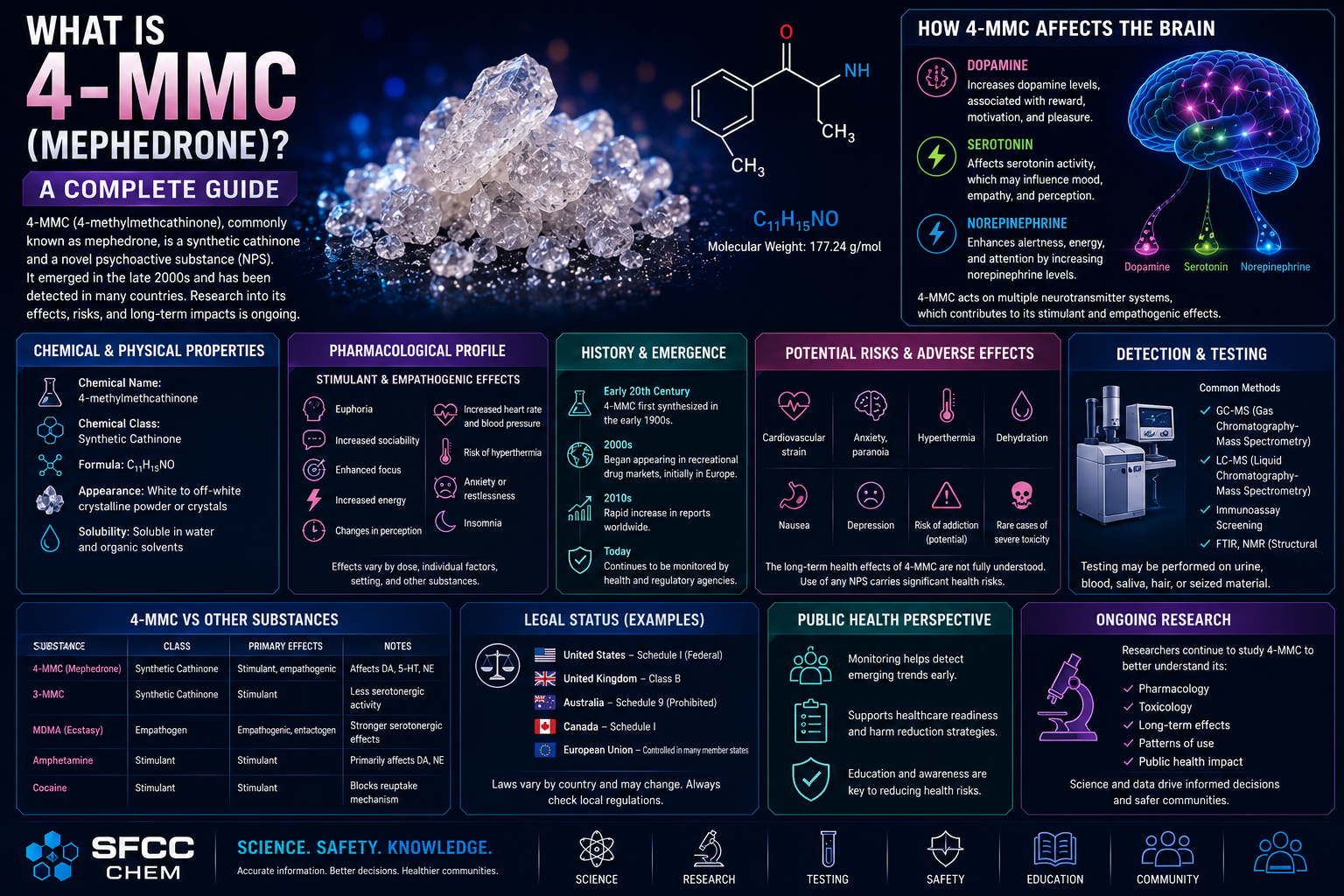
What Is 4-MMC (Mephedrone)? A Complete Guide
The rapid emergence of novel psychoactive substances (NPS) has transformed the landscape of drug monitoring, public health, toxicology, and forensic science over the past two decades. Among the most widely discussed synthetic cathinones is 4-MMC, commonly known as mephedrone. Since its appearance in recreational drug markets during the late 2000s, mephedrone has attracted significant attention from researchers, healthcare professionals, toxicologists, and policymakers.
Understanding 4-MMC requires more than simply recognizing its name. Researchers continue to investigate its chemical properties, pharmacological effects, toxicological profile, and public health implications. As with many emerging psychoactive compounds, scientific understanding has evolved substantially since the substance first gained attention.
This comprehensive guide explores what 4-MMC is, how it works, its history, chemical structure, pharmacology, toxicology, detection methods, legal status, and ongoing scientific research.
What Is 4-MMC (Mephedrone)?
4-MMC stands for 4-Methylmethcathinone, a synthetic cathinone that belongs to a broader class of compounds known as novel psychoactive substances.
Mephedrone is structurally related to cathinone, a naturally occurring stimulant found in the khat plant (Catha edulis).
Synthetic cathinones are laboratory-produced compounds designed to mimic or modify certain pharmacological characteristics of naturally occurring stimulants.
Key Facts About 4-MMC
- Chemical name: 4-Methylmethcathinone
- Common name: Mephedrone
- Drug class: Synthetic cathinone
- Category: Novel psychoactive substance (NPS)
- Chemical family: Phenethylamine derivative
Because of its stimulant-like properties and rapid emergence in drug markets, 4-MMC became a major focus of toxicological and public health research.
The History of Mephedrone
Understanding the history of 4-MMC helps explain why it became an important topic in public health discussions.
Early Development
Mephedrone was first synthesized by chemists during the twentieth century as part of broader research into substituted cathinone compounds.
For many years, the compound received little attention outside scientific circles.
Emergence in Drug Markets
During the mid-to-late 2000s, mephedrone began appearing in various international markets.
Its rapid spread attracted attention because:
- Scientific data were limited.
- Healthcare providers had little clinical experience with the substance.
- Toxicology laboratories needed new detection methods.
- Public health agencies required updated monitoring systems.
Regulatory Responses
As reports involving mephedrone increased, many countries introduced regulations and control measures to address its growing presence.
Understanding Synthetic Cathinones
To understand 4-MMC, it is important to understand the broader category to which it belongs.
What Are Synthetic Cathinones?
Synthetic cathinones are chemically manufactured compounds structurally related to cathinone.
These substances often share stimulant-like properties and are commonly classified as novel psychoactive substances.
Examples include:
- Mephedrone (4-MMC)
- Methylone
- Pentedrone
- 3-MMC
- 4-MPD
- Alpha-PVP
Each compound possesses unique pharmacological characteristics despite structural similarities.
Chemical Structure of 4-MMC
The chemical structure of mephedrone is closely related to other cathinone derivatives.
Molecular Information
- Molecular formula: C11H15NO
- Chemical family: Substituted cathinone
- Structural category: Beta-keto amphetamine derivative
Even small changes in molecular structure can significantly affect:
- Pharmacology
- Toxicity
- Duration of action
- Metabolism
- Detection methods
This is why researchers carefully analyze structural differences among synthetic cathinones.
How Does 4-MMC Affect the Brain?
One of the most important areas of research involves understanding how mephedrone interacts with neurotransmitter systems.
Neurotransmitters Affected by 4-MMC
Research suggests that mephedrone primarily influences:
- Dopamine
- Serotonin
- Norepinephrine
These neurotransmitters play important roles in:
- Mood regulation
- Motivation
- Alertness
- Reward processing
- Emotional responses
- Cognitive function
The combined interaction with multiple neurotransmitter systems contributes to its complex pharmacological profile.
Dopamine and 4-MMC
Dopamine is one of the brain’s most important neurotransmitters.
Functions of Dopamine
Dopamine contributes to:
- Reward processing
- Motivation
- Learning
- Reinforcement behaviors
- Goal-directed activity
Researchers continue investigating how synthetic cathinones interact with dopamine transport systems and neural circuits.
Serotonin and Mephedrone
Mephedrone also appears to influence serotonin activity.
Why Serotonin Matters
Serotonin helps regulate:
- Mood
- Sleep
- Appetite
- Emotional processing
- Social behavior
The involvement of serotonin distinguishes some synthetic cathinones from traditional stimulant compounds.
Norepinephrine Activity
Norepinephrine contributes to:
- Attention
- Alertness
- Stress responses
- Blood pressure regulation
- Heart rate control
Many stimulant-type compounds influence norepinephrine pathways, which may contribute to physiological effects observed during exposure.
Why Public Health Agencies Monitor 4-MMC
Public health agencies worldwide continue monitoring mephedrone and related compounds.
Emerging Drug Trends
Novel psychoactive substances frequently appear and evolve within changing drug markets.
Limited Long-Term Data
Compared with older substances, mephedrone has a relatively short research history.
Healthcare Preparedness
Monitoring helps healthcare providers:
- Identify emerging trends
- Improve patient care
- Develop educational resources
- Enhance public health responses
Early Warning Systems
Many countries operate monitoring systems designed to detect newly emerging substances before they become widespread.
Understanding Mephedrone Toxicology
Toxicology focuses on understanding how substances affect biological systems.
Why Toxicology Research Is Important
Researchers study:
- Mechanisms of action
- Potential health effects
- Toxicity profiles
- Adverse reactions
- Drug interactions
For newer substances such as mephedrone, toxicological research remains essential for improving scientific understanding.
Potential Health Concerns
Researchers have documented a variety of concerns associated with stimulant-type synthetic cathinones.
Cardiovascular Effects
Areas of investigation include:
- Heart rate changes
- Blood pressure changes
- Cardiovascular stress
Neurological Effects
Researchers also study:
- Agitation
- Anxiety
- Sleep disruption
- Cognitive effects
Because individual responses vary, ongoing research continues to evaluate risk factors and outcomes.
Hyperthermia and Stimulant Toxicity
One area of particular concern involves hyperthermia.
What Is Hyperthermia?
Hyperthermia occurs when body temperature rises to dangerous levels.
Potential complications may include:
- Organ stress
- Cardiovascular complications
- Neurological injury
- Medical emergencies requiring immediate treatment
Healthcare professionals monitor body temperature closely when evaluating stimulant-related emergencies.
How Is 4-MMC Detected?
Modern forensic and clinical laboratories use advanced analytical technologies to identify mephedrone.
Common Detection Methods
Scientists may use:
- Gas Chromatography-Mass Spectrometry (GC-MS)
- Liquid Chromatography-Mass Spectrometry (LC-MS)
- High-Resolution Mass Spectrometry (HRMS)
- Immunoassay screening methods
These technologies provide highly accurate identification of substances and metabolites.
The Role of Forensic Toxicology
Forensic toxicologists play a crucial role in monitoring emerging substances.
Their work includes:
- Substance identification
- Toxicological investigations
- Trend monitoring
- Public health support
- Scientific reporting
Forensic laboratories often provide the earliest evidence of new psychoactive substances entering drug markets.
Mephedrone and Drug Monitoring Programs
Drug monitoring programs help identify emerging trends and support public health initiatives.
Key Monitoring Activities
Programs often analyze:
- Laboratory submissions
- Toxicology reports
- Seized materials
- Adverse event reports
- Emerging substances
These data support evidence-based policymaking and healthcare planning.
Legal Status of 4-MMC
The legal status of mephedrone varies by country and jurisdiction.
Many nations classify mephedrone as a controlled substance due to concerns regarding public health and safety.
Regulatory Considerations
Laws may govern:
- Possession
- Distribution
- Manufacturing
- Research use
Researchers studying mephedrone typically require appropriate regulatory approvals.
Current Scientific Research
Research on 4-MMC continues across multiple scientific disciplines.
Neuroscience
Scientists investigate:
- Brain function
- Neurotransmitter systems
- Behavioral effects
Pharmacology
Research focuses on:
- Mechanisms of action
- Receptor interactions
- Drug metabolism
Toxicology
Researchers examine:
- Adverse effects
- Toxicity mechanisms
- Risk factors
Public Health
Studies evaluate:
- Population trends
- Healthcare impacts
- Prevention strategies
Why Researchers Continue Studying Mephedrone
Researchers remain interested in 4-MMC because it helps improve understanding of:
- Synthetic cathinones
- Neurotransmitter systems
- Emerging drug markets
- Public health responses
- Forensic detection methods
The knowledge gained contributes to broader scientific understanding of psychoactive substances.
Practical Takeaways
Important points to remember include:
- 4-MMC is also known as mephedrone.
- It belongs to the synthetic cathinone family.
- It is classified as a novel psychoactive substance.
- It affects dopamine, serotonin, and norepinephrine systems.
- Public health agencies actively monitor mephedrone trends.
- Advanced laboratory testing is required for accurate identification.
- Research into its pharmacology and toxicology remains ongoing.
Internal Linking Opportunities
To strengthen topical authority, consider linking this article to:
- What Are Synthetic Cathinones?
- Understanding Novel Psychoactive Substances
- The Science of Dopamine and Reward Pathways
- How Forensic Laboratories Detect Emerging Drugs
- Toxicology and Public Health Monitoring
- 4-MMC vs 3-MMC: Scientific Differences
- Understanding Neurotransmitters and Brain Function
- Advances in Analytical Toxicology
Frequently Asked Questions
What is 4-MMC?
4-MMC, also known as mephedrone, is a synthetic cathinone classified as a novel psychoactive substance.
What type of compound is mephedrone?
Mephedrone belongs to the synthetic cathinone family, which consists of stimulant-type compounds structurally related to cathinone.
How does 4-MMC affect the brain?
Research suggests it influences dopamine, serotonin, and norepinephrine neurotransmitter systems.
Why is mephedrone monitored by public health agencies?
Because it is an emerging psychoactive substance with evolving patterns of use and limited long-term research data.
How is 4-MMC detected?
Scientists use analytical techniques such as LC-MS, GC-MS, and HRMS for identification.
Is research on mephedrone complete?
No. Researchers continue studying its pharmacology, toxicology, metabolism, and public health implications.
Conclusion
4-MMC (mephedrone) remains one of the most recognized synthetic cathinones within the broader category of novel psychoactive substances. Since its emergence in international drug markets, it has become a significant subject of interest for neuroscientists, toxicologists, forensic laboratories, public health agencies, and policymakers. Read more.
Although scientific understanding has expanded considerably, researchers continue investigating its pharmacology, toxicology, and long-term health implications. Through ongoing research, surveillance, and public health monitoring, scientists hope to improve understanding of mephedrone and other emerging psychoactive substances, ultimately supporting informed decision-making and evidence-based public health responses. Click here for those seeking 4-MMC and researchers looking for 4-MMC crystal.
