- Your cart is empty
- Continue Shopping


What Is 6-APB?
- Guides
- Posted on
-
by admin
- 0 comments
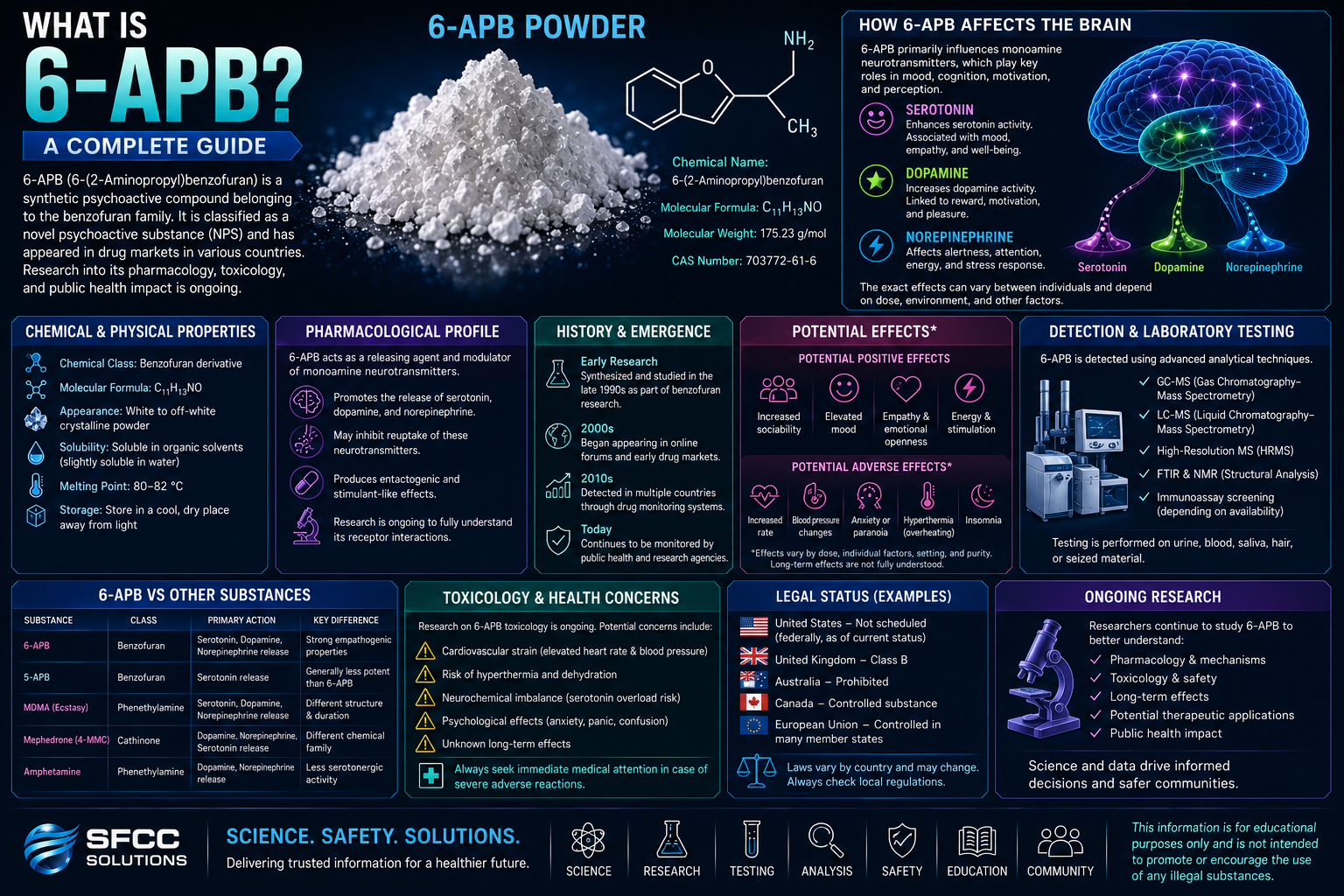
What Is 6-APB? A Complete Guide
The rapid emergence of novel psychoactive substances (NPS) has significantly changed the landscape of drug monitoring, toxicology, neuroscience, and public health over the last two decades. Among the many compounds that have attracted scientific attention is 6-APB, also known as 6-(2-Aminopropyl)benzofuran. As researchers continue to investigate new psychoactive substances, 6-APB has become an important subject of study due to its unique chemical structure, pharmacological profile, and relationship to other psychoactive compounds.
Although 6-APB is often discussed alongside other emerging substances, there remains considerable public confusion regarding what it is, how it affects the brain, why scientists study it, and what concerns public health agencies have regarding its appearance in drug markets. Understanding 6-APB requires examining its chemistry, pharmacology, toxicology, history, and ongoing scientific research.
This comprehensive guide explores what 6-APB is, how it works, its chemical properties, effects on neurotransmitter systems, toxicological concerns, forensic detection methods, legal considerations, and why it continues to be monitored by researchers and public health professionals worldwide.
What Is 6-APB?
6-APB stands for 6-(2-Aminopropyl)benzofuran, a synthetic psychoactive compound belonging to a family of substances known as benzofurans.
Benzofurans are structurally distinct from many traditional stimulant compounds, although they may share certain pharmacological characteristics. Because of its chemical structure and interactions with multiple neurotransmitter systems, 6-APB has attracted attention from neuroscientists, pharmacologists, toxicologists, and forensic laboratories.
The compound is generally classified as a novel psychoactive substance (NPS), a term used to describe newly emerging substances that may not have a long history of scientific study or public health surveillance.
As with many novel psychoactive substances, researchers continue working to better understand its pharmacological effects, toxicological profile, metabolism, and long-term health implications.
Understanding Novel Psychoactive Substances
To fully understand 6-APB, it is helpful to understand the broader category to which it belongs.
What Are Novel Psychoactive Substances?
Novel psychoactive substances are compounds that have emerged relatively recently within scientific, toxicological, and public health discussions.
These substances often present unique challenges because
- Scientific research may be limited.
- Long-term health data may be unavailable.
- Toxicity profiles may not be fully understood.
- Detection methods often require ongoing development.
- Public health monitoring systems must continually adapt.
Public health agencies around the world actively monitor novel psychoactive substances to identify emerging trends and potential risks.
The History of 6-APB
Understanding the history of 6-APB provides valuable context regarding its place within modern research.
Early Development
6-APB was initially investigated during research involving benzofuran derivatives and related compounds.
Researchers studying psychoactive compounds became interested in benzofuran structures because they differed chemically from many previously studied substances.
Emergence in Drug Monitoring Systems
As novel psychoactive substances became more common during the 2000s and 2010s, 6-APB began appearing in toxicology reports, forensic investigations, and international monitoring programs.
This increased scientific interest in understanding its chemical properties and biological activity.
Growing Research Interest
Since its emergence, researchers have studied 6-APB in areas including:
- Pharmacology
- Neuroscience
- Toxicology
- Public health
- Forensic science
Despite growing knowledge, many aspects of the compound remain under investigation.
Chemical Structure of 6-APB
One reason 6-APB attracts scientific attention is its unique chemical structure.
Chemical Information
- Chemical Name: 6-(2-Aminopropyl)benzofuran
- Molecular Formula: C11H13NO
- Chemical Family: Benzofuran derivative
- Classification: Novel psychoactive substance
Small structural differences between psychoactive compounds can significantly affect:
- Pharmacological activity
- Metabolism
- Duration of effects
- Toxicity
- Detection methods
This is why chemists and pharmacologists carefully analyze molecular structures when studying new substances.
How Does 6-APB Affect the Brain?
Researchers believe that 6-APB interacts with several neurotransmitter systems that regulate mood, behavior, cognition, and physiological function.
Neurotransmitters Associated With 6-APB
Scientific research suggests involvement with:
- Serotonin
- Dopamine
- Norepinephrine
These neurotransmitters serve as chemical messengers that allow communication between nerve cells throughout the brain and nervous system.
The interaction with multiple neurotransmitter systems contributes to the complexity of the compound’s pharmacological profile.
Serotonin and 6-APB
Serotonin plays a critical role in many biological processes.
Functions of Serotonin
Serotonin influences:
- Mood regulation
- Emotional processing
- Appetite
- Sleep
- Social behavior
- Cognitive function
Because serotonin is involved in such a wide range of physiological processes, compounds affecting serotonin systems often become important subjects of neuroscience research.
Scientists continue investigating how 6-APB interacts with serotonin transporters and receptors.
Dopamine Activity
Dopamine is another neurotransmitter frequently examined in psychoactive substance research.
Functions of Dopamine
Dopamine contributes to:
- Motivation
- Reward processing
- Learning
- Reinforcement behaviors
- Goal-directed activity
Researchers study dopamine interactions to better understand behavioral and neurological effects associated with various compounds.
Norepinephrine and Alertness
Norepinephrine helps regulate:
- Attention
- Alertness
- Stress responses
- Blood pressure
- Heart rate
Compounds influencing norepinephrine pathways may affect physiological and neurological processes that remain important areas of toxicological investigation.
Why Do Researchers Study 6-APB?
There are several reasons scientists continue studying 6-APB.
Understanding Neurotransmitter Systems
Research helps scientists better understand how chemical compounds influence communication between neurons.
Public Health Monitoring
Because 6-APB powder has appeared within emerging drug markets, public health agencies seek accurate information regarding its pharmacology and potential risks.
Toxicological Research
Researchers investigate:
- Biological effects
- Potential toxicity
- Metabolism
- Detection methods
Forensic Identification
Forensic laboratories require reliable analytical methods for identifying new psychoactive substances.
Toxicology and Safety Research
One of the most important areas of study involves toxicology.
What Is Toxicology?
Toxicology is the scientific study of how substances affect biological systems.
Researchers use toxicological investigations to understand:
- Health effects
- Risk factors
- Mechanisms of toxicity
- Biological responses
- Adverse outcomes
For emerging substances such as 6-APB, toxicological research is particularly important because long-term human data may be limited.
Public Health Concerns
Public health agencies monitor 6-APB because of broader concerns associated with novel psychoactive substances.
Challenges Faced by Public Health Agencies
These challenges include:
- Rapidly changing drug markets
- Limited scientific data
- Emerging trends
- Healthcare preparedness
- Laboratory detection needs
Monitoring programs help identify compounds early and improve public health responses.
How Is 6-APB Detected?
Accurate identification requires sophisticated laboratory techniques.
Common Analytical Methods
Scientists commonly use:
- Liquid Chromatography-Mass Spectrometry (LC-MS)
- Gas Chromatography-Mass Spectrometry (GC-MS)
- High-Resolution Mass Spectrometry (HRMS)
- Nuclear Magnetic Resonance (NMR) Spectroscopy
These technologies help distinguish 6-APB from other chemically related substances.
Why Detection Matters
Accurate detection supports:
- Public health surveillance
- Toxicological investigations
- Forensic analysis
- Scientific research
Reliable testing remains essential for understanding emerging compounds.
Forensic Science and 6-APB
Forensic laboratories play a crucial role in monitoring new psychoactive substances.
Responsibilities of Forensic Laboratories
Their work includes:
- Substance identification
- Chemical characterization
- Toxicological investigations
- Trend monitoring
- Scientific reporting
Many emerging compounds are first recognized through forensic investigations.
Drug Monitoring Programs
International monitoring systems continuously track novel psychoactive substances.
Key Activities
These programs often collect information regarding:
- Toxicology reports
- Laboratory findings
- Emerging trends
- Seized materials
- Public health incidents
The information gathered helps support evidence-based public health policies.
Comparing 6-APB to Other Novel Psychoactive Substances
Researchers frequently compare compounds to understand similarities and differences.
6-APB vs 5-APB
Both belong to the benzofuran family but differ structurally.
6-APB vs MDMA
Researchers often compare neurotransmitter activity and pharmacological characteristics.
6-APB vs Synthetic Cathinones
Synthetic cathinones and benzofurans belong to different chemical families and may exhibit different pharmacological profiles.
These comparisons help scientists better understand emerging substances.
Legal Status of 6-APB
The legal status of 6-APB varies internationally.
Many jurisdictions have introduced regulations addressing novel psychoactive substances due to public health concerns.
Regulatory Considerations
Laws may govern:
- Possession
- Distribution
- Manufacturing
- Research activities
Researchers studying such compounds generally require appropriate regulatory approvals.
Current Scientific Research
Scientific understanding of 6-APB continues to evolve.
Areas of Active Investigation
Researchers continue studying:
- Pharmacology
- Toxicology
- Metabolism
- Neurotransmitter activity
- Detection methods
- Public health implications
As additional data become available, understanding of the compound may continue to expand.
Practical Takeaways
Key points to remember include:
- 6-APB stands for 6-(2-Aminopropyl)benzofuran.
- It belongs to the benzofuran family of compounds.
- It is classified as a novel psychoactive substance.
- Researchers study its interactions with serotonin, dopamine, and norepinephrine systems.
- Public health agencies actively monitor emerging substances such as 6-APB.
- Advanced laboratory techniques are required for accurate identification.
- Scientific research regarding pharmacology and toxicology remains ongoing.
Internal Linking Opportunities
To strengthen topical authority, consider linking this article to:
- What Are Novel Psychoactive Substances?
- Understanding Neurotransmitters and Brain Function
- The Science of Serotonin Explained
- Dopamine and Reward Pathways
- How Toxicology Laboratories Detect Emerging Compounds
- Benzofurans vs Synthetic Cathinones
- Public Health Monitoring of New Psychoactive Substances
- Advances in Forensic Toxicology
Frequently Asked Questions
What is 6-APB?
6-APB is a benzofuran compound classified as a novel psychoactive substance that has attracted scientific interest because of its interactions with multiple neurotransmitter systems.
What does 6-APB stand for?
6-APB stands for 6-(2-Aminopropyl)benzofuran.
What type of compound is 6-APB?
It belongs to the benzofuran family of compounds and is generally classified as a novel psychoactive substance.
Why is 6-APB studied?
Researchers study 6-APB to better understand its pharmacology, toxicology, metabolism, and public health implications.
How is 6-APB detected?
Scientists use advanced laboratory methods such as LC-MS, GC-MS, HRMS, and NMR spectroscopy.
Is research on 6-APB complete?
No. Research remains ongoing, and many aspects of its pharmacology and toxicology continue to be investigated.
Conclusion
6-APB represents an important example of how novel psychoactive substances continue to challenge researchers, toxicologists, forensic laboratories, and public health agencies around the world. As a benzofuran compound with complex interactions involving serotonin, dopamine, and norepinephrine systems, it remains a significant subject of scientific investigation. Read more.
Although researchers have learned much about its chemical structure and biological activity, substantial questions remain regarding its long-term effects, toxicological profile, and broader public health implications. Continued research, laboratory monitoring, and evidence-based public health surveillance will remain essential for improving scientific understanding of 6-APB and other emerging psychoactive substances in the years ahead. Click here for those seeking 6-APB and researchers looking for 6-APB powder.
