- Your cart is empty
- Continue Shopping


What Is MDMA Crystal?
- Guides
- Posted on
-
by admin
- 0 comments
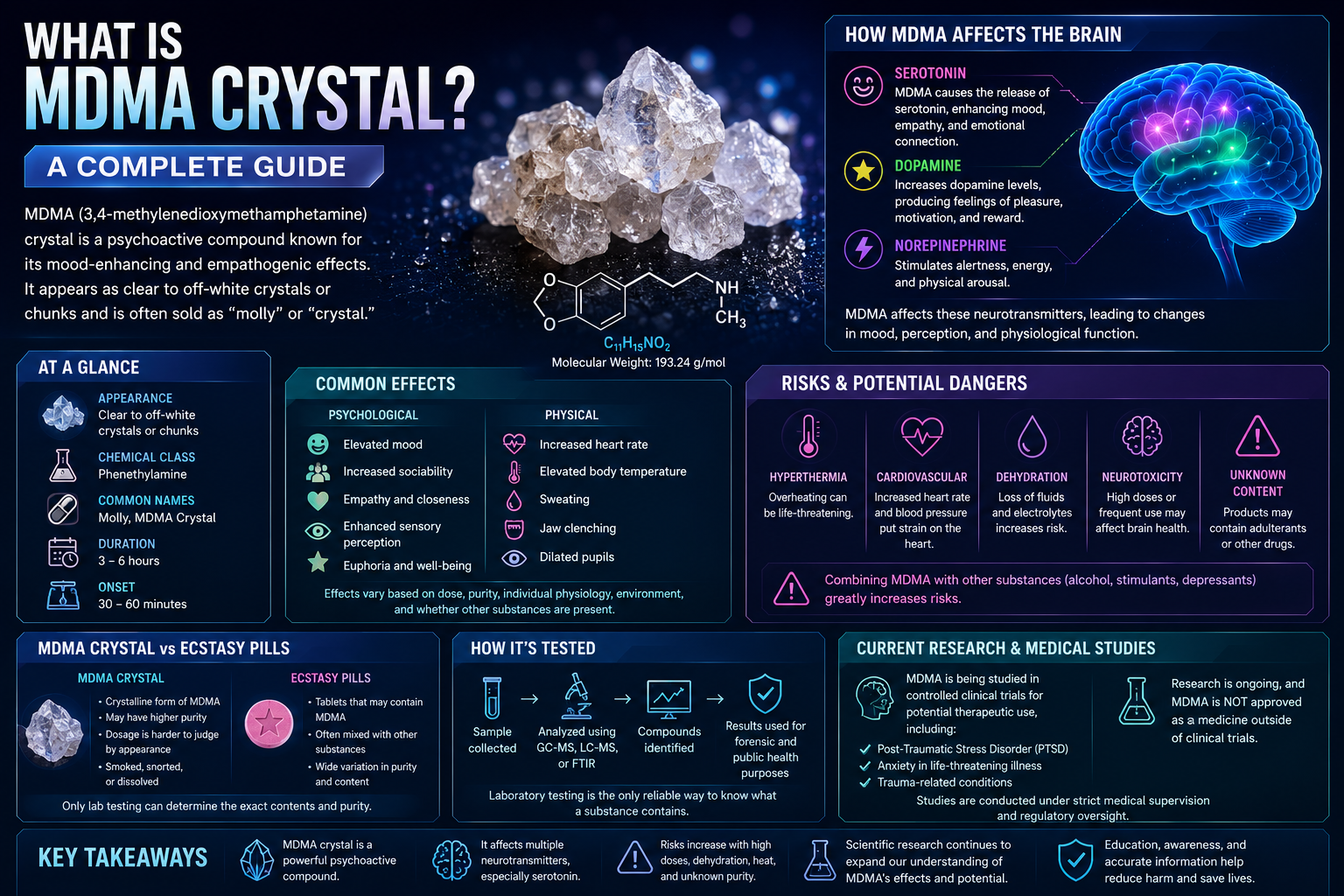
What Is MDMA Crystal? A Complete Guide
MDMA crystal is one of the most widely discussed psychoactive substances in modern neuroscience, toxicology, public health, and mental health research. Although commonly associated with nightlife culture and recreational settings, MDMA has also become a significant subject of scientific investigation due to its unique effects on brain chemistry and its potential applications in controlled clinical research.
Understanding what MDMA crystal is, how it affects the brain and body, its risks, legal status, and current scientific developments is important for healthcare professionals, researchers, students, policymakers, and anyone interested in evidence-based drug education.
This comprehensive guide explores the science behind MDMA crystal, including its history, pharmacology, effects, public health concerns, toxicology, and ongoing research.
What Is MDMA Crystal?
MDMA stands for 3,4-methylenedioxymethamphetamine, a synthetic psychoactive compound that affects several neurotransmitter systems within the brain.
MDMA crystal refers to a crystalline form of the substance that may vary in appearance depending on manufacturing methods, purity, and other factors. It is often discussed separately from ecstasy tablets because ecstasy products may contain MDMA along with other substances, whereas crystal forms are frequently marketed as containing primarily MDMA.
However, laboratory analysis has shown that appearance alone cannot determine purity or composition. Only proper chemical testing can identify the contents of a substance accurately.
The History of MDMA
The origins of MDMA date back more than a century.
Early Development
MDMA was first synthesized in 1912 by chemists working for the German pharmaceutical company Merck.
At the time, researchers were exploring new chemical compounds for potential pharmaceutical applications.
For several decades, MDMA received relatively little scientific attention.
Emergence in Research
During the 1970s, researchers began examining MDMA’s unique psychological effects.
Scientists noted that the compound appeared to produce effects distinct from traditional stimulants, sedatives, and hallucinogens.
This led to increased interest in understanding how MDMA influences emotional processing and social behavior.
Increased Public Awareness
By the 1980s and 1990s, MDMA became more widely known through recreational use and public discussions surrounding psychoactive substances.
Today, MDMA remains an important topic in both public health and clinical research.
Understanding the Chemistry of MDMA
MDMA belongs to a class of compounds known as substituted amphetamines.
Its chemical structure shares similarities with both stimulant and hallucinogenic compounds, which helps explain its unique pharmacological profile.
Molecular Characteristics
- Chemical Name: 3,4-Methylenedioxymethamphetamine
- Molecular Formula: C11H15NO2
- Chemical Class: Phenethylamine and amphetamine derivative
- Pharmacological Category: Psychoactive compound
The structure of MDMA allows it to interact with several neurotransmitter systems simultaneously.
How Does MDMA Affect the Brain?
One of the most studied aspects of MDMA is its effect on neurotransmitters.
Neurotransmitters are chemical messengers that allow communication between nerve cells.
MDMA primarily affects:
- Serotonin
- Dopamine
- Norepinephrine
Serotonin Effects
Serotonin influences:
- Mood
- Emotional regulation
- Sleep
- Appetite
- Social behavior
MDMA causes a substantial release of serotonin, which contributes to many of its psychological effects.
Dopamine Effects
Dopamine is involved in:
- Motivation
- Reward processing
- Learning
- Pleasure responses
Norepinephrine Effects
Norepinephrine helps regulate:
- Alertness
- Blood pressure
- Heart rate
- Stress responses
The combined activity on these neurotransmitters produces a complex set of physiological and psychological effects.
Why Is MDMA Called an Empathogen?
Researchers often describe MDMA as an empathogen.
An empathogen is a substance that may increase feelings of emotional openness, connectedness, and empathy.
This classification distinguishes MDMA from traditional stimulants and classic psychedelics.
Scientists continue studying these effects to better understand social cognition and emotional processing.
Common Effects Associated With MDMA
Research has documented numerous effects associated with MDMA exposure.
Psychological Effects
Reported effects may include:
- Elevated mood
- Increased sociability
- Enhanced emotional awareness
- Increased empathy
- Altered perception
- Heightened sensory experiences
Physical Effects
Physical effects may include:
- Increased heart rate
- Elevated blood pressure
- Sweating
- Jaw tension
- Dilated pupils
- Increased body temperature
Effects vary significantly among individuals and depend on many factors.
MDMA Crystal vs Ecstasy Pills
A common question involves the difference between MDMA crystal and ecstasy pills.
MDMA Crystal
MDMA crystal generally refers to the crystalline form of MDMA.
Ecstasy Pills
Ecstasy tablets may contain:
- MDMA
- Other stimulants
- Synthetic cathinones
- Caffeine
- Various adulterants
Public health experts emphasize that visual appearance alone cannot verify composition or purity.
Laboratory analysis remains the only reliable method for identifying substances.
Why Public Health Agencies Monitor MDMA
Public health organizations worldwide continue monitoring MDMA-related trends.
Several factors contribute to this attention.
Variable Composition
Substances sold as MDMA may contain unexpected compounds.
Changing Drug Markets
Drug markets frequently evolve, introducing new substances and formulations.
Health Emergencies
Medical professionals monitor MDMA-related incidents to improve prevention, education, and treatment strategies.
Emerging Research
Ongoing clinical research has increased scientific interest in MDMA and its effects.
Understanding MDMA Toxicity
MDMA toxicity occurs when physiological responses exceed the body’s ability to maintain normal functioning.
Potential Warning Signs
Medical emergencies may involve:
- Severe agitation
- Confusion
- Elevated body temperature
- High blood pressure
- Rapid heart rate
- Seizures
- Loss of consciousness
Emergency medical evaluation is essential whenever serious symptoms occur.
Hyperthermia and Overheating
One of the most significant concerns associated with MDMA-related emergencies is hyperthermia.
What Is Hyperthermia?
Hyperthermia occurs when body temperature rises to dangerous levels.
Potential complications may include:
- Organ damage
- Cardiovascular complications
- Neurological injury
- Medical emergencies requiring hospitalization
Healthcare professionals closely monitor body temperature in suspected cases of MDMA toxicity.
Long-Term Research Questions
Scientists continue investigating potential long-term effects associated with repeated MDMA exposure.
Areas of ongoing study include:
Memory and Learning
Researchers examine potential impacts on:
- Memory formation
- Attention
- Learning capacity
- Information processing
Emotional Processing
Studies explore potential effects on:
- Mood regulation
- Anxiety
- Depression
- Emotional awareness
Scientific findings continue to evolve as additional research becomes available.
How Scientists Detect MDMA
Modern laboratories use advanced analytical technologies to identify MDMA and related compounds.
Common Testing Methods
- Gas Chromatography-Mass Spectrometry (GC-MS)
- Liquid Chromatography-Mass Spectrometry (LC-MS)
- High-Resolution Mass Spectrometry (HRMS)
- Infrared Spectroscopy
These techniques provide highly accurate identification of substances.
Forensic Toxicology and MDMA
Forensic toxicologists play an important role in understanding MDMA-related incidents.
Their work includes:
- Identifying substances
- Investigating toxic exposures
- Supporting public health surveillance
- Monitoring emerging drug trends
This information helps healthcare providers and policymakers respond to evolving challenges.
MDMA and Clinical Research
One of the most rapidly developing areas of MDMA research involves mental health studies.
Researchers are examining whether MDMA may have therapeutic potential under carefully controlled clinical conditions.
Areas of Investigation
Current research has explored:
- Post-traumatic stress disorder (PTSD)
- Anxiety-related conditions
- Trauma-focused therapies
These studies occur under strict medical supervision and regulatory oversight.
It is important to distinguish clinical research environments from non-medical use.
Legal Status of MDMA
MDMA is classified as a controlled substance in many countries.
Laws vary internationally regarding:
- Possession
- Distribution
- Manufacturing
- Scientific research
Researchers conducting MDMA studies must comply with applicable regulations and ethical standards.
Why Researchers Continue Studying MDMA
Scientific interest in MDMA continues for several reasons.
Researchers seek to better understand:
- Brain chemistry
- Emotional processing
- Neurotransmitter systems
- Mental health conditions
- Therapeutic mechanisms
Insights gained from MDMA research may contribute to broader knowledge in neuroscience and psychiatry.
Practical Takeaways
Key points to remember include:
- MDMA stands for 3,4-methylenedioxymethamphetamine.
- MDMA crystal refers to a crystalline form of the compound.
- The substance primarily affects serotonin, dopamine, and norepinephrine.
- MDMA is often classified as an empathogen.
- Public health agencies monitor MDMA because of health and safety concerns.
- Advanced laboratory testing is required to accurately identify substances.
- Scientists continue studying MDMA in neuroscience and clinical research settings.
Internal Linking Opportunities
To build topical authority, link this article to:
- What Are Ecstasy Pills? A Complete Guide
- Understanding Neurotransmitters and Brain Chemistry
- MDMA vs Ecstasy: Key Differences Explained
- How Toxicology Laboratories Identify Psychoactive Substances
- Understanding Serotonin and Mood Regulation
- Public Health Monitoring of Emerging Drug Trends
- Advances in Mental Health Research
- The Science of Empathogens and Psychoactive Compounds
Frequently Asked Questions
What is MDMA crystal?
MDMA crystal refers to a crystalline form of 3,4-methylenedioxymethamphetamine, a psychoactive compound that affects multiple neurotransmitter systems.
How does MDMA affect the brain?
MDMA primarily influences serotonin, dopamine, and norepinephrine, affecting mood, emotion, and physiological responses.
Is MDMA crystal the same as ecstasy?
Not necessarily. Ecstasy tablets may contain MDMA but can also contain other substances. Composition varies widely.
Why is MDMA called an empathogen?
Researchers use the term empathogen because MDMA may increase feelings of emotional openness and social connectedness.
How do laboratories identify MDMA?
Scientists use analytical methods such as GC-MS, LC-MS, and HRMS to accurately identify compounds.
Is MDMA being studied medically?
Researchers continue investigating MDMA in controlled clinical studies involving specific mental health conditions.
Conclusion
MDMA crystal remains one of the most extensively studied psychoactive substances in neuroscience, toxicology, public health, and clinical research. Its unique effects on serotonin, dopamine, and norepinephrine systems have generated decades of scientific interest and continue to inform research into brain function, emotional processing, and mental health. Read more.
Understanding what MDMA crystal is, how it affects the body, its potential risks, and the ongoing research surrounding it helps support informed, evidence-based discussions. As science continues to advance, MDMA remains an important subject for researchers, healthcare professionals, policymakers, and public health experts seeking to better understand the complex relationship between psychoactive substances and human health. Click here for those seeking MDMA and researchers looking for MDMA crystal.
