- Your cart is empty
- Continue Shopping


What Is 4-MPD Crystal?
- Guides
- Posted on
-
by admin
- 0 comments
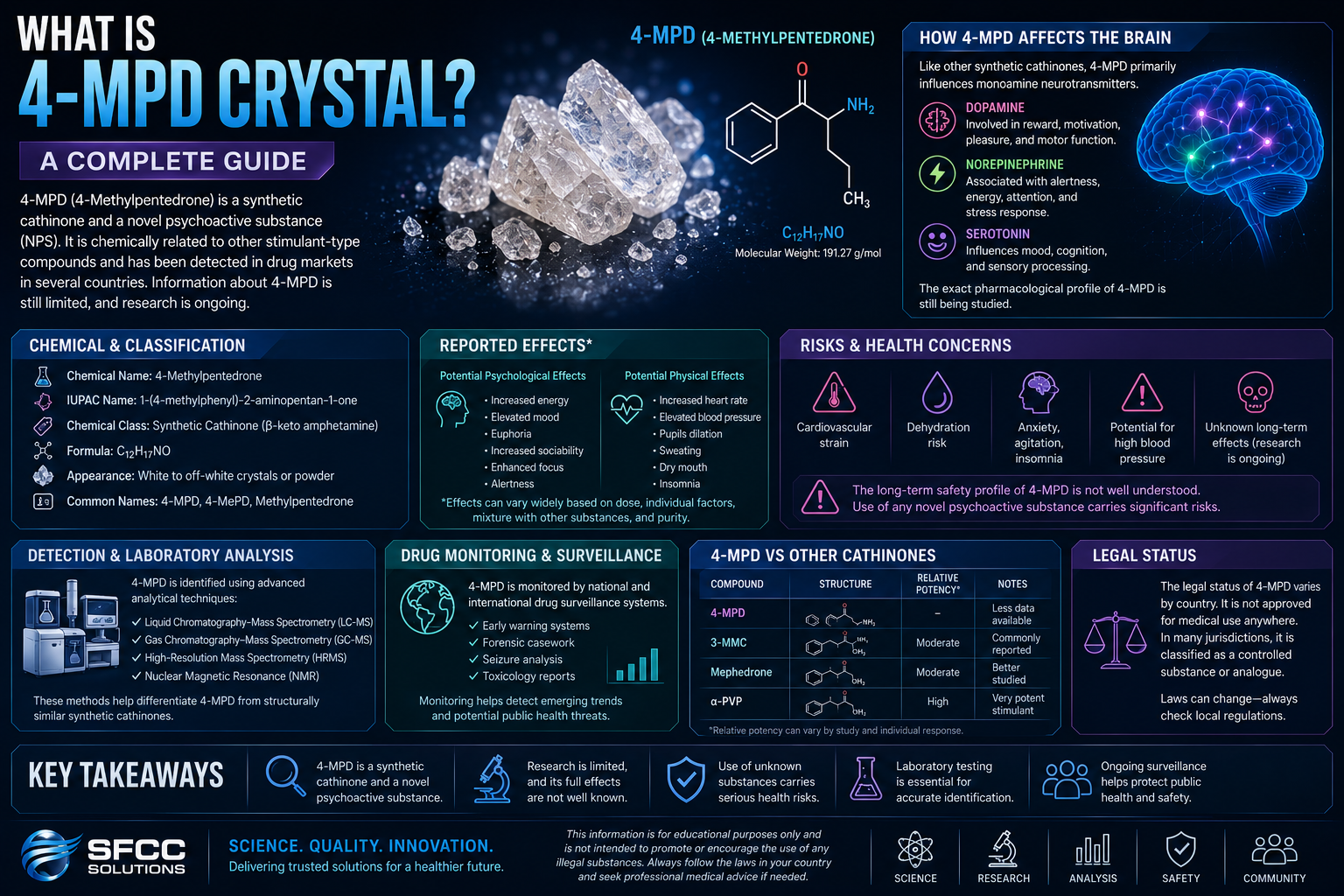
What Is 4-MPD Crystal? A Complete Guide
The emergence of novel psychoactive substances (NPS) has become one of the most significant challenges facing public health agencies, forensic laboratories, toxicologists, and researchers worldwide. Among the growing number of synthetic compounds attracting scientific attention is 4-MPD (4-Methylpentedrone), a synthetic cathinone that has appeared in drug monitoring systems and forensic investigations in recent years.
As new psychoactive substances continue to evolve, researchers and healthcare professionals seek to better understand their pharmacology, toxicology, chemical properties, and potential public health implications. One such compound that has generated increasing interest is 4-MPD crystal.
This comprehensive guide explores what 4-MPD crystal is, its chemical classification, pharmacological characteristics, toxicology considerations, forensic detection methods, legal concerns, and why it remains an important subject of ongoing scientific investigation.
What Is 4-MPD Crystal?
4-MPD, short for 4-Methylpentedrone, is a synthetic cathinone belonging to a broader group of substances commonly referred to as novel psychoactive substances (NPS).
Synthetic cathinones are laboratory-created compounds structurally related to cathinone, a naturally occurring stimulant found in the khat plant (Catha edulis).
4-MPD has been identified in various regions through drug monitoring programs, forensic investigations, and toxicological analyses. Because it is a relatively recent entrant into the NPS landscape, scientific information regarding its effects and long-term health consequences remains limited compared with older psychoactive substances.
The term “4-MPD crystal” generally refers to a crystalline form of the compound that may vary in appearance depending on production methods, purity levels, and associated substances.
Understanding Novel Psychoactive Substances
To understand 4-MPD, it is important to understand the broader category of novel psychoactive substances.
What Are Novel Psychoactive Substances?
Novel psychoactive substances are newly emerging compounds designed to mimic the effects of established psychoactive drugs while often differing slightly in chemical structure.
These substances present unique challenges because:
- Scientific research may be limited.
- Toxicity profiles are often poorly understood.
- Detection methods require continual updates.
- Legal classifications may vary by jurisdiction.
Public health agencies closely monitor NPS compounds to identify emerging risks and trends.
What Are Synthetic Cathinones?
4-MPD belongs to a family of compounds known as synthetic cathinones.
Origin of Cathinones
Natural cathinone is found in the khat plant, which has historically been used in parts of East Africa and the Arabian Peninsula.
Synthetic cathinones are chemically modified versions created in laboratories.
Characteristics of Synthetic Cathinones
Researchers generally classify synthetic cathinones as stimulant-type substances because many interact with neurotransmitter systems involved in alertness, motivation, and reward processing.
Examples of synthetic cathinones include:
- Mephedrone
- Methylone
- Alpha-PVP
- Pentedrone
- 4-MPD
Each compound possesses unique pharmacological characteristics despite structural similarities.
Chemical Structure of 4-MPD
4-MPD is chemically known as 4-Methylpentedrone.
It belongs to the substituted cathinone family and shares structural features with several other synthetic stimulants.
Why Chemical Structure Matters
Small modifications to chemical structures can significantly alter:
- Biological activity
- Duration of action
- Metabolism
- Toxicity
- Detection methods
For this reason, chemists and pharmacologists carefully analyze molecular structures when evaluating emerging compounds.
How Does 4-MPD Affect the Brain?
Although research on 4-MPD remains limited, scientists believe it acts primarily through interactions with neurotransmitter systems involved in stimulant activity.
Neurotransmitters Potentially Affected
Research suggests synthetic cathinones may influence:
- Dopamine
- Norepinephrine
- Serotonin
These neurotransmitters play critical roles in:
- Mood regulation
- Motivation
- Attention
- Reward processing
- Alertness
- Emotional responses
The specific pharmacological profile of 4-MPD remains an active area of investigation.
Dopamine and 4-MPD
Dopamine is a neurotransmitter involved in reward and motivation pathways.
Researchers studying synthetic cathinones often examine how these substances influence dopamine transporters and signaling mechanisms.
Dopamine activity may affect:
- Motivation
- Reinforcement learning
- Behavioral responses
- Pleasure-related processes
Understanding dopamine interactions is essential for evaluating potential risks and behavioral effects.
Norepinephrine Activity
Norepinephrine plays a major role in:
- Alertness
- Stress responses
- Blood pressure regulation
- Heart rate control
Many stimulant-type compounds influence norepinephrine pathways, which may contribute to physiological effects observed during exposure.
Why Is 4-MPD Being Monitored?
Several factors have contributed to increased attention surrounding 4-MPD.
Emerging Drug Markets
Novel psychoactive substances frequently appear in rapidly evolving drug markets.
Monitoring systems seek to identify newly emerging compounds before they become widespread.
Limited Research
Because 4-MPD is relatively new, substantial gaps remain in scientific knowledge.
Researchers continue investigating:
- Pharmacology
- Toxicology
- Metabolism
- Health risks
- Detection methods
Public Health Surveillance
Early identification of emerging substances allows public health agencies to develop appropriate responses and educational initiatives.
Potential Toxicological Concerns
One challenge associated with novel psychoactive substances is the limited availability of comprehensive toxicological data.
Why Toxicology Matters
Toxicology helps scientists understand:
- Biological effects
- Potential health risks
- Adverse reactions
- Mechanisms of toxicity
For emerging compounds such as 4-MPD, toxicological research is often still developing.
Challenges in Assessing Toxicity
Researchers face several obstacles:
- Limited clinical data
- Limited human studies
- Rapidly changing markets
- Variability in product composition
As a result, scientists often rely on laboratory investigations and case reports to build understanding.
Forensic Significance of 4-MPD
Forensic laboratories play a critical role in identifying emerging substances.
How Forensic Scientists Study 4-MPD
Their work includes:
- Substance identification
- Chemical characterization
- Toxicological investigations
- Monitoring drug trends
- Supporting public health surveillance
Forensic findings often provide the earliest evidence of newly emerging compounds.
Laboratory Detection of 4-MPD
Accurate identification requires sophisticated analytical technologies.
Common Detection Methods
Scientists may use:
- Liquid Chromatography-Mass Spectrometry (LC-MS)
- Gas Chromatography-Mass Spectrometry (GC-MS)
- High-Resolution Mass Spectrometry (HRMS)
- Nuclear Magnetic Resonance (NMR) Spectroscopy
These methods allow researchers to distinguish 4-MPD from chemically related substances.
Importance of Advanced Testing
Many synthetic cathinones share structural similarities.
Advanced testing helps ensure:
- Accurate identification
- Reliable toxicology reports
- Effective monitoring programs
How Drug Monitoring Programs Track 4-MPD
International monitoring organizations continually collect information about emerging compounds.
Key Monitoring Activities
Programs often focus on:
- Seizure analysis
- Toxicology reports
- Laboratory submissions
- Public health alerts
- Emerging trends
This information supports evidence-based policy decisions and risk assessments.
4-MPD and Public Health
Public health agencies face unique challenges when dealing with novel psychoactive substances.
Lack of Historical Data
Unlike older substances, 4-MPD lacks decades of research and epidemiological information.
Rapid Market Changes
Novel compounds may emerge and disappear quickly, making surveillance difficult.
Education and Awareness
Public health organizations emphasize:
- Early detection
- Accurate information
- Research development
- Healthcare provider education
These efforts help improve preparedness and response capabilities.
Comparing 4-MPD to Other Synthetic Cathinones
Researchers frequently compare emerging compounds to better-understood substances.
4-MPD vs Mephedrone
Both belong to the synthetic cathinone family but differ in molecular structure and potentially pharmacological activity.
4-MPD vs Pentedrone
Structural similarities exist because 4-MPD is closely related to pentedrone derivatives.
4-MPD vs Alpha-PVP
These compounds belong to different subgroups within the broader synthetic cathinone category.
Understanding such distinctions helps researchers evaluate emerging trends and risks.
Current State of Scientific Research
Research on 4-MPD remains relatively limited compared with older psychoactive compounds.
Scientists continue investigating:
Pharmacology
How the compound interacts with neurotransmitter systems.
Toxicology
Potential health risks and biological effects.
Metabolism
How the body processes and eliminates the compound.
Detection
Improved laboratory methods for identification.
As additional studies become available, understanding of 4-MPD will continue to evolve.
Why Researchers Study Emerging Compounds Like 4-MPD
Studying novel psychoactive substances serves several important purposes.
Improving Public Health Responses
Research helps agencies identify and respond to emerging risks.
Supporting Healthcare Professionals
Better information assists clinicians when encountering unfamiliar substances.
Enhancing Forensic Investigations
Accurate identification improves toxicological and legal investigations.
Expanding Scientific Knowledge
Each newly identified compound contributes to broader understanding of neurochemistry and pharmacology.
Practical Takeaways
Key points to remember include:
- 4-MPD stands for 4-Methylpentedrone.
- It belongs to the synthetic cathinone family.
- It is classified as a novel psychoactive substance.
- Research on 4-MPD remains limited.
- Scientists continue investigating its pharmacology and toxicology.
- Advanced laboratory methods are required for accurate detection.
- Public health agencies monitor 4-MPD as part of broader NPS surveillance efforts.
Internal Linking Opportunities
To strengthen topical authority, link this article to related content such as:
- What Are Synthetic Cathinones?
- Understanding Novel Psychoactive Substances
- How Toxicology Laboratories Identify Emerging Drugs
- The Science of Dopamine and Reward Pathways
- Forensic Drug Analysis Explained
- Drug Monitoring and Early Warning Systems
- Public Health Challenges of Emerging Psychoactive Compounds
- Advances in Analytical Toxicology
Frequently Asked Questions
What is 4-MPD crystal?
4-MPD crystal refers to a crystalline form of 4-Methylpentedrone, a synthetic cathinone classified as a novel psychoactive substance.
What type of compound is 4-MPD?
4-MPD belongs to the synthetic cathinone family, a group of stimulant-type compounds structurally related to cathinone.
Why is 4-MPD being studied?
Researchers study 4-MPD to understand its pharmacology, toxicology, metabolism, and potential public health implications.
How is 4-MPD detected?
Scientists use analytical methods such as LC-MS, GC-MS, HRMS, and NMR spectroscopy to identify 4-MPD.
Is research on 4-MPD complete?
No. Research remains ongoing, and significant gaps in knowledge still exist regarding its long-term effects and toxicological profile.
Why do public health agencies monitor 4-MPD?
Public health agencies monitor emerging substances to identify trends, assess risks, and support evidence-based responses.
Conclusion
4-MPD crystal represents one of many emerging synthetic cathinones that have attracted attention from toxicologists, forensic scientists, public health agencies, and researchers worldwide. As a novel psychoactive substance, it highlights the ongoing challenges posed by rapidly evolving drug markets and limited scientific data.
Although researchers have made progress in understanding its chemical properties and classification, much remains unknown about its pharmacology, toxicology, and long-term effects. Continued scientific investigation, forensic monitoring, and public health surveillance are essential for expanding knowledge and supporting informed responses to emerging compounds such as 4-MPD.
As research continues to evolve, accurate education and evidence-based information remain crucial for healthcare professionals, scientists, policymakers, and the broader public. Click here for those seeking 4-mpd and researchers looking for what is 4-mpd crystal.
